Make a potter's wheel
Build a simple tabletop potter's wheel using a lazy susan, plastic bowl, and foot-powered spinner to shape clay and learn pottery basics.


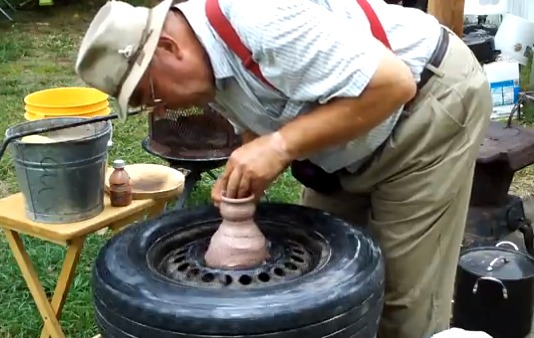

Step-by-step guide to build a tabletop potter's wheel
Kids Try Making Pottery with a Potter | Kids Meet | HiHo Kids
Step 1
Spread the plastic sheet or newspaper on the table to protect your work area.
Step 2
Put the lazy susan in the middle of the protected area so you have room all around.
Step 3
Press non-slip putty or pieces of double-sided tape under the lazy susan to stop it from sliding on the table.
Step 4
Place the plastic bowl upside-down in the center of the lazy susan and tape it down securely.
Step 5
Put the flat plastic lid or cardboard circle on top of the upside-down bowl and secure it with putty or tape to make a flat wheel head.
Step 6
Tape the small round foot-pusher to the outer edge of the lazy susan so you can reach it with your foot.
Step 7
Roll a softball-sized piece of clay into a smooth ball and press it firmly onto the center of the wheel head.
Step 8
Dip your fingers in the damp sponge or cup of water and gently moisten the outside of the clay.
Step 9
Sit comfortably so your foot can reach the foot-pusher and rest one foot lightly on the pusher.
Step 10
Tap or press the foot-pusher with steady gentle movements to make the wheel spin smoothly.
Step 11
While the wheel is spinning, use both hands to center the clay by pressing it down and inward until it stays in the middle.
Step 12
Push your thumbs into the center to make a hollow and slowly pull the clay walls upward to form a cup or bowl.
Step 13
Smooth the shape with the damp sponge to remove fingerprints and even the walls.
Step 14
Let your clay piece dry completely following the clay package directions so it hardens.
Step 15
Share a photo of your finished pot on DIY.org so everyone can see your pottery creation.
Help!?
What can we use if we can't find a lazy susan, non-slip putty, or a small round foot-pusher?
If you don't have a lazy susan use a sturdy round cake turntable or cutting board firmly taped to the table, replace non-slip putty with shelf liner strips or rubber jar-openers under the lazy susan (step 3), and substitute the foot-pusher by taping a rolled towel or a wooden dowel to the outer edge so your foot can reach it (step 10).
My wheel keeps sliding or the wheel head wobbles—how do I troubleshoot those problems?
Make sure you press larger pieces of non-slip putty or extra double-sided tape under the lazy susan (step 3), tape the plastic bowl and flat lid down more securely (steps 4–5), and reposition the foot-pusher so you can tap it with steady gentle movements (step 10) to keep the wheel stable and spinning smoothly.
How can I adapt this potter's wheel activity for younger children or older kids?
For ages 3–5 have an adult prepare and tape the wheel and give pre-rolled clay balls to press and decorate (skipping independent foot-pushing), for 6–9 offer guided help with centering and pulling walls (steps 11–12), and for 10+ encourage thinner walls, refining shapes with the damp sponge, and independent spinning practice (steps 12–13).
What are some ways to extend or personalize the finished pot after it dries?
After the clay piece dries per the package directions (step 14) you can sand and paint or seal it with acrylics, carve textures or add painted marbling while the wheel spins, then share a photo on DIY.org as suggested in step 15 to show your customized pottery creation.
Watch videos on how to build a tabletop potter's wheel
Pottery | Kids Videos
4 Videos

Pottery | Kids Videos
Get Messy and Make Pottery! 🪴 Creative Clay Adventure for Kids & Families
Unexpected Clay Pottery Crafts And Mesmerizing Pot Making For Beginners And Professionals
CLAY POTTERY FOR BEGINNERS || Satisfying Clay Pottery Tricks And DIY Crafts For Coziness
Facts about pottery and clay crafts for kids
🌀 The potter's wheel appeared around 3500 BCE and let potters make symmetrical shapes much faster than hand-building.
🏺 Pottery is one of humanity's oldest crafts — some clay pots date back up to about 20,000 years.
👣 Foot-powered treadle wheels were invented so potters could keep both hands on the clay while powering the wheel.
🎨 Shaping clay on a wheel is called "throwing" — a quirky name that doesn't mean you're tossing the clay!
♻️ Tabletop wheels using a lazy susan and a bowl are a low-energy, kid-friendly way to learn pottery basics at home.
How do I build and use a homemade tabletop potter's wheel with a lazy susan and a foot-powered spinner?
What materials do I need to make a DIY tabletop potter's wheel for kids?
What ages is a foot-powered tabletop potter's wheel suitable for?
What are the benefits, safety tips, and variations for a kid-friendly potter's wheel?
