Cello Facts For Kids
The cello is a warm, medium-low string instrument played with a bow that matters because it makes deep and sweet sounds for solos and groups.


Do more with AI
Images of Cello

Cello open strings Playⓘ
Cello close-up with a bow.

A baroque cello strung with gut strings. Note the absence of fine tuners on the tailpiece.
Josephine van Lier plays a violoncello piccolo, a five-string variant of the Baroque cello, during a recording session of Bach's 6th Cello Suite.
The cello section of the orchestra of the Munich University of Applied Sciences is shown here.
Apocalyptica at the 2009 Ilosaarirock festival.

An audio speaker emitting sound waves, in the Gnome style
Cello open strings Playⓘ
Cello close-up with a bow.
A baroque cello strung with gut strings. Note the absence of fine tuners on the tailpiece.
Josephine van Lier plays a violoncello piccolo, a five-string variant of the Baroque cello, during a recording session of Bach's 6th Cello Suite.
The cello section of the orchestra of the Munich University of Applied Sciences is shown here.
Apocalyptica at the 2009 Ilosaarirock festival.
An audio speaker emitting sound waves, in the Gnome style
Cello open strings Playⓘ
Cello close-up with a bow.
A baroque cello strung with gut strings. Note the absence of fine tuners on the tailpiece.
Josephine van Lier plays a violoncello piccolo, a five-string variant of the Baroque cello, during a recording session of Bach's 6th Cello Suite.
The cello section of the orchestra of the Munich University of Applied Sciences is shown here.
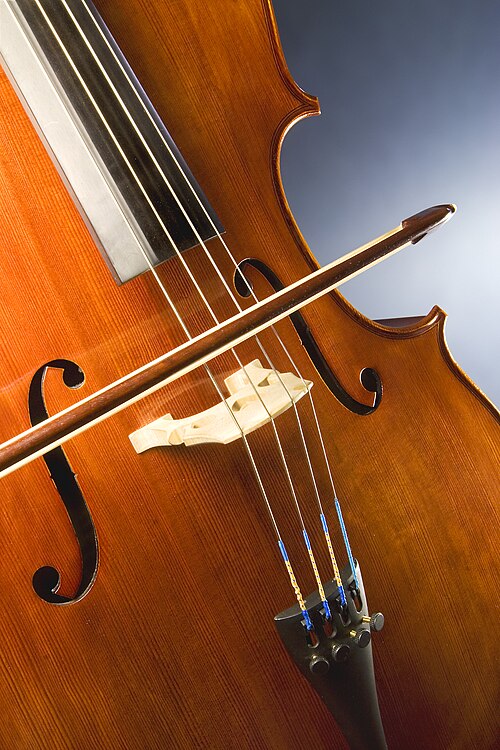
Cello close-up

Cello open strings Playⓘ

Cello close-up with a bow.
A baroque cello strung with gut strings. Note the absence of fine tuners on the tailpiece.

Josephine van Lier plays a violoncello piccolo, a five-string variant of the Baroque cello, during a recording session of Bach's 6th Cello Suite.

The cello section of the orchestra of the Munich University of Applied Sciences is shown here.
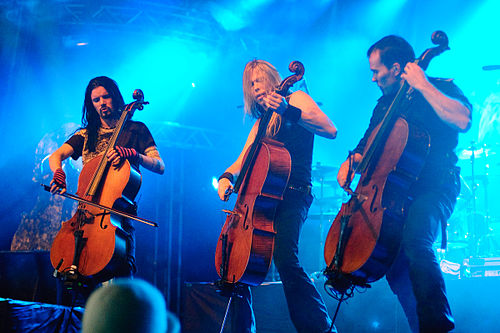
Apocalyptica at the 2009 Ilosaarirock festival.
An audio speaker emitting sound waves, in the Gnome style
Apocalyptica at the 2009 Ilosaarirock festival.
An audio speaker emitting sound waves, in the Gnome style
History
In Europe, instruments like the cello appear around the year 1500. By about 1530, artists in Italy were drawing instruments that look much like the violins and cellos we know today. The cello grew beside another family called the viols, but it did not come from them.
The cello’s direct ancestor was a larger bass instrument often called the violone or bass violin. Italian players helped the cello become popular in northern Europe by 1700. Sizes and tunings varied for many years, and the instrument slowly changed into a more standard shape by about 1750.
Introduction
Cello is a medium-low pitched string instrument you play with a bow, though players sometimes pluck or tap it for special sounds. It has four strings that usually tune to the notes C, G, D, and A, and its music is often written in the bass clef. A person who plays the cello is a cellist. The cello can sing low, warm bass notes and also reach higher, sweet tones, so it can sound like both a bass and a voice. You hear cellos alone in solos, with an orchestra in concerti, and in groups from chamber music to modern bands that mix rock or world music.
Famous Instruments
Some cellos become famous because of who made them, how old they are, the way they look, or the players who used them. Instruments made by great makers like Stradivarius are especially prized because many people think they sound wonderful.
Top instruments are often very expensive and sometimes belong to museums or foundations. These groups loan the cellos to important players so the instruments are heard in concerts. For example, the Davidov Stradivarius is a famous cello now cared for by a foundation and played by a world-famous cellist. Which cello would you like to see up close?
Construction And Materials
The top of the cello has a wooden piece called the bridge that holds the strings up and sends their vibrations into the body so the instrument can make sound. The bridge is not glued on; the strings press it down and keep it in place. On each side of the bridge you see the f-holes, shaped like the letter "f." These openings let air move in and out and give you a way to reach inside the cello.
At the bottom the tailpiece holds the string ends. Tiny screws called fine tuners on the tailpiece help you make small pitch changes. Strings used to be made from animal gut, but modern strings are metal-wound and mixed to give different sounds. Some cellos are even made from aluminum or carbon fibre today, so they are light, strong, and handle weather changes better than old wood instruments.
What A Cello Is And Tuning
The cello is part of the violin family, which also includes the violin and viola. Long ago this family had different names, but today we call the instrument the cello. It has four strings tuned in fifths: usually C, G, D, and A. These are the same steps apart as the viola’s strings, but the cello sounds one octave lower.
A key part of the cello is the endpin, a metal spike at the bottom that rests on the floor and keeps the instrument steady while you play. Sometimes music asks a player to tune the lowest string a bit lower for special notes.
Playing Technique And Sizes
You play the cello while sitting, with the instrument supported by the endpin on the floor. Your right hand either draws the bow across the strings or plucks them with fingers (called pizzicato). Your left hand presses the strings down at different places to make higher or lower notes — pressing closer to the bridge makes a higher sound, while pressing closer to the pegbox makes a lower sound.
Cellists use many special techniques to change the sound. Vibrato adds a small, lovely wobble in pitch. A glissando slides smoothly from one note to another. Players also do double stops (two notes at once), spiccato (bouncy bow), and col legno (tap with the wood of the bow). Cellos come in sizes like 4/4 (full size), 3/4, 1/2 and smaller so children and short adults can find one that fits. A full-size cello has a scale length of about 70 cm (27.5 inches).
Modern Use, Ensembles, And Repertoire
In a modern orchestra, the cello section usually has about eight to twelve players and sits near the front. The lead player, the principal cellist, decides how the section bows and often plays solos. Cellos give deep, warm harmony but also sing beautiful melodies when composers ask for them.
There are many works for cello: concertos for cello and orchestra by Vivaldi, Haydn, and Saint-Saëns; solo pieces like Bach's six Suites; and newer works from the 1900s and 2000s. Cellists also form special groups made only of cellos, called cello choirs or ensembles. These groups can play everything from classical music to modern songs, showing how flexible the cello is.
Tailpiece, Endpin, And Internal Features
Tailpiece: This small piece sits at the bottom of the cello and holds the ends of the strings. It is often made of hardwood like ebony, though some instruments use plastic or metal. Tiny screws called fine tuners fit on the tailpiece so you can make small pitch changes without touching the pegs.
Endpin: The endpin is a spike at the cello's bottom that rests on the floor. It can slide in and out so the player can adjust height. Endpins might be metal, wood, or carbon fiber, and they wear a rubber tip or pad so the cello does not slip or scratch the floor.
Inside the cello are two important parts: the soundpost and the bass bar. The soundpost is a small wooden dowel standing between the top and back plates that helps carry vibrations. The bass bar is a wooden strip under the low strings that supports and shapes the sound. The bridge, which holds the strings up, is not glued but stays in place because the strings pull on it. The f-holes are the f-shaped openings that let air move and help the cello sing; people sometimes use a small humidifier through the f-holes to keep the wood safe.
Did you know?
🎻 The cello is part of the violin family and is usually tuned to the notes C2, G2, D3, and A3.
🪑 Cellists play the cello while seated and the instrument rests on the floor on a metal endpin.
🖐️ The cellist's right hand holds the bow with all five fingers to control the sound and volume.
🤏 Pizzicato is when a cellist plucks the strings with a finger or the thumb to make sound.
🔔 Natural harmonics are made by lightly touching the string at certain points and bowing to create high, ringing notes.
🇮🇹 The modern cello developed around 1700 in Italy and replaced earlier smaller bass violins.
Cello Quiz
Learn more about Cello
Frequently Asked Questions