Linear Programming Facts For Kids
Linear programming is a method used to achieve the best outcome in a mathematical model represented by linear relationships, often applied to optimize resources under various constraints.
Select reading age

Linear Programming Facts For Kids
Videos & Quizzesincluded
About this topic
Linear programming, or linear optimization, is a special math method that helps people make the best choices! 🎯Imagine you want to buy candies and toys with your allowance. You have to decide how to spend it wisely to get the most fun! Linear programming uses rules and equations to find the best option. The best part? It works for various problems, such as making a factory run efficiently or helping farmers decide how much of each crop to grow! 🌾It's all about using math to solve real-world puzzles!
Explore with ChatDinoKey Points
The graphical method is like drawing a treasure map!
The Simplex algorithm is a math superhero!
Sometimes, linear programming can be tricky!
In linear programming, we use some important words!
Duality is like having a mirror!
As we learn more about linear programming, there's opportunity for exciting discoveries!
Linear programming started in the 1940s!
Linear programming plays a big role in economics, which studies how people use resources!
Linear programming is used in many fun and useful ways!
Many people use special computer programs to help with linear programming!
Photos of Linear Programming

John von Neumann

Graphical solution to the farmer example – after shading regions violating the conditions, the vertex of the unshaded region with the dashed line farthest from the origin gives the optimal combination (its lying on the land and pesticide lines implies that revenue is limited by land and pesticide, not fertilizer)
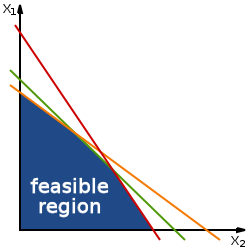
In a linear programming problem, a series of linear constraints produces a convex feasible region of possible values for those variables. In the two-variable case this region is in the shape of a convex simple polygon.
🗺️ Graphical Method
The graphical method is like drawing a treasure map! 🗺️ You plot points on a graph to represent decision variables. For instance, if you want to buy toys (x) and candies (y), you can draw lines to show constraints. 🎈The area where the lines cross is called the feasible region! The best outcome, like getting the most candies and toys, is often found at the corners of this area. 📍By checking each corner, you can figure out which combination of toys and candies gives you the most fun!
Go deeper🦸♂️ Simplex Algorithm
The Simplex algorithm is a math superhero! 🦸♂️ It helps solve linear programming problems quickly and efficiently! Instead of drawing graphs, the Simplex method uses a table to keep track of different solutions. 👩🏫 It starts with one solution and then checks nearby solutions to see if they are better. This process continues until it finds the best option—just like climbing the steps to reach the top of a slide! So, if you need to make decisions about resources, the Simplex algorithm is there to save the day!
Go deeper🚧 Challenges And Limitations
Sometimes, linear programming can be tricky! 🚧One challenge is that it only works with straight lines, known as linear relationships. This means that some real-life problems with curves or sudden jumps can't be solved using linear programming. 💔Additionally, if there are too many constraints, it can get complicated and take a long time to find a solution! Lastly, not all decisions can be represented by numbers, like emotions or personal choices. It's essential to know when not to rely solely on linear programming!
Go deeper🗺️ Key Concepts And Terminology
In linear programming, we use some important words! First, there's a "feasible region," which is the area where all the solutions that meet our restrictions are found. 🗺️ A "constraint" is a rule that limits what we can do, like a budget! We also talk about "objective functions," which are the goals we want to achieve, like maximizing profits! 📈Lastly, we have "decision variables," which are the choices we can control, like how many toys or candies to buy! Each part plays a key role in finding the best solution!
Go deeper🔍 Duality In Linear Programming
Duality is like having a mirror! 🔍In linear programming, for every problem, there is a mirrored version called the "dual problem." If the original problem is about maximizing something (like profits), the dual problem is about minimizing (like costs). For example, if a farmer wants to get the most crops from their land (primal), the dual problem is figuring out how to use the least resources to grow those crops. 🌱Understanding both helps give a complete picture of the problem, just like looking at both sides of a coin!
Go deeper🔮 Future Directions In Research
As we learn more about linear programming, there's opportunity for exciting discoveries! 🔮Researchers are exploring ways to make linear programming even better by using new techniques, like artificial intelligence! 🤖This means that computers could solve even more complicated problems and learn from past solutions. They are also looking into using it for new fields, like environmental studies, to find the best ways to conserve resources. 🌎With advancements in technology, the future of linear programming is bright and full of possibilities!
Go deeper🎉 History Of Linear Programming
Linear programming started in the 1940s! 🎉A mathematician named George Dantzig created it to help the U.S. Air Force make better decisions about supplies. Before that, people used trial and error to solve problems. Dantzig's method changed everything! By 1947, he published his first paper about linear programming. 📄Soon, everyone realized they could use this method not just in the military, but in farming, transportation, and even in businesses! Today, it helps countless people find efficient solutions to complex problems.
Go deeper💰 Linear Programming In Economics
Linear programming plays a big role in economics, which studies how people use resources! 💰Economists use it to model different situations, like how to produce the most products at the lowest cost. For example, if a factory makes both shoes and hats, linear programming helps figure out how many of each to create. ⚙️ This way, they make the most money while keeping costs low! It also helps governments decide how to spend budgets wisely, ensuring everyone gets what they need!
Go deeper🎡 Applications Of Linear Programming
Linear programming is used in many fun and useful ways! 🎡For example, it can help restaurants decide how to prepare their favorite dishes while using the least amount of ingredients. 🥗Companies use it to find the best ways to transport products to stores, so nothing gets wasted! Even video game designers use it to make the games fun while balancing resources. 🎮With linear programming, we can make smart decisions that save time and money while being super efficient in our everyday lives!
Go deeper💻 Common Software Tools For Linear Programming
Many people use special computer programs to help with linear programming! 💻Some popular ones are LINDO, MATLAB, and R. These tools can solve complex problems much faster than doing it by hand! 💨They allow users to input their equations and constraints, and the software finds solutions quickly. There's also Excel, which has a built-in tool called Solver, perfect for students learning about linear programming! 🧑🎓 With these tools, anyone can easily explore and find the best answers to challenging problems!
Go deeper