Coelacanth Facts For Kids
The coelacanth is a rare deep-sea fish known for its ancient lineage and distinctive lobed fins, which closely resemble the limbs of early tetrapods.
Select reading age

Coelacanth Facts For Kids
Videos & Quizzesincluded
About this topic
The coelacanth is a fascinating fish that has been swimming around for over 400 million years! 🐟It was thought to be extinct until a living one was found off the coast of Madagascar in 1938. These fish are unique because they have large, lobed pectoral fins that look like arms! Coelacanths can grow up to 6.5 feet long and can weigh around 200 pounds! They're known as "living fossils" because their ancestors swam in the oceans when dinosaurs roamed the Earth. Coelacanths are rare and special beings that help scientists learn about ocean life long ago. 🌊
Explore with ChatDinoKey Points
The discovery of the coelacanth sparked great excitement in the scientific community!
Coelacanths are classified as "Critically Endangered" by the International Union for Conservation of Nature (IUCN).
Scientists study coelacanths to learn more about their biology and history.
Coelacanths live in deep ocean waters, usually at depths of about 500 to 2,600 feet!
Coelacanths have some really cool features that make them stand out!
Coelacanths are carnivorous, which means they eat meat!
Coelacanths are important to scientists studying evolution.
Coelacanths have a unique way of reproducing!
Photos of Coelacanth

Coelacanth — photo 1

Fossil of Coelacanthus granulatus, the first described coelacanth, named by Louis Agassiz in 1839

Geographical distribution of coelacanth

Pectoral fin of a West Indian Ocean coelacanth

Specimen of Libys (Latimeriidae) from the Upper Jurassic of Germany

Estimated size of the largest known individual of the Jurassic-Cretaceous freshwater coelacanth Mawsonia compared to a human

Life restoration of the basal coelacanth Allenypterus from the Carboniferous of North America

Coelacanth — photo 8
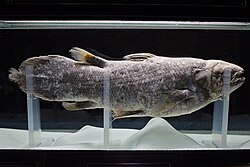
Coelacanth — photo 9
🌟 Cultural Impact
The discovery of the coelacanth sparked great excitement in the scientific community! 🌟People around the world became fascinated by this "living fossil." Many cultures have stories and legends about ancient sea creatures, and the coelacanth fits perfectly into those tales. In Madagascar, the locals believe that the coelacanth has magical powers. In art and literature, the coelacanth is often used as a symbol of mystery and ancient times. Today, it serves as a reminder of how much we can learn from the oceans and the incredible creatures that call it home! 🎨
Go deeper🚨 Conservation Status
Coelacanths are classified as "Critically Endangered" by the International Union for Conservation of Nature (IUCN). 🚨This means they are at a very high risk of extinction in the wild. This is mainly due to overfishing and habitat destruction. The coelacanth's slow reproduction rate makes it harder for their population to recover. To help protect these incredible fish, scientists and governments are working together to create marine protected areas where coelacanths can live safely. If we all work together, we can help keep coelacanths swimming for generations to come! 🌿
Go deeper🧑🔬 Studying Coelacanths
Scientists study coelacanths to learn more about their biology and history. 🧑🔬 They use special underwater cameras and submersibles to observe these elusive fish in their deep-sea habitats. Researchers also collect samples of coelacanth tissues to analyze their DNA, helping us understand their evolution and relationship with other fish. Every study contributes important information about ocean life and biodiversity. With new technologies, scientists hope to uncover even more secrets about these ancient fish and increase awareness about their conservation needs. By working together, we can protect the coelacanth for future generations! 🔬
Go deeper🌊 Habitat And Distribution
Coelacanths live in deep ocean waters, usually at depths of about 500 to 2,600 feet! 🌊They are mainly found around the coasts of Africa and the Comoros Islands near Madagascar. Scientists have also spotted them in areas around Indonesia. These ancient fish prefer to hang out near underwater rock formations and caves where they can find shelter. Coelacanths like the cool, dark waters and are rarely seen by humans. They are often found in deep-sea habitats, making them tricky to study and observe! 🌍
Go deeper🤩 Physical Characteristics
Coelacanths have some really cool features that make them stand out! 🤩They have thick, bumpy skin covered with small scales that look like rocks. Their colors can vary from blue to brown, often with lighter spots or stripes. One of their most interesting traits is their unique lobe-shaped fins, which move in a wave-like pattern. They also have a special type of organ in their heads called a "rostral lobe," which helps them sense their environment. Coelacanths have big, powerful jaws filled with sharp teeth, making them excellent hunters in the deep sea. 🦈
Go deeper🍽️ Diet And Feeding Behavior
Coelacanths are carnivorous, which means they eat meat! 🍽️ Their diet mainly consists of smaller fish, squid, and even some crustaceans. They use their sharp teeth to catch their prey, swallowing it whole! Coelacanths are known for their clever hunting tactics. They often stay very still and wait for their dinner to swim by. Using their special rostral lobe, they can sense movement in the water and quickly strike when they see a snack! This makes them effective hunters in their dark, deep-sea homes. 🦐
Go deeper🧬 Evolutionary Significance
Coelacanths are important to scientists studying evolution. 🧬They are part of a group called lobe-finned fishes, which are closely related to the first creatures that crawled onto land! Scientists believe that the fins of coelacanths resemble the limbs of early land animals. This fish helps us understand how life moved from water to land about 375 million years ago. The discovery of coelacanths has given us clues about how different species have evolved and adapted over time. Many scientists study coelacanths to learn more about their ancient relatives and the history of life on Earth. 📚
Go deeper🐾 Reproduction And Life Cycle
Coelacanths have a unique way of reproducing! 🐾Unlike most fish that lay eggs, coelacanths give birth to live young. Females carry their eggs inside their bodies until the babies are ready to hatch. A female can have up to 30 babies at once! The young coelacanths look like mini versions of their parents. They grow slowly, taking about 20 years to reach adulthood, and can live for around 60 years or more! This long lifespan makes them vulnerable to threats like overfishing and habitat loss, so every baby coelacanth counts! 🌱
Go deeper