What Is the Cost of Your Weekly Grocery List?
Create a weekly grocery list, check prices with an adult, calculate total cost, compare store options, and practice budgeting with addition and multiplication.




Step-by-step guide to calculate the cost of your weekly grocery list
Step 1
Decide how many meals you will plan for the week and write that number at the top of your paper.
Step 2
Write the name of each meal you plan to make this week as a list, one meal per line.
Step 3
Under each meal write every ingredient you need and the amount of each ingredient.
Step 4
Check your pantry and put a checkmark next to any ingredient you already have.
Step 5
With an adult look up the unit price of each ingredient at Store A and write the price next to the ingredient.
Step 6
For any ingredient you need more than one of multiply the Store A unit price by the quantity and write the item total.
Step 7
Add all the Store A item totals to find the Store A subtotal and write the subtotal at the bottom.
Step 8
With an adult look up the unit price of each ingredient at Store B and write those prices next to the ingredients.
Step 9
For any ingredient you need more than one of multiply the Store B unit price by the quantity and write the item total.
Step 10
Add all the Store B item totals to find the Store B subtotal and write the subtotal at the bottom.
Step 11
Compare the Store A and Store B subtotals and circle the cheaper total and write one sentence about which store is the better deal.
Step 12
Share your finished grocery list and cost comparison on DIY.org.
Help!?
What can we use instead of internet access to look up unit prices for Store A and Store B?
If you can't use the internet to find unit prices for Store A or Store B, use printed store flyers or circulars, recent receipts, price labels in the store with an adult, or call the store to ask for the unit price of each ingredient.
What should we do if the unit price is listed per pound but my ingredient list uses count or cups when calculating Store A item totals?
If a unit price is per pound while your ingredient amounts are in counts or cups (steps 3 and 5), ask an adult to help convert the weight to the needed quantity or find a unit-price-per-item equivalent before multiplying for the Store A and Store B item totals.
How can this activity be adjusted for younger children or made harder for older kids?
For younger children simplify by planning fewer meals, using pictures for each ingredient and checking the pantry together (steps 1–4), while older kids can add sales tax, compute cost per serving, and compare unit-price-per-ounce across Store A and Store B.
How can we enhance or personalize the project after comparing subtotals and circling the cheaper store?
To extend the activity, have the child pick the cheapest store for each item to make a combined shopping list, recalculate a final total, create a simple bar chart comparing the Store A and Store B subtotals from step 9, and then share the annotated list and chart on DIY.org.
Watch videos on how to calculate the cost of your weekly grocery list
** REALISTIC ** $75 Weekly Grocery Budget || Family Of 5 || Cheap Meals
3 Videos
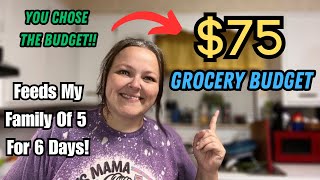
** REALISTIC ** $75 Weekly Grocery Budget || Family Of 5 || Cheap Meals

Only Buy These 20 Groceries Every Week!
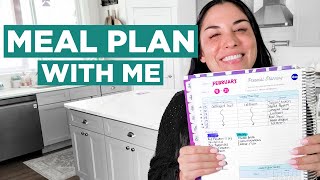
MY WEEKLY MEAL PLAN | Grocery Tips + Food Budget
Facts about budgeting and grocery math
🛒 Many stores print a unit price (like price per ounce or per 100 g) on the shelf so you can easily compare which package is the better deal.
🧮 Multiplication is a shopping superpower: 5 cans at $1.20 each equals 5 × $1.20 = $6.00 — faster than adding again and again!
💡 Making a weekly grocery list before you go helps stop impulse buys and saves money by keeping you focused on what you really need.
📱 Using a calculator or grocery app while you shop gives a running total so you can practice budgeting and avoid surprises at checkout.
✂️ Sales and coupons can cut costs, but always check the unit price and compare stores to be sure it's the true bargain.
How do I do the "What Is the Cost of Your Weekly Grocery List?" activity with my child?
What materials do I need for the grocery list cost and budgeting activity?
What ages is the weekly grocery cost and budgeting activity suitable for?
What are the benefits of doing this grocery budgeting activity with children?
