Take the Grasshopper Pose Challenge
Learn and practice the Grasshopper yoga pose with warm-ups, balance drills, and guided breathing to improve flexibility, strength, and concentration.
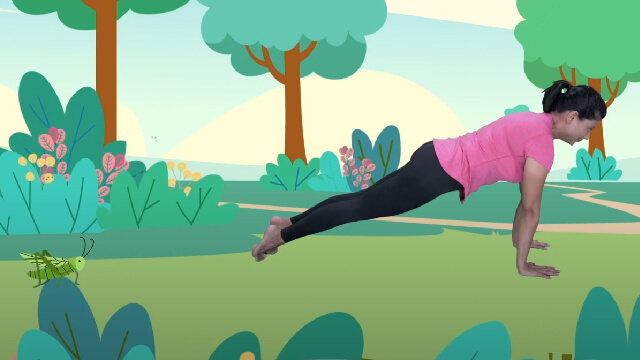
About this activity
Learn and practice the Grasshopper yoga pose with warm-ups, balance drills, and guided breathing to improve flexibility, strength, and concentration.
What you need
Step by step
- 1
Step 1
Put on comfortable clothes you can move in.
- 2
Step 2
Lay your yoga mat or towel on the floor in a clear quiet space.
- 3
Step 3
Sit cross-legged on the mat.
- 4
Step 4
Take five slow deep breaths through your nose and out your mouth.
- 5
Step 5
Come onto your hands and knees on the mat.
- 6
Step 6
Do five cat-cow cycles to gently warm your spine.
- 7
Step 7
Stand up slowly next to your mat.
- 8
Step 8
Do ten hip circles on each side to open your hips.
- 9
Step 9
Return to the mat and come back onto your hands and knees.
- 10
Step 10
Slide your right knee forward and rest it on your right upper arm to feel the leg supported.
- 11
Step 11
Lean forward slowly so your weight shifts onto your arms.
- 12
Step 12
Lift your left leg straight back to find your balance like a grasshopper.
- 13
Step 13
Place the small cushion under your forehead or belly if you want extra support.
- 14
Step 14
Hold the balance for three slow deep breaths, then slowly come out and rest on your belly.
- 15
Step 15
Share your finished Grasshopper Pose on DIY.org.
Fun facts
How do I run a Grasshopper Pose Challenge with warm-ups, balance drills, and guided breathing?
Begin with a 5–8 minute warm-up: gentle cat–cow, hip circles, hamstring and ankle stretches. Demonstrate the Grasshopper pose step-by-step, breaking the movement into small parts (entry, balance, exit). Use short balance drills (one-leg stands, toe taps, wall-assisted holds) and set progressive goals (hold 10–20 seconds, repeat 3–5 times). Add guided breathing: slow inhales and exhales during each hold. Finish with a 3–5 minute cool-down and positive feedback.
What materials do I need for a Grasshopper yoga pose challenge?
You need a non-slip yoga mat or soft surface, comfortable clothing that allows movement, and a small cushion or folded blanket for knee comfort. Use a wall or sturdy chair for balance support, a timer or stopwatch, and a water bottle. Optional: yoga blocks for modifications and a child-friendly breathing script or music for guided breaths. Always have adult supervision and a clear, clutter-free practice area.
What ages is the Grasshopper Pose Challenge suitable for?
This activity suits children roughly 5 years and up, with modifications for younger kids. Preschoolers (3–5) can try simplified balance games and supported holds; school-age kids (6–12) can follow step progressions and timed challenges. Teenagers can focus on alignment and longer holds. Always adapt difficulty, keep sessions short for little ones, and provide hands-on support until the child demonstrates safe balance and body awareness.
Is the Grasshopper Pose Challenge safe and what precautions should I take?
Safety first: ensure a warm-up, clear practice area, and close adult supervision. Avoid forcing stretches or hyperextending joints; stop if a child feels pain or dizziness. Use wall or chair support and props for beginners. Children with recent injuries, balance disorders, or chronic conditions should consult a healthcare provider before starting. Encourage gradual progression, rest between attempts, and teach children to breathe steadily to maintain focus and reduce strain.
Watch & Learn
Need help?
What can I use instead of a small cushion or yoga mat if I don't have them?
If you don't have a small cushion, place a folded towel, soft pillow, or thin blanket under your forehead or belly during the 'Place the small cushion...' step, and use a bath towel on the floor in place of a yoga mat.
I'm wobbling when I lift my left leg — how can I balance better?
If you wobble when you 'Lift your left leg straight back', press your hands into the mat, engage your core, keep your gaze on the mat, and practice with your forehead supported on the small cushion or beside a wall for extra stability.
How can I adapt this challenge for younger children or older kids?
For younger children, reduce counts to two deep breaths, three cat-cow cycles, and hold the grasshopper balance for one breath with the cushion under the forehead, while older kids can increase to five breaths, longer holds, and extra hip circles as described in the 'Do ten hip circles' step.
How can we make the Grasshopper Pose Challenge more fun or advanced?
Make the challenge more fun by turning the pose into a grasshopper story, playing gentle music during the 'Take five slow deep breaths', timing longer balance holds for a challenge, or recording and decorating your mat before you share the finished pose on DIY.org.