Sing and Play - Boom, Snap, Clap
Sing and play rhythmic patterns using body percussion such as boom by stomping, snap with fingers, and clap, compose songs and perform for others.


Step-by-step guide to Sing and Play - Boom, Snap, Clap
Step 1
Make a clear space to move so you have room to stamp and clap safely.
Step 2
Wiggle your arms legs and shoulders for 30 seconds to warm up your body.
Step 3
Stomp the floor slowly eight times and say "boom" each time to practice the boom sound.
Step 4
Snap your fingers eight times slowly and say "snap" each time to practice the snap sound.
Step 5
Clap your hands eight times slowly and say "clap" each time to practice the clap sound.
Step 6
Use your paper and pencil to write a 4-beat pattern using B for boom S for snap and C for clap.
Step 7
Perform the written 4-beat pattern with your body sounds four times in a row.
Step 8
Write a second different 4-beat pattern on your paper that sounds new and fun.
Step 9
Alternate the two patterns to make a short song and practice the song four times.
Step 10
Perform your song once loudly so it sounds big and exciting.
Step 11
Perform your song once softly so it sounds gentle and calm.
Step 12
Share your finished Boom Snap Clap song and performance on DIY.org.
Help!?
What can I use instead of paper and pencil if I don't have them?
If you don't have paper and pencil, write your 4-beat B/S/C patterns on a dry-erase board, draw them with sidewalk chalk, or place three colored stickers to stand for B, S, and C on a table.
My child can't snap or stomp loudly—how can they still do the boom and snap steps?
If snapping or stomping is hard, substitute a thigh pat or a soft stomp for 'boom', tap a tabletop with fingertips for 'snap', and keep the clap step as written so they can practice the stomp/snap/clap sequence safely.
How can I adapt the activity for different ages?
For younger kids, use 2-beat patterns, fewer repeats, and slower stomps/snaps/claps from the practice steps, while older kids can create 8-beat patterns, add faster tempos, and alternate patterns more quickly as they perform the song four times.
How can we extend or personalize our Boom Snap Clap song?
Extend the activity by adding simple instruments (a bowl drum for 'boom', a shaker for 'snap'), choreographing movements for each 4-beat pattern, practicing loud and soft performances, and uploading the final video to DIY.org.
Watch videos on how to Sing and Play - Boom, Snap, Clap
Boom, Snap, Clap | Klatschspiele Anleitung (Kinderlieder)
4 Videos
Boom, Snap, Clap | Klatschspiele Anleitung (Kinderlieder)
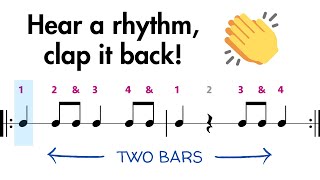
Rhythm Clap Along: Two-Bar Phrases - Level 1 to 3 (for Beginners/Kids) 👏
Clap, Snap, Tap! | Fun Body Percussion Song for Kids | Rhythm & Movement Activity
Clap Clap Snap 👏 #rhythm #kidsmusic #alanabanana #original
Facts about music and rhythm for kids
🦶 Stomp — A strong foot stomp can make low-frequency beats you can feel in your chest as well as hear.
👏 Clap — People have used hand claps in games and ceremonies around the world for hundreds of years.
🤌 Snap — A finger snap is a very quick percussive sound made by pressing and releasing skin against bone.
🧠 Rhythm — Practicing rhythmic activities can boost coordination, attention, and timing skills in kids.
🥁 Performance — Groups like STOMP turned body percussion into big-stage shows using only everyday sounds.
How do I play Boom, Snap, Clap with my child?
What materials do I need for Boom, Snap, Clap body percussion?
What ages is Boom, Snap, Clap suitable for?
What are the benefits and safety tips for Boom, Snap, Clap?
