Showcase your ventriloquist act with 2 puppets!
Create two simple puppets, practice ventriloquism techniques and dialogue, rehearse timing and expression, then perform a short two puppet act for friends.




Step-by-step guide to showcase your ventriloquist act with two puppets
Step 1
Gather all Materials Needed onto a clean workspace.
Step 2
Choose whether you will make sock puppets or paper bag puppets.
Step 3
Create the first puppet by attaching eyes a mouth and hair to one sock or paper bag using glue or tape.
Step 4
Create the second puppet by attaching eyes a mouth and hair to the other sock or paper bag.
Step 5
Add clothing or extra details with yarn and fabric to make each puppet look unique.
Step 6
Give each puppet a name and pick one short sentence that shows its personality.
Step 7
Practice speaking without moving your lips using a mirror and try to voice words from your throat while softening B P M sounds into D T N sounds when needed.
Step 8
Find a distinct voice for each puppet by practicing different pitch speed and attitude for each one.
Step 9
Write a short 6 line script where the puppets introduce themselves encounter a small problem and then share a funny solution.
Step 10
Rehearse the script slowly while switching puppet voices and keeping your lips as still as possible to match the timing and expression.
Step 11
Perform your two puppet ventriloquist act for friends or family using your practiced voices timing and expressions.
Step 12
Share your finished puppet act on DIY.org
Help!?
What can I use if I don't have socks or paper bags for the puppets?
If you don't have socks or paper bags, use an old glove, a toilet-paper roll wrapped in fabric, or a folded piece of felt and attach eyes, a mouth, and hair with glue or tape just like the instructions say.
My lips keep moving when I practice ventriloquism—how can I fix that?
To keep your lips still, practice in front of a mirror while placing a small folded cloth or thin cardboard inside the sock or paper bag to push the puppet's mouth forward and concentrate on voicing from your throat while softening B, P, M into D, T, N as the instructions advise.
How can I adapt this puppet project for different ages?
For younger kids use stickers, pre-cut eyes and yarn with glue dots and adult help to attach the eyes, mouth and hair, while older kids can sew or glue more detailed clothing and fabric, experiment with distinct voices, and expand the short 6-line script into a longer scene.
How can we enhance or personalize our ventriloquist act after making the two puppets?
Enhance your act by adding clothing or extra details with yarn and fabric, creating a small cardboard stage or curtain, practicing switching voices and timing during rehearsal, recording the performance on a phone, and sharing the finished puppet act on DIY.org.
Watch videos on how to showcase your ventriloquist act with two puppets
Teaching with Puppets for Beginners
4 Videos

Teaching with Puppets for Beginners

How to Be a Ventriloquist
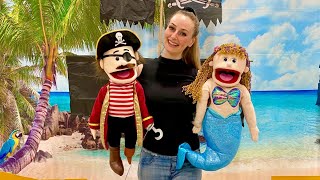
Ventriloquist Puppet Show with Julianne | Comedy for Children

How to Perform with Puppets - Puppetry Basics
Facts about ventriloquism and puppetry for kids
🎭 Ventriloquism is often called 'throwing your voice' — the sound still comes from you, but the trick makes it seem like it comes from the puppet.
🗣️ Ventriloquists train to replace lip-heavy sounds (like b, p, m) with easier ones (like d, t, n) so they can speak with barely any lip movement.
🧦 You can make a delightful puppet from everyday items — socks, paper bags, or wooden spoons become characters in minutes.
⭐ Jim Henson began with simple hand puppets and went on to create the Muppets, making puppetry famous on TV and film.
⏱️ Two-puppet acts shine because of timing and personality — quick voice switches, pauses, and different expressions make the dialogue funny and clear.
How do you put together and perform a two-puppet ventriloquist act?
What materials do I need to create two puppets for a ventriloquist act?
What ages is a two-puppet ventriloquist activity suitable for?
What are the benefits of making and performing a two-puppet ventriloquist act?
