Perform your favorite acting improv exercise
Choose and perform your favorite acting improv exercise, create characters, practice "Yes, and..." listening, and present a short improvised scene for friends or family.


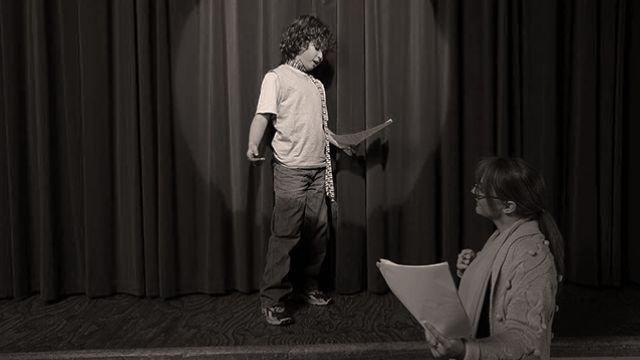

Step-by-step guide to perform your favorite acting improv exercise
Step 1
Gather your props paper and pencil and bring them to your clear play space.
Step 2
Ask 1 or more friends or family to join your improv game.
Step 3
Pick one improv warm up exercise to try like One Word Story Zip Zap Zop or Statues.
Step 4
Do the warm up exercise for two minutes to get your voice and body ready.
Step 5
Each player writes a character name and one quirky trait on their paper.
Step 6
Take turns saying your character and trait to the group in one sentence.
Step 7
Pair up and practice "Yes and..." with your partner for three short exchanges.
Step 8
Choose a simple scene location out loud such as a spaceship kitchen or park.
Step 9
Give your character a clear goal in one short sentence.
Step 10
Perform your improvised scene for one to two minutes using "Yes and..." to listen and build on ideas.
Step 11
Share your finished scene on DIY.org with help from an adult.
Help!?
What can we use if we don't have the listed materials like props, paper, or a pencil?
Use household items or small toys as props and substitute a notebook, index cards, or the notes app on a phone/tablet for paper with a pen or stylus instead of a pencil.
What should we do if players freeze or the scene stalls during the 'Yes and...' practice or performance?
If the scene stalls during the pair 'Yes and...' practice or the 1–2 minute performance, prompt players to read their written character name, quirky trait, or their one-sentence clear goal from the paper to jump-start ideas or ask a simple question like 'What happens next?'.
How can we adapt this activity for different age groups?
For younger children (3–5) shorten the warm-up to 30–60 seconds and use Statues or one-word traits, for elementary kids (6–9) keep the two-minute warm-up but shorten scenes to 30–45 seconds, and for older kids (10+) keep or extend the two-minute warm-up and perform 1–2+ minute scenes with more detailed goals and locations like 'spaceship kitchen'.
How can we extend or personalize the improv scene beyond the basic instructions?
Add simple costumes or labeled prop bags when you 'gather your props', record the scene on a device to review or edit with an adult, create a series of linked scenes using the same characters and goals, and then share the finished clip on DIY.org with parental help.
Watch videos on how to perform your favorite acting improv exercise
Anyone Can Act | Acting Lessons For Kids | Acting Tips For Beginners | How To Act
4 Videos

Anyone Can Act | Acting Lessons For Kids | Acting Tips For Beginners | How To Act

Build Voice Acting Skills with IMPROV and CHARACTER Lessons!
Improv Warmups and Exercises (Quick demos)

"How You Say It" Acting Game for Kids
Facts about improvisational theater for kids
🎭 Improvisational theatre often uses no script — performers invent characters, dialogue, and actions on the spot.
🤝 "Yes, and..." is a core improv rule that means accept your partner’s idea and add something new to keep the scene growing.
🧠 Practicing improv boosts listening, quick thinking, creativity, and teamwork — skills scientists say are great for young brains.
🌟 Famous comedians like Tina Fey, Amy Poehler, and Steve Carell sharpened their skills in improv troupes such as The Second City.
⏱️ Many improv games use short time limits (1–3 minutes) to encourage bold choices and playful energy.
How do I perform a favorite acting improv exercise with my child at home?
What materials do I need to do this acting improv exercise with my child?
What ages is this improv activity suitable for?
What are the benefits and safe variations of kids' improv exercises?
