Perfect your Ground Pass
Practice and improve your ground passing skills using cones, a partner, and a ball. Focus on accuracy, pace, and receiving technique.
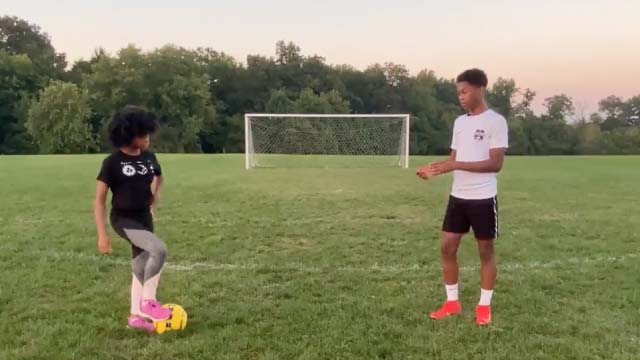
About this activity
Practice and improve your ground passing skills using cones, a partner, and a ball. Focus on accuracy, pace, and receiving technique.
What you need
Step by step
- 1
Step 1
Place four cones about six big steps apart to make two small gates facing each other and a clear passing lane.
- 2
Step 2
Stand with your partner at opposite ends of the lane behind each gate so you are ready to start.
- 3
Step 3
Warm up by tapping the ball back and forth gently for one minute to wake up your feet.
- 4
Step 4
Perform 10 gentle passes using the inside of your foot and aim the ball through the cone gate to your partner.
- 5
Step 5
Practice receiving by cushioning the ball with the inside of your foot to bring it under control.
- 6
Step 6
Pass the ball back with one touch using the inside of your foot focusing on a straight and accurate roll.
- 7
Step 7
Do 20 passes trying to get as many balls as you can through the cone gates and count your successful passes.
- 8
Step 8
Do 20 driven passes using the instep aiming through the gates to practice pace and power.
- 9
Step 9
Switch roles with your partner so both players practice passing and receiving at pace.
- 10
Step 10
Cool down with two minutes of light jogging or gentle leg stretches to relax your muscles.
- 11
Step 11
Share a short clip or photo of your best pass and explain what you improved on DIY.org
Fun facts
How do I practice a ground pass drill with my child to improve accuracy and receiving?
Start by setting 3–5 cones 5–10 yards apart to form passing lanes. One partner stands at each end; the passer aims at a cone or the partner’s feet, striking the ball with the inside of the foot for accuracy. The receiver cushions the ball with a soft first touch and returns with controlled pace. Practice short, medium, and long ground passes, alternate feet, increase tempo gradually, and finish by aiming at small goals or target cones to measure progress.
What materials do we need to set up a ground pass practice session?
You’ll need 4–8 cones to mark lanes and targets, one size-appropriate soccer ball, a partner or coach, and a flat playing surface like grass or turf. Optional items: small pop-up goals or flat discs for targets, a stopwatch for timed drills, and bibs to organize players. Ensure the ball is properly inflated and have appropriate footwear and shin guards for safety.
What ages is perfecting ground passing suitable for?
This activity suits children roughly aged 4–16 with modifications. Ages 4–6 should use short distances (2–4 yards), gentle coaching, and a softer ball to focus on fun and basic control. Ages 7–11 can work on two-touch passing and accuracy at medium range. Ages 12–16 can practice pace, weighted passes, and movement off the ball. Always adapt distance, drill complexity, and coaching to each child’s skill and attention level.
What are the benefits of practicing ground passing and what safety tips or variations should we use?
Ground-pass practice improves passing accuracy, first touch, spatial awareness, teamwork, and decision-making—key technical and cognitive skills for play. Safety tips: warm up, inspect the surface for hazards, use age-appropriate distances, wear proper footwear and shin guards, and provide water breaks. Variations include one-touch passing, moving targets, triangle passing, increasing speed, or adding passive defenders to simulate pressure and make sessions game-like.
Watch & Learn
Need help?
What can we use instead of cones if we don't have any?
If you don't have cones, use four water bottles, shoes, or rolled-up socks placed about six big steps apart to make the two small gates facing each other as in the instructions.
My passes keep missing the cone gates; how can we fix that?
Warm up with the one-minute gentle taps, focus on using the inside of your foot to aim through the cone gate, shorten your passing distance and slow your pace during the 10 gentle passes and 20 passes to improve accuracy.
How can we adapt this drill for younger or older kids?
For younger children reduce the gate spacing, use a larger or softer ball and insist on slower, softer touches during the warm-up and 10 gentle passes, while older kids can widen the gates, increase distance, and emphasis the 20 driven passes for pace and power.
How can we extend or personalize the activity?
Keep score of successful balls through the gates, add a moving cone or passive defender to increase difficulty, or film your best pass to post on DIY.org and explain what you improved on.