Make Value Scales
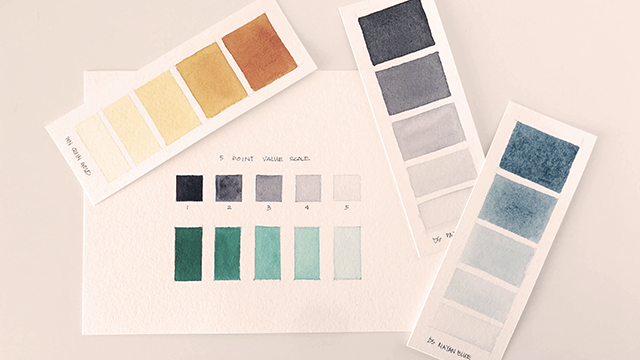
Make a five-step value scale by shading rectangles with pencils. Compare and label tones from lightest to darkest while practicing control and observation.
About this tutorial
Make a five-step value scale by shading rectangles with pencils. Compare and label tones from lightest to darkest while practicing control and observation.
What you need
Instructions
- 1
Step 1
Place your paper flat on a table in a landscape position.
- 2
Step 2
Use the ruler to draw five equal rectangles side by side across the paper.
- 3
Step 3
Write the numbers 1 2 3 4 5 under each rectangle from left to right.
- 4
Step 4
Write the word Lightest under box 1 and Darkest under box 5.
- 5
Step 5
Shade box 1 with very light pencil strokes so it looks faint.
- 6
Step 6
Shade box 2 slightly darker than box 1 by adding a bit more pressure or another light layer.
- 7
Step 7
Shade box 3 slightly darker than box 2 by adding more layers or using a softer pencil.
- 8
Step 8
Shade box 4 slightly darker than box 3 to continue the gradual darkening.
- 9
Step 9
Shade box 5 as the darkest value using firm pressure or the softest pencil you have.
- 10
Step 10
Hold the paper at arm’s length and look to see if the five boxes change smoothly from light to dark.
- 11
Step 11
Make small shading adjustments to any boxes that need to be lighter or darker to improve the steps.
- 12
Step 12
Share your finished value scale on DIY.org
Fun facts
How do you make a five-step value scale by shading rectangles?
Start by drawing five equal rectangles in a row with a ruler. Lightly shade the first square with very soft pencil pressure for the lightest value. Gradually increase pressure and pencil strokes across each box so the fifth square is the darkest. Keep strokes consistent, use small circular or back-and-forth motions, and compare adjacent boxes to adjust. Label each tone from lightest to darkest and practice controlling pressure and blending for smooth transitions.
What materials do I need to make a value scale?
You’ll need drawing paper, a ruler, and a set of graphite pencils (for example HB, 2B, 4B) or a single pencil you vary in pressure. Add a kneaded eraser and a vinyl eraser for highlights, a sharpener, and an optional blending stump or tissue for smoothing. A clipboard or hard surface helps, and a reference grayscale or well-lit area makes comparing tones easier for accurate shading practice.
What ages is this value scale activity suitable for?
This activity suits children around age 5 and up with adult guidance; younger kids may need help with drawing straight boxes and consistent pressure. Ages 6–10 can practice fine motor control and observation, while older children and teens benefit from refining shading techniques and tonal awareness. Adjust complexity: simplify to three steps for preschoolers or add eight steps for advanced students to challenge precision and subtle value shifts.
What are the benefits of making a five-step value scale?
Making value scales improves pencil control, hand-eye coordination, and the ability to see and compare light and dark areas—skills essential for drawing and painting. It trains observation of subtle tonal shifts and strengthens concentration. Variations include using charcoal, colored pencils, or more steps for nuance. It’s a low-risk exercise that builds confidence and prepares kids for shading objects, portraits, and landscapes by understanding how value creates form and depth.
Watch & Learn
Need help?
I don’t have a ruler or soft pencils — what can I use instead?
If you don’t have a ruler or soft pencils, fold the paper into five equal rectangles or use a book edge as a straightedge to draw the boxes and create darker values for box 5 by layering an ordinary pencil, using charcoal or crayon, or smudging with a tissue.
My values don’t look like smooth steps — how do I fix that?
If the five boxes don’t change smoothly when you hold the paper at arm’s length, make small shading adjustments by lightening box 1 with an eraser, darkening box 5 with firmer pressure or a softer mark-making tool, and add circular layers to the middle boxes to blend transitions.
How can I adapt this activity for different ages or skill levels?
For younger children, pre-draw the rectangles and reduce to three boxes using crayons for simple Lightest–Darkest practice, while older kids can expand to ten rectangles, label pencil grades (e.g., 2H–6B) under each box, and practice subtler pressure changes as in the original steps.
What are some ways to extend or personalize the value scale project?
To extend the activity, use your five-box scale as a reference to shade a sphere or egg drawing, add color scales with colored pencils, write pencil grades under each box, mount the paper on cardstock, photograph it, and then share your finished value scale on DIY.org.