Make the back and forth bottle
Build a back-and-forth bottle pendulum using string, a plastic bottle, and tape to observe oscillations and learn about frequency and energy transfer.


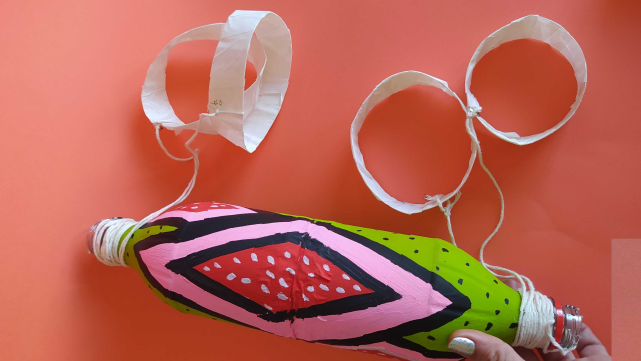

Step-by-step guide to build a back-and-forth bottle pendulum
Step 1
Remove any labels from the empty plastic bottle.
Step 2
Put a few coins or pebbles into the bottle to add weight.
Step 3
Screw the cap back onto the bottle tightly.
Step 4
Wrap tape around the cap to make sure it stays closed.
Step 5
Cut a piece of string about 50 centimeters long with scissors.
Step 6
Tie one end of the string tightly around the bottle neck under the cap with a secure knot.
Step 7
Tie the other end of the string to your stable support so the bottle hangs freely.
Step 8
Move the hanging bottle so it is at least 10 centimeters away from walls and objects.
Step 9
Pull the bottle gently about 20 centimeters to one side.
Step 10
Let go of the bottle to start it swinging back and forth.
Step 11
Use a watch or timer to time 30 seconds while the bottle swings.
Step 12
Count how many complete back-and-forth swings happen during those 30 seconds.
Step 13
Change the weight inside the bottle or make the string longer or shorter to test what happens.
Step 14
Repeat the swinging and the 30-second timing and counting after your change to compare results.
Step 15
Share your finished bottle pendulum and what you learned on DIY.org.
Help!?
What can we use instead of coins or pebbles as weight?
If you don't have coins or pebbles, use dry rice, metal washers, or small craft beads as weight and still screw the cap back on tightly and wrap tape around the cap.
What should I do if the cap opens or the bottle comes loose while swinging?
If the cap comes loose or the string slips, add extra tape around the cap, put a drop of glue under the cap, and tie a double knot around the bottle neck under the cap so the bottle stays securely hung at least 10 centimeters from walls.
How can I adapt this activity for younger or older kids?
For preschoolers, have an adult cut the 50 cm string and tie the knot and use a lighter weight and a smaller pull, while older kids can vary string length, change the weight, time 30 seconds, count swings, and record results for comparisons.
How can we extend or personalize the bottle pendulum activity?
Decorate the bottle, test at least three different weights or three string lengths and repeat the 30-second timing to compare how the number of back-and-forth swings changes, then share your findings on DIY.org.
Watch videos on how to build a back-and-forth bottle pendulum
DIY Plastic Bottle Robot Toy for kids | Crafts ideas
4 Videos
DIY Plastic Bottle Robot Toy for kids | Crafts ideas
DIY Toy Boat: How to Make a Fun Boat with a Recycled Plastic Bottle! KidiesTime7
"Recycle & Create: DIY Toy Car from Plastic Bottles!" kidiesTime7 How to make Kids Car Fun & Learn

How to make a Sensory Bottle | Easy + Quick | DIY
Facts about pendulum motion and energy transfer
🕰️ Foucault’s pendulum (first shown in 1851) visually proves the Earth rotates beneath a swinging bob.
⚖️ A simple pendulum’s period depends on its length and gravity — not the mass of the bob — so heavy and light bottles swing the same if the string is the same length.
🎯 Double the length of a pendulum and its swing period increases by about 1.41× (the square root of 2).
⚡ Pendulums swap energy each swing: gravitational potential energy at the ends becomes kinetic energy at the bottom.
🧵 Friction and air resistance slowly stop a pendulum — that energy loss is called damping and you can change it by altering the bottle shape or adding fins.
How do I build a back-and-forth bottle pendulum to observe oscillations?
What materials do I need for a bottle pendulum experiment?
What ages is the back-and-forth bottle activity suitable for?
What are the benefits and fun variations of a bottle pendulum?
