Make a Fun Cube Pattern
Make and decorate a paper cube from a net, creating repeating patterns on each face, then fold and assemble to explore symmetry.



Step-by-step guide to make a fun cube pattern
Step 1
Use your ruler and pencil to draw six equal squares in a “T” shaped cube net on the paper.
Step 2
Draw small tabs along some outer edges of the net so you can glue the cube together later.
Step 3
Pick one simple motif to repeat (like dots stripes or triangles) and choose the colors you will use.
Step 4
Lightly sketch the chosen motif inside each square so the design can repeat across the connected faces.
Step 5
Color in each square with your colouring materials making the repeating patterns bright and neat.
Step 6
Cut out the net carefully around the outside edge following your pencil lines.
Step 7
Fold along every square edge to make crisp crease lines for easy assembly.
Step 8
Fold all the glue tabs inward so they are ready to attach to the cube’s inside.
Step 9
Put glue on one tab and press it to the inside of the adjacent face to start forming the cube.
Step 10
Glue the remaining tabs one at a time and press each join until the cube is fully assembled.
Step 11
Hold your cube and find one line or rotation that shows a mirror or repeating symmetry on the faces.
Step 12
Share your finished patterned cube on DIY.org so others can see your cool creation.
Help!?
What can we use instead of a ruler, heavy paper, or liquid glue if we don't have them?
Use a straight edge like a hardcover book or cardboard edge as your ruler, a cereal-box panel or other stiff card for the net, and double-sided tape or a glue stick to attach the glue tabs instead of liquid glue.
My tabs won't stick and the cube falls apart—how can I fix assembly problems?
If the glue tabs don't hold, press each glued tab firmly for a minute, use a stronger adhesive such as tacky glue or double-sided tape, trim or refold tabs so they fit flush against the adjacent face, and hold joins with a clothespin while the glue dries.
How can I change the activity for younger or older kids?
For younger children have an adult pre-draw and pre-cut the T-shaped net and pre-fold the edges, letting them decorate with stickers or chunky crayons, while older kids can measure equal squares with a ruler, sketch more complex repeating motifs, and aim for crisp coloring and symmetry before assembling.
How can we make the cube more special or challenging after finishing the basic version?
Personalize and extend the activity by adding washi tape, textured fabric, or glitter to specific squares, numbering or labeling faces to create story or math cubes, or designing a series of themed cubes to photograph and share on DIY.org.
Watch videos on how to make a fun cube pattern
How to Make a Clear Tape Cube | Easy 3D Craft for Kids
4 Videos
How to Make a Clear Tape Cube | Easy 3D Craft for Kids
Origami Moving Cubes | Easy Paper Cube Toy Tutorial | DIY Origami Craft
✨ 3D Rubik's Cube Drawing Tutorial | Step by Step for Kids
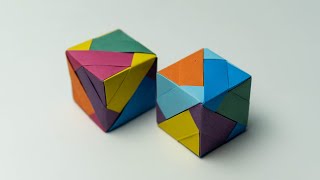
How to Make an Easy Origami Cube | Step-by-Step Tutorial for Beginners
Facts about paper crafts and symmetry
🔲 There are exactly 11 different nets that fold up into a cube — can you spot or draw them all?
🎲 A cube (regular hexahedron) has 6 faces, 8 vertices, and 12 edges — it’s the shape of most dice!
✂️ Paper models and nets have been used for centuries to teach spatial thinking and geometry hands-on.
🔁 Rotate a cube 90° around the center of a face and it maps onto itself — a neat example of rotational symmetry!
🎨 Repeating designs that cover a surface without gaps are called tessellations — great inspiration for cube-face patterns.
How do I make and decorate a paper cube from a net to create repeating patterns and explore symmetry?
What materials do I need to make and decorate a paper cube net?
What ages is this cube pattern activity suitable for?
What are some variations, benefits, and safety tips for the paper cube pattern activity?
