Let's Doodle
Draw and decorate a themed doodle journal, practicing shapes, patterns, and storytelling while exploring creativity, composition, and observational drawing techniques.


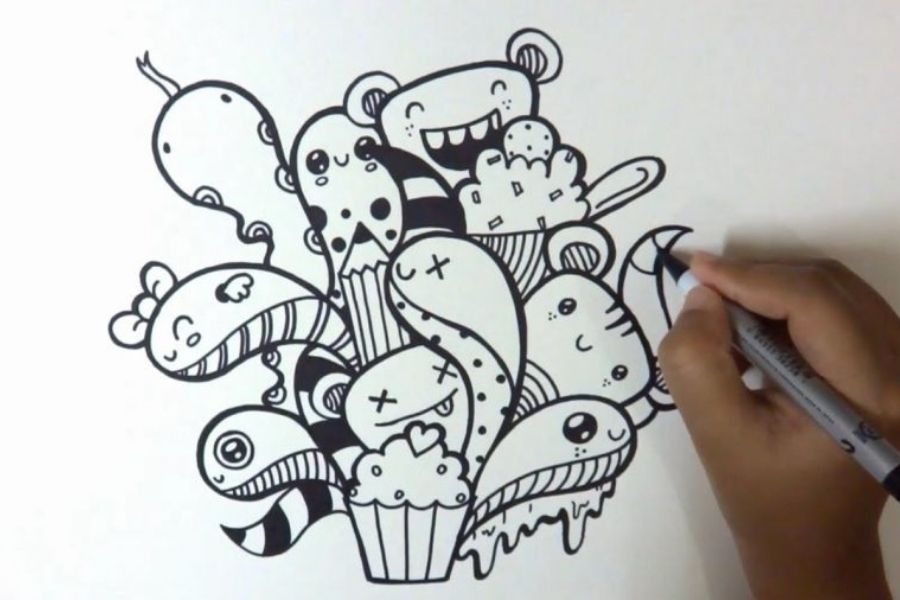

Step-by-step guide to draw and decorate a themed doodle journal
Step 1
Gather all your materials and put them where you can reach them easily.
Step 2
Choose a theme for your doodle journal like space gardens animals or superheroes and say the theme out loud.
Step 3
Write the theme as a title on the cover or first page in big letters.
Step 4
Draw one big central doodle on the cover that shows your theme using simple shapes.
Step 5
Make a tiny thumbnail plan on the next page by sketching three small boxes that show where your doodles and captions will go.
Step 6
Warm up by filling a page with simple shapes related to your theme such as circles triangles and squares.
Step 7
Pick one warm-up shape and turn it into a character or object by adding eyes limbs or other details.
Step 8
Add patterns and textures like stripes dots or zigzags to parts of your doodle to make it interesting.
Step 9
Look at a real object related to your theme and draw one detail you observe into your page.
Step 10
Choose a color palette of three or four colors to use for this page.
Step 11
Color your doodle using only the colors from your chosen palette.
Step 12
Decorate the page edges with stickers or decorative tape to frame your doodle.
Step 13
Write a short one-sentence story or caption that explains what is happening in your doodle.
Step 14
Share your finished doodle journal page on DIY.org
Help!?
What can we use if we don't have stickers, decorative tape, or markers?
If you don't have stickers or decorative tape to frame the page edges, cut strips from colored or wrapping paper and glue them down, and if markers are missing use colored pencils or crayons to stick to your chosen three- or four-color palette.
My big central doodle doesn't look like my thumbnail plan—what should we do?
If the big central doodle looks cramped or off from your thumbnail plan, lightly sketch a larger guide using the thumbnail boxes as layout, simplify into the same simple shapes you warmed up with, then erase extra lines before adding patterns, textures, and color from your chosen palette.
How can we adapt this activity for different ages?
For younger kids, say the theme aloud while an adult writes the cover title and provide chunky crayons and premade stickers for the warm-up shapes and edge decoration, whereas older kids can make a detailed thumbnail plan, observe and draw a real-object detail, limit colors to a three- or four-color palette, and write a one-sentence caption before sharing on DIY.org.
How can we extend or personalize the doodle journal beyond one page?
Turn this into a series by repeating the thumbnail-plan, warm-up-shape, detail-observation, and one-sentence caption steps across multiple pages, experiment with mixed media like collage and washi tape for edge decoration, and personalize each cover with a different central doodle before sharing on DIY.org.
Watch videos on how to draw and decorate a themed doodle journal
Beginner's Guide to Cute Doodles: 26 Adorable Designs to Draw | Easy and Fun Drawing Tutorial
4 Videos
Beginner's Guide to Cute Doodles: 26 Adorable Designs to Draw | Easy and Fun Drawing Tutorial

How to Draw a Beautiful Doodle | Easy Doodle Art with Patterns for Beginners

20 EASY Doodles You Can Draw in PROCREATE
Learn How To Draw Shapes🔺 | Step by Step Drawing For Beginners | Chiki Doodle
Facts about drawing and sketching for kids
🎨 Doodling can help your brain focus — studies show people who doodle remember more details after listening.
📓 Artists keep sketchbooks to practice ideas — Leonardo da Vinci filled hundreds with drawings and notes.
🐚 Patterns are everywhere in nature: many shells and flowers follow spiral and repeating patterns kids can copy.
✏️ Keith Haring started drawing bold, simple figures in subway stations — his doodle-like style became iconic.
📚 Turning doodles into short picture-stories is called visual storytelling and makes journals feel like tiny comics.
How do I guide my child to make a themed "Let's Doodle" journal?
What materials do I need for a Let's Doodle themed doodle journal?
What ages is a Let's Doodle journal suitable for?
What are the benefits of keeping a themed doodle journal for kids?
