Join a chorus
Learn to join a children’s chorus by practicing breathing, pitch, listening, simple harmonies, and performing a short song together to build confidence and teamwork.


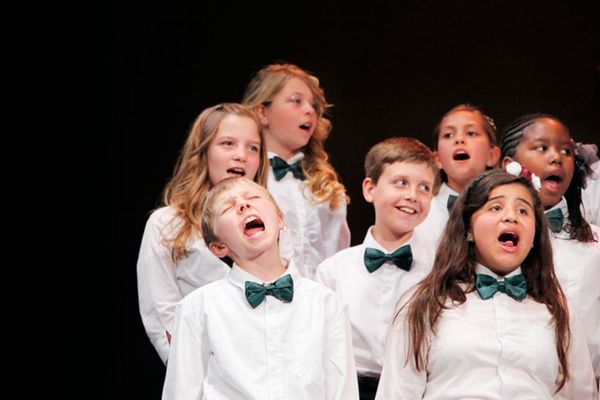

Step-by-step guide to join a children's chorus
How to Teach a Choir Parts (SATB)
Step 1
Choose a quiet room to practice where you can move and sing without distractions.
Step 2
Bring your printed lyrics into the room so you can read the words while you sing.
Step 3
Place the lyrics where you can read them easily during practice.
Step 4
Stand in front of the mirror so you can watch your mouth and body while you sing.
Step 5
Fix your posture by relaxing your shoulders and keeping your chin level.
Step 6
Take five deep belly breaths inhaling for four counts and exhaling for four counts to warm your lungs.
Step 7
Hum a siren sound gently from low to high and back down five times to wake up your voice.
Step 8
Ask an adult to sing or play a single note for you to use as a starting pitch.
Step 9
Match that starting note with your voice until it sounds the same as the note you heard.
Step 10
Sing the first two lines of the song slowly while focusing on matching pitch and clear words.
Step 11
With a partner, take turns singing one line while the other listens carefully to pitch and words.
Step 12
Clap a steady beat and sing the whole song together two times to practice teamwork and timing.
Step 13
Perform the short song for your family or a small audience to build confidence.
Step 14
Share your finished chorus performance on DIY.org
Help!?
What can we use if we don't have printed lyrics or a mirror for steps 2–4?
Use a tablet or phone to display the lyrics and prop the front-facing camera or a clean window as a mirror so you can read the words and watch your mouth while practicing.
If I can't match the adult's starting note in steps 8–9, what should I try to fix it?
Before matching, reset your posture from step 5, take the five deep belly breaths in step 6, then hum the starting pitch from step 7 slowly while comparing to the adult's note and sliding your voice up or down until it matches.
How can I change the activity for younger or older kids using steps like 7, 10, and 11?
For preschoolers focus on humming the siren (step 7) and clapping a beat with an adult helper, for elementary kids work on the first two lines slowly (step 10) with a partner turn-taking (step 11), and for teens add harmony practice and full run-throughs (step 12) before performing for family (step 13).
What are simple ways to improve or personalize the chorus before sharing on DIY.org (step 14)?
After you can sing together twice (step 12), arrange a short harmony or call-and-response part, add small mirror-checked gestures from step 4, and record or edit a video to polish your performance for DIY.org (step 14).
Watch videos on how to join a children's chorus
Fun Vocal Exercises For Kids Choirs | Singing Warm Up With Yummy Foods!
4 Videos
Fun Vocal Exercises For Kids Choirs | Singing Warm Up With Yummy Foods!

PART 2 - How To Teach SOPRANO, ALTO & TENOR Parts To Your Choir
![Singing Masterclass: How to Sing in a Choir [40 Minutes of Tips!]](https://img.youtube.com/vi/kug7F1sw5jQ/mqdefault.jpg)
Singing Masterclass: How to Sing in a Choir [40 Minutes of Tips!]

Throw Catch Choir Warm-Up & Game, how to!
Facts about choral singing for kids
🎵 Singing lights up both sides of the brain—language, memory, and emotion centers all get involved.
🫁 Diaphragmatic breathing helps kids sing longer phrases and can lower performance nerves.
🎶 Two-part children's choruses often use simple harmonies like thirds and fifths that sound rich with just a few voices.
👂 Choir practice sharpens listening skills—singers must tune their pitch and timing to blend with others.
🌟 Performing in a chorus boosts confidence and teamwork; many children feel proud after their first group performance.
How can my child join a children's chorus and learn breathing, pitch, listening, and simple harmonies?
What materials do we need for a children's chorus rehearsal and practice?
What ages is joining a children's chorus suitable for?
What are the benefits of joining a children's chorus, and what safety or vocal health tips should parents follow?
