How to Draw Snowflakes
Make and draw symmetrical snowflakes by folding paper, cutting shapes, and adding details. Practice symmetry, fine motor skills, and pattern design.
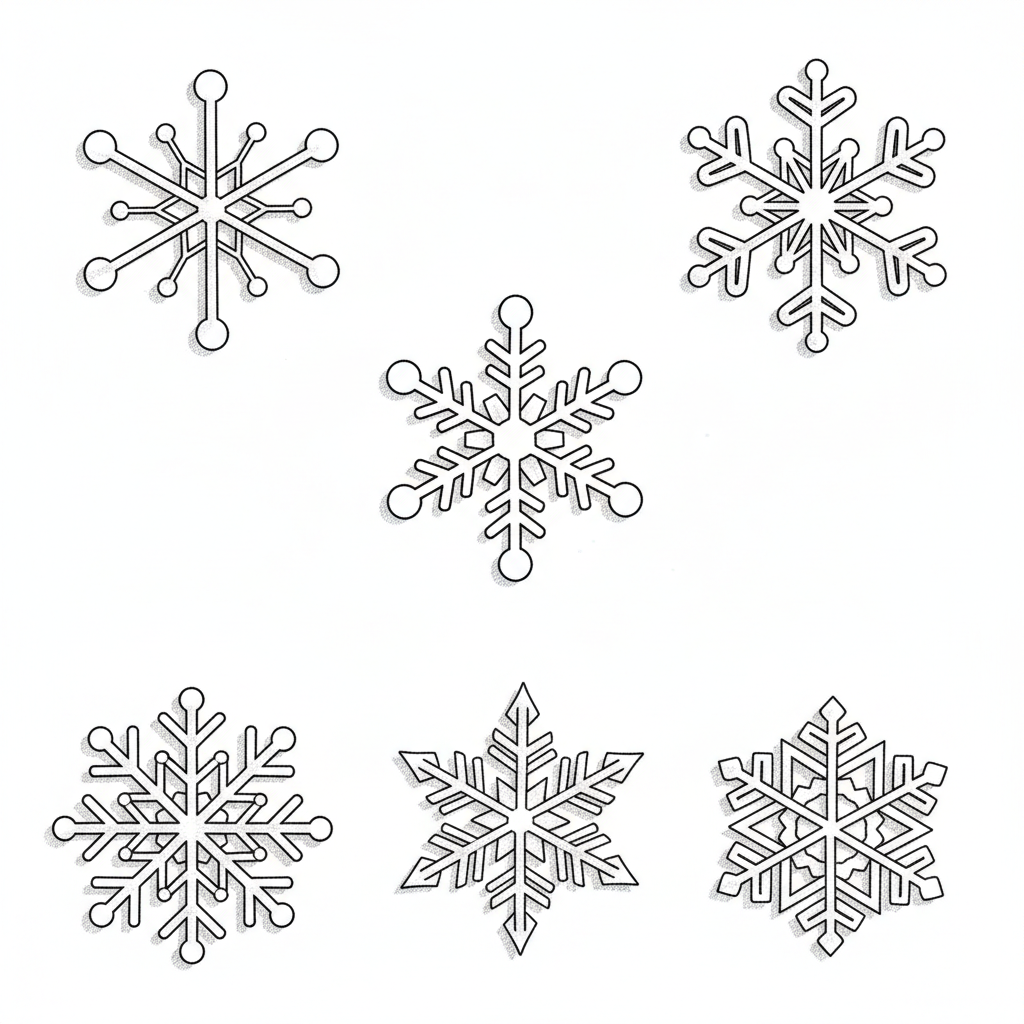
About this tutorial
Make and draw symmetrical snowflakes by folding paper, cutting shapes, and adding details. Practice symmetry, fine motor skills, and pattern design.
What you need
Instructions
- 1
Step 1
Pick one sheet of paper and fold one corner to the opposite edge to make a triangle then press the crease firmly.
- 2
Step 2
Cut off the long rectangle that sticks out along the triangle edge so the folded paper becomes a square shape.
- 3
Step 3
Keep the paper folded as a triangle and fold it in half by bringing the pointed ends together then press the crease.
- 4
Step 4
Fold the small triangle into thirds by folding one point across and then folding the other point over so the edges overlap like a little cone.
- 5
Step 5
Trim the top of the folded cone with scissors so the top edge is a straight line.
- 6
Step 6
Use your pencil to draw shapes and lines along the folded edges and sides where you want the snowflake holes to be.
- 7
Step 7
Carefully cut out the pencil shapes through all the folded layers with scissors.
- 8
Step 8
Slowly and gently unfold the paper to reveal your symmetrical snowflake.
- 9
Step 9
Decorate your snowflake with colouring and decorating materials to make it sparkle and special.
- 10
Step 10
Share your finished snowflake creation on DIY.org.
Get inspired
Fun facts
How do I teach my child to draw and cut folded paper snowflakes?
Fold a square paper in half, then into a triangle and into a smaller wedge. While folded, draw half of a snowflake pattern along the open edges—avoid cutting the folded tip so the snowflake stays connected. Carefully cut along your pencil lines, then unfold to reveal a symmetrical design. Finish with markers, glitter glue, or stickers. Work slowly, demonstrate each fold, and supervise cuts for safety.
What materials do I need to make folded paper snowflakes?
You’ll need square paper (printer paper, origami, or thin cardstock), a pencil for drawing, child-safe scissors, and a flat surface. Optional extras: markers, colored pencils, glitter glue, sequins, hole punches, and a cutting mat or scrap paper to protect the table. For younger children, use pre-folded templates and blunt-tip scissors. Choose non-toxic craft supplies and keep small decorations away from toddlers.
What ages is folding, drawing, and cutting snowflakes suitable for?
This activity suits ages 3+ with adult help. Preschoolers (3–5) can enjoy simple snips with supervision and larger patterns. Early elementary kids (6–9) can fold more precisely and draw detailed designs. Tweens (10+) can create intricate patterns and experiment with different papers. Adjust complexity, tools, and supervision to match your child’s fine motor skills and experience with scissors.
What are the benefits of making paper snowflakes and safety tips to keep in mind?
Cutting and drawing snowflakes builds fine motor skills, hand-eye coordination, and an understanding of symmetry and pattern-making—great for early math concepts and creativity. It also boosts patience and following step-by-step instructions. Safety tips: use child-safe scissors, supervise cutting, avoid small decorations for children under three, use non-toxic glue, and protect surfaces with a mat or newspaper.
Watch & Learn
Need help?
What can we use if we don't have standard paper, a pencil, or scissors for this snowflake activity?
Use thin construction paper, newspaper, or tissue paper for the folding and cutting steps, draw your shapes with a pen or marker instead of a pencil, and cut with child-safe scissors or have an adult use a craft knife for the trimming step.
My snowflake rips or looks uneven after unfolding—what might be going wrong and how can I fix it?
Make sure each crease (the corner-to-edge square fold and the triangle folds) is pressed firmly with a fingernail before you trim the long rectangle and before you cut through all folded layers, and cut slowly along your pencil lines to prevent ripping or uneven shapes.
How can I adapt the folding and cutting steps for younger or older kids?
For younger children, pre-fold the paper to the triangle or cone stage and let them make large simple cut-outs with safety scissors, while older kids can draw finer, more intricate shapes and try layered or multiple snowflake sizes for a challenge.
What are some ways to decorate or display the finished snowflakes to make them extra special?
After you slowly unfold the snowflake, decorate it with glitter glue, sequins, or watercolor, punch a small hole and add string to hang it, or glue several different-sized snowflakes together to make ornaments or a garland to share on DIY.org.