How to Draw Mountains
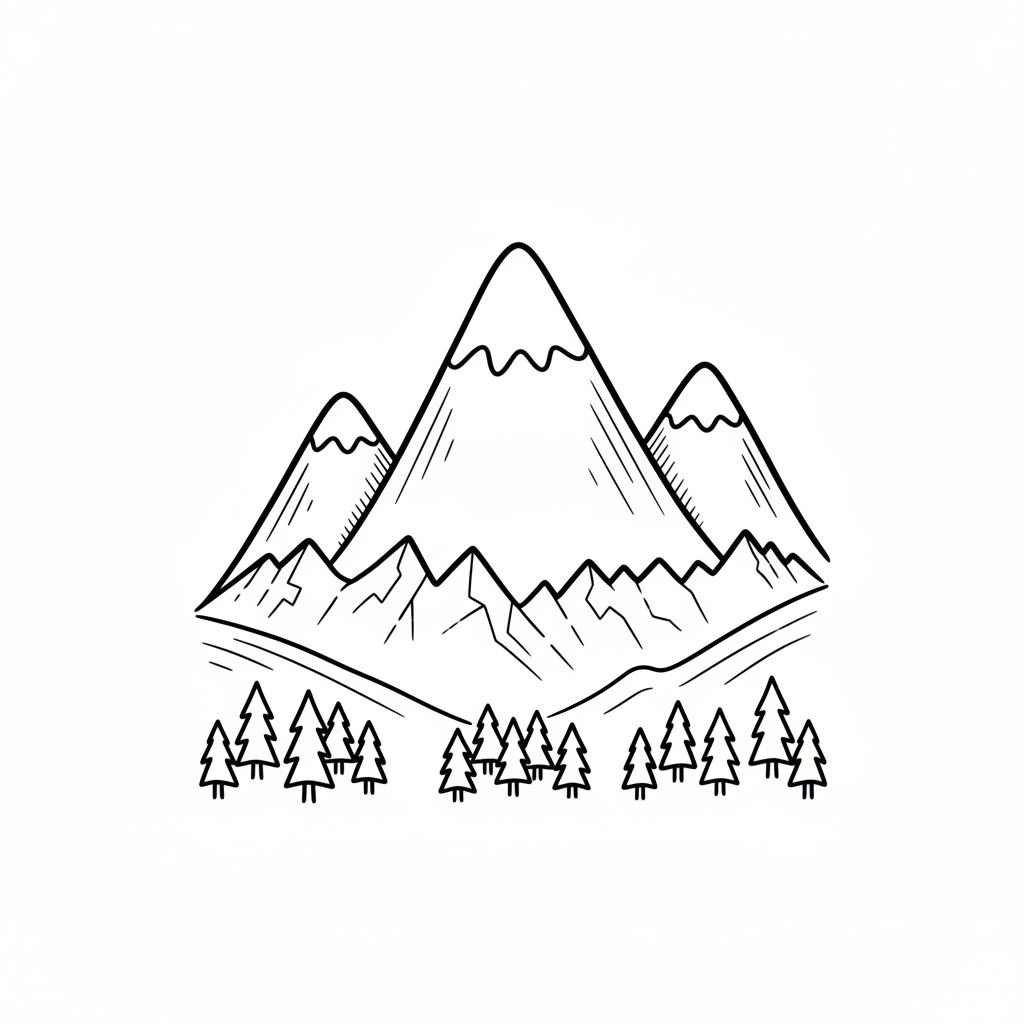
Draw realistic mountain landscapes using simple shapes, shading, and perspective. Practice sketching peaks, adding texture, and creating depth with foreground and background techniques. Download the PDF for complete instructions.
About this tutorial
Draw realistic mountain landscapes using simple shapes, shading, and perspective. Practice sketching peaks, adding texture, and creating depth with foreground and background techniques. Download the PDF for complete instructions.
What you need
Instructions
- 1
Step 1
Gather your pencil eraser sharpener ruler and paper.
- 2
Step 2
Find a clean flat workspace with good light.
- 3
Step 3
Lightly draw a straight horizontal line across your paper to mark the horizon.
- 4
Step 4
Choose a spot on the horizon and put a small dot to be your vanishing point.
- 5
Step 5
Sketch three large overlapping triangle shapes near the bottom for the foreground mountains.
- 6
Step 6
Draw smaller triangle shapes higher on the page behind the first ones to create midground and background ranges.
- 7
Step 7
Add jagged ridgelines along the triangle tops to turn simple shapes into mountain peaks.
- 8
Step 8
Draw short contour strokes along the slopes to add rocky texture and snow lines.
- 9
Step 9
Decide where the sunlight comes from and mark its direction with a tiny arrow.
- 10
Step 10
Shade the sides of each peak that face away from the light using even pencil strokes to make shadows.
- 11
Step 11
Lightly smudge the background mountains with your blending tool so they look hazier and farther away.
- 12
Step 12
Draw darker sharper details like trees rocks or a stream in the foreground to boost depth.
- 13
Step 13
Erase any stray construction lines you no longer need.
- 14
Step 14
Darken the strongest outlines or add colour where you want your picture to pop.
- 15
Step 15
Share your finished mountain landscape on DIY.org.
Get inspired
Fun facts
How do I draw realistic mountain landscapes step by step?
Start by blocking basic shapes: use large triangles for distant peaks and uneven polygons for closer ridges. Lightly sketch a horizon and overlapping layers to define foreground, middleground, and background. Add shading with soft strokes, making shadow faces darker and distant peaks lighter to show depth. Create texture with short directional lines for rock and trees, blend edges for atmosphere, erase highlights, and refine contrast. See the downloadable PDF for step-by-step diagrams and exampl
What materials do I need to draw mountains with kids?
You’ll need drawing paper or a sketchbook, a range of pencils (HB, 2B, 4B), a soft eraser, and a blending stump or tissue for smooth gradients. Optional items: charcoal or colored pencils, a kneaded eraser for highlights, a ruler for horizon lines, and printed reference photos. For younger children, washable pencils or crayons work well. The PDF includes a printable supplies checklist and kid-friendly substitutes.
What ages is mountain drawing suitable for?
Mountain drawing suits many ages with adjustments: children 4–5 can practice simplified shapes and colouring, ages 6–8 work on overlapping layers and basic shading, and ages 9+ can learn perspective, detailed textures, and value scales. Tailor instructions, time, and supervision to the child’s attention and fine-motor skills. Encourage practice and celebrate progress rather than perfection.
What are the benefits and fun variations of drawing mountains?
Drawing mountains improves observation, fine motor control, and understanding of light, shadow, and depth, boosting concentration and creative confidence. Variations: use watercolor washes for misty atmospheres, charcoal for dramatic contrast, or colored pencils for sunset palettes. Try plein air sketching from life or adding tiny cabins and trees to practice scale. The PDF offers practice prompts and variation ideas to keep lessons engaging.
Watch & Learn
Need help?
If I don't have a blending tool, ruler, or eraser, what can I use so I can still follow the horizon, vanishing point, and smudging steps?
Use a clean tissue or your fingertip to lightly smudge the background mountains, the straight edge of a book or cardboard for drawing the horizon and vanishing point, and a folded clean paper corner or kneaded gum as an eraser substitute to remove stray construction lines.
My mountains look flat or don't feel distant—what should I check or redo in the steps?
Make sure foreground triangles overlap larger and lower, smudge the background mountains lightly with your blending tool or tissue, and darken shadows on sides facing away from the light arrow while adding sharper foreground details like trees or rocks to increase depth.
How can I adapt this activity for younger kids, older kids, or teens while still following the same instructions?
For preschoolers simplify to three big triangles colored with crayons and skip smudging, for elementary add jagged ridgelines and short contour strokes, and for teens emphasize accurate horizon and vanishing point with a ruler plus refined shading and smudging with a blending tool before darkening outlines or adding colour.
What are simple ways to extend or personalize the finished mountain landscape beyond the basic steps?
After erasing construction lines, add colour or a light watercolor wash, place a darkened cabin, animals, or a stream in the foreground for interest, and experiment with changing the light arrow to create sunrise or sunset shadows before sharpening outlines.