How to Draw a Tennis Ball
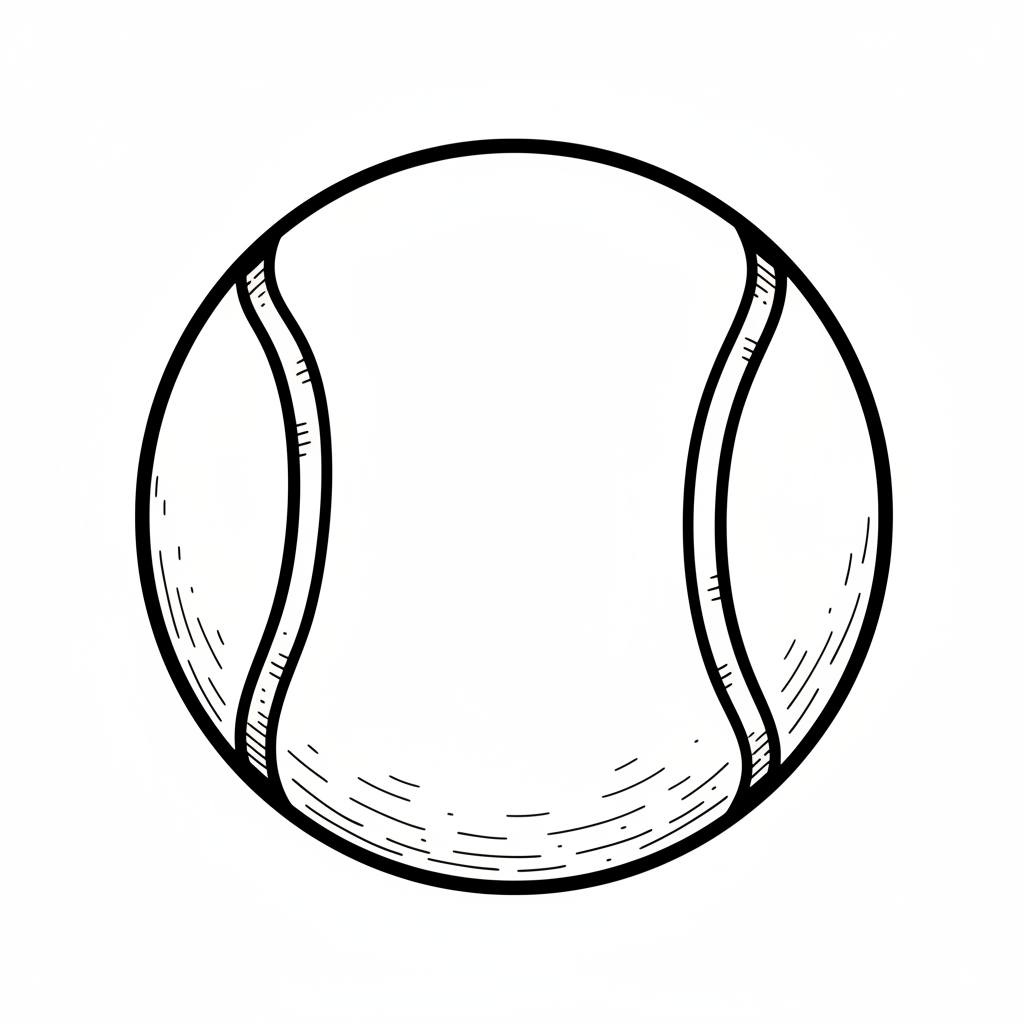
Draw a realistic tennis ball using simple shapes, curved seams, and shading to show light. Practice observation and shading techniques.
About this tutorial
Draw a realistic tennis ball using simple shapes, curved seams, and shading to show light. Practice observation and shading techniques.
What you need
Instructions
- 1
Step 1
Find a real tennis ball or a clear picture of one to look at while you draw.
- 2
Step 2
Place your paper and lightly trace a round object or draw a neat circle the size you want your tennis ball.
- 3
Step 3
Decide where the light is coming from and lightly mark a small oval on the circle where the brightest highlight will stay white.
- 4
Step 4
Draw two curved S-shaped seam lines across the circle so they meet near the top and bottom like a stretched figure-eight.
- 5
Step 5
Draw a thin parallel curve along each seam line to show the white seam edges.
- 6
Step 6
Erase extra sketch marks so the circle and seams look clean and ready to shade.
- 7
Step 7
Lightly shade the side opposite the highlight with your pencil to start making the ball look round.
- 8
Step 8
Darken the shading near the outer edge and close to the seams to deepen the shadow and add roundness.
- 9
Step 9
Gently blend the pencil shading with a tissue or cotton bud so the tones look smooth.
- 10
Step 10
Colour the ball with yellow and green, keeping the highlight area white and adding darker layers where you shaded.
- 11
Step 11
Draw a soft shadow beneath the ball with your pencil to make it sit on the page.
- 12
Step 12
Share your finished tennis ball drawing on DIY.org.
Get inspired
Fun facts
How do I teach my child to draw a realistic tennis ball?
Begin with a light, accurate circle—trace a lid or use a compass. Draw the ball’s curved seam as two flowing S-shaped lines that wrap around the sphere. Decide on a light source, then lay in basic values: light, midtone, and shadow. Build tone with layered pencil strokes, darken the seam and contact shadow, and blend smoothly with a stump or tissue. Finish by lifting a small highlight with an eraser or adding a white pen for shine.
What materials do I need to draw a realistic tennis ball with my child?
You’ll need drawing paper, a range of pencils (HB, 2B, 4B), a soft eraser and a kneaded eraser, and a pencil sharpener. For blending use a stump, tortillon, or tissue. Optional: colored pencils or soft pastels in yellow-green, a white gel pen for highlights, and a circular object to trace. Keep washable supplies for younger kids and a cloth to protect surfaces.
What ages is drawing a realistic tennis ball suitable for?
This activity suits ages about 6 and up with adjustments: 6–8-year-olds can focus on tracing the circle and simple seams with basic shading; 9–12 can practice smoother gradients and proportion; teens can refine realistic textures and highlights. Provide supervision for younger children with sharp tools, and offer simplified steps or more advanced techniques depending on each child’s fine motor skills and attention span.
What are the benefits of drawing a tennis ball and creative variations to try?
Drawing a tennis ball builds observation, hand–eye coordination, and shading skills while teaching light and form. It’s a short, focused project that improves patience and confidence. Variations: try colored pencils or pastels to capture the neon fuzz, charcoal for bold contrast, draw multiple balls overlapping for composition practice, or sketch a ball in motion with motion blur lines to study action and energy.
Watch & Learn
Need help?
What can we use if we don't have a real tennis ball, a round object to trace, or a cotton bud for blending?
Use a clear photo of a tennis ball from the internet instead of a real ball, trace any round object like a cup or lid for the circle, and blend shading with a clean fingertip or a soft piece of tissue in place of a cotton bud.
My seams look uneven and the ball appears flat—what should I check or redo?
Check that the two S-shaped seam lines meet near the top and bottom (step 4), erase extra sketch marks (step 6), darken shading near the outer edge and seams (steps 7–8), and gently blend with tissue to smooth transitions while keeping the highlight area white.
How can I adapt this activity for younger children or make it more challenging for older kids?
For younger kids, simplify by tracing a circle, using crayons and a sticker to mark the highlight, and letting them color flat, while older kids can add layered colored-pencil washes, stronger graphite values, and short pencil strokes to simulate the fuzzy texture following steps 6–9.
What are simple ways to enhance or personalize the finished tennis ball drawing?
Add a soft shadow beneath the ball (step 10), paint short curved pencil strokes for fuzz, draw a tennis-court background, or sign and share the finished drawing on DIY.org as suggested.