How to Draw a T-rex
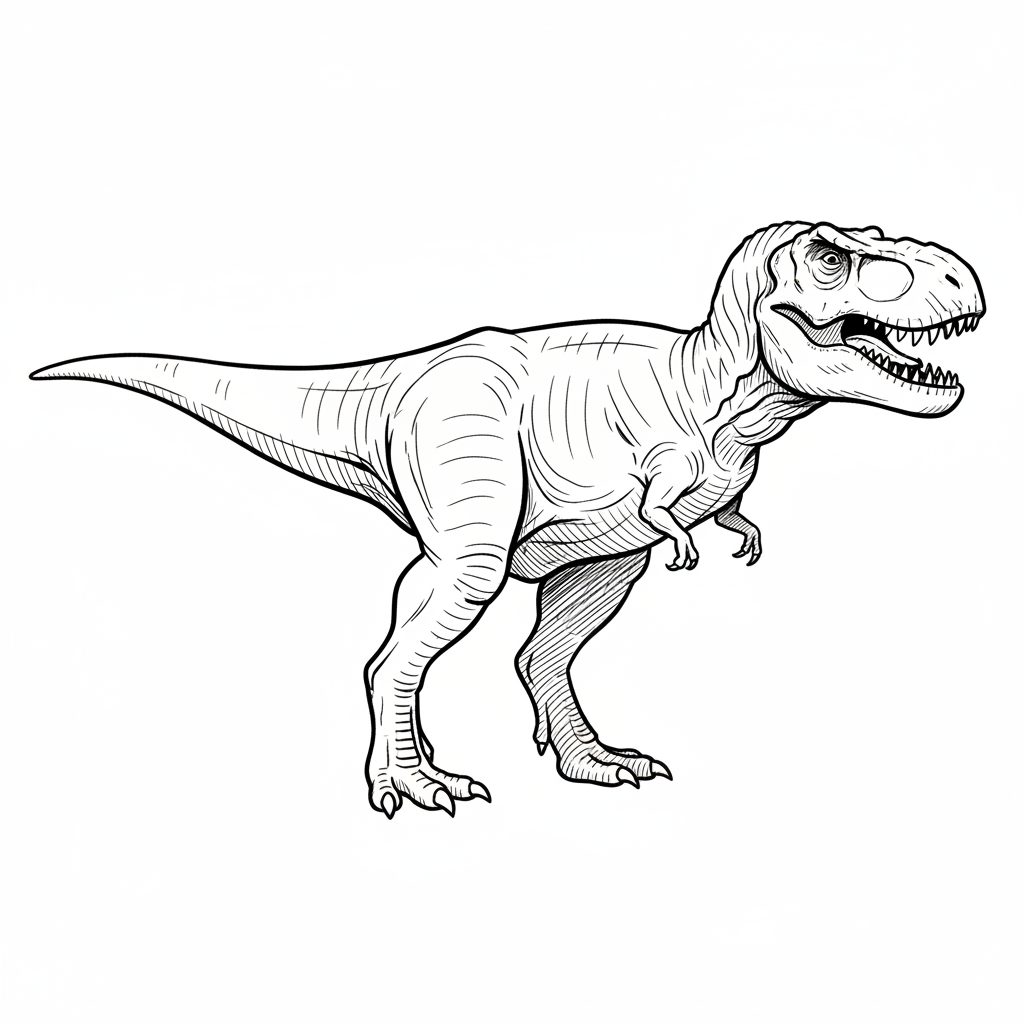
Draw a detailed T-Rex using simple shapes, proportion guides, and shading to create a realistic dinosaur sketch. Practice observation and shading skills.
About this tutorial
Draw a detailed T-Rex using simple shapes, proportion guides, and shading to create a realistic dinosaur sketch. Practice observation and shading skills.
What you need
Instructions
- 1
Step 1
Gather your drawing materials and put them on a flat surface.
- 2
Step 2
Lightly draw a horizontal ground line across the paper so your T‑Rex has a place to stand.
- 3
Step 3
Sketch a large sideways oval in the middle of the paper for the T‑Rex body.
- 4
Step 4
Draw a medium circle in front of the oval to mark the head position.
- 5
Step 5
Add a small circle near the back of the oval to mark the hip joint.
- 6
Step 6
Connect the head circle to the body with two curved lines to make a neck guide.
- 7
Step 7
Draw a long curved line from the back of the body to make a tail guide.
- 8
Step 8
Sketch angled line guides from the hip circle to place the hind legs and draw two short lines near the front of the body for the tiny arms.
- 9
Step 9
Smooth and connect the simple shapes to refine the T‑Rex contour into a clear head jaw chest belly legs and tail outline.
- 10
Step 10
Add facial and skin details like the open mouth with teeth the eye the nostril and a few wrinkles or scale marks.
- 11
Step 11
Decide where your light comes from by drawing a small arrow and lightly mark the areas that will be in shadow.
- 12
Step 12
Shade the shadow areas with your pencil using hatching and layered tones then gently blend with a stump or tissue and erase stray construction lines to clean up the drawing.
- 13
Step 13
Share your finished T‑Rex sketch on DIY.org
Get inspired
Fun facts
How do I draw a detailed T-Rex step by step?
Start by sketching simple shapes: a circle for the skull, an oval for the body, and a long sweeping line for the tail. Add proportion guides for jawline, hip, and leg placement. Block in limbs with cylinders and triangles for claws. Refine the outline, add teeth, eye socket, and skin folds. For shading, pick a light source, add darker values in shadow areas, blend lightly, and finish with texture like scales and highlights.
What materials do I need to draw a realistic T-Rex?
You'll need drawing paper or a sketchbook, a range of pencils (HB for outlines, 2B–4B for shading), a kneaded eraser, a regular eraser, pencil sharpener, blending stump or tissue, and a ruler for proportion guides. Optional: reference photos of T‑rex bones or reconstructions, colored pencils or ink pens for final lines, and a light box or tracing paper for transferring sketches.
What ages is drawing a detailed T-Rex suitable for?
This activity suits children roughly ages 7–13. Younger kids (5–6) can try simplified shapes and bold outlines with adult help; ages 7–9 can follow guided proportion steps; ages 10–13 are ready to practice detailed anatomy and shading. Adapt the complexity and session length to the child's attention span. Supervision is advised when children use sharpeners or blending tools.
What are the benefits of drawing a detailed T-Rex?
Drawing a detailed T‑rex builds observation, proportion sense, and shading technique while boosting fine motor skills and patience. Following guides trains spatial reasoning and measuring distances. It encourages research (looking at fossils and references) and creative problem-solving when adding textures. Variations like cartoon T‑rex, fossil-style sketch, or color studies keep it fresh. Safety: keep pencils and sharpeners handled carefully and take breaks to prevent eye strain.
Watch & Learn
Need help?
What can I use if I don't have a blending stump or a range of pencils?
If you don't have a blending stump, gently blend the shaded shadow areas after hatching with a clean tissue, cotton swab, or fingertip, and use whatever softer pencils you have (e.g., a 2B or 4B) for darker tones while keeping an HB for the light construction lines like the sideways oval and head circle.
My T‑Rex looks out of proportion when I smooth the shapes—how do I fix that?
Lighten and recheck the initial construction guides—the horizontal ground line, the large sideways oval for the body, the medium head circle, and the hip circle with angled leg guides—and resize or reposition those shapes before refining the contour and erasing stray construction lines.
How can I adapt this activity for different ages?
For younger kids use only the big sideways oval, head circle, and two short arm lines and skip shading; for elementary kids add tail and leg guides and simple hatching; and for older kids encourage detailed teeth, skin marks, directional light arrow, layered shading with a stump or tissue, and posting to DIY.org.
What are some ways to extend or personalize my T‑Rex drawing?
Personalize by changing the light arrow direction and deepening hatching in the shadow areas, adding a background along the ground line, coloring the sketch with colored pencils or markers, or drawing multiple poses to create a T‑Rex scene to share on DIY.org.