How to draw a stage - a free stage drawing guide
Draw a theater stage with curtains, proscenium arch, stage floor, and simple actors using pencil, ruler, and color to practice perspective and design.


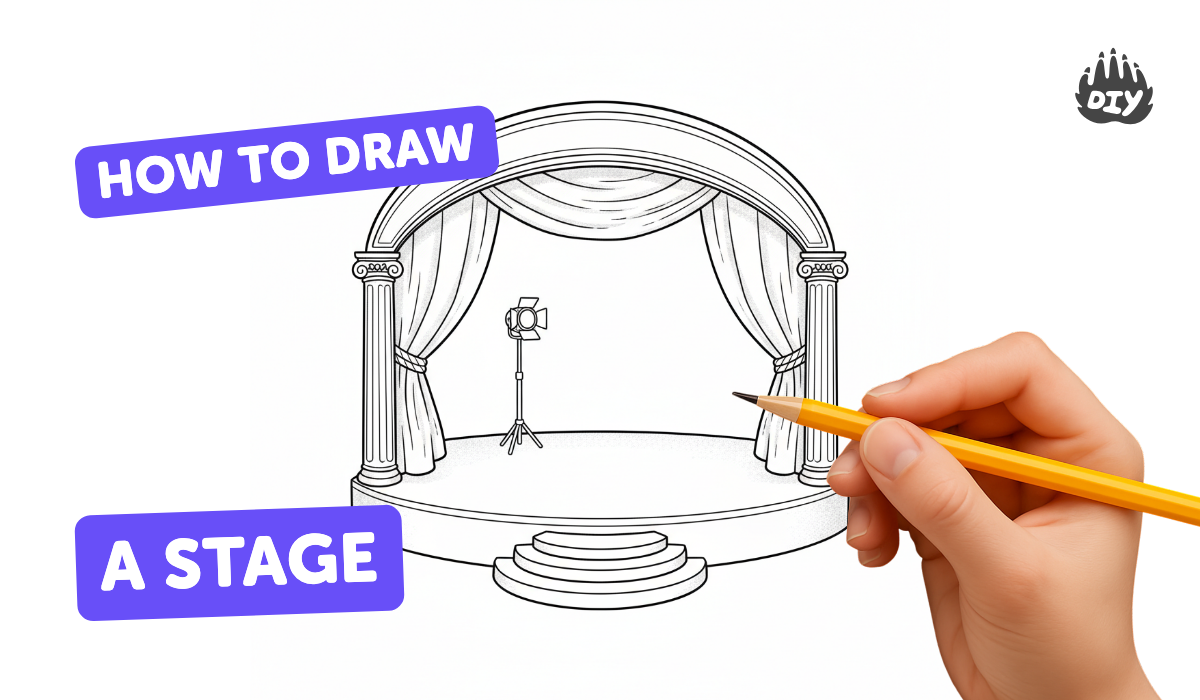
Step-by-step guide to draw a theater stage with curtains, proscenium arch, stage floor, and simple actors
How to draw a Stage - Easy step-by-step drawing lessons for kids
Step 1
Put your paper in landscape position on a flat table so you have lots of room for the stage.
Step 2
Lightly draw a straight horizontal line about one-third down from the top of the paper to be your eye level.
Step 3
Put a small dot in the middle of that line to mark the vanishing point where things will seem to meet.
Step 4
Draw a large rectangle or rounded rectangle centered below the horizon line to make the proscenium arch opening.
Step 5
Draw a second inner rectangle or rounded shape inside the first to show the depth of the arch frame.
Step 6
Use your ruler to draw two straight lines from the bottom corners of the arch toward the vanishing point to make the stage floor recede.
Step 7
Add evenly spaced horizontal lines between the floor lines to create floorboards or tiles that get smaller toward the vanishing point.
Step 8
Sketch big curtain shapes on each side of the arch by drawing two curved panels that hang down past the arch edges.
Step 9
Put wavy vertical folds inside each curtain panel to show ruffles and fabric texture.
Step 10
Draw simple actors on the stage using small ovals for heads and rectangles or cylinders for bodies placed on the floor.
Step 11
Add simple face features and clothing details like hats or buttons using small shapes to give each actor personality.
Step 12
Trace the important outlines like the arch curtains floor and actors with a slightly darker pencil so the scene reads clearly.
Step 13
Color the curtains arch floor and actors using bold colors and shade areas closer to the vanishing point slightly darker for depth.
Step 14
Gently erase leftover construction lines so your stage looks neat and tidy.
Step 15
Share your finished stage drawing on DIY.org so everyone can see your theater design.
Help!?
What can we use if we don't have a ruler or colored pencils for this stage drawing?
If you don't have a ruler, use the straight edge of a book or cereal box to draw the floor lines and arch edges, and substitute crayons or markers for colored pencils to color the curtains, arch, floor, and actors.
My floorboards don't look like they go back into the distance—what should I check?
If your floorboards don't look like they recede, make sure you drew the two straight lines from the bottom corners of the arch toward the vanishing point and then add evenly spaced horizontal lines that get smaller as they approach that vanishing point.
How can I adapt this activity for younger or older kids?
For younger children, simplify by skipping the inner rectangle and drawing the arch, curtains, and actors with big rounded shapes and thick crayons, while older kids can add the inner arch depth, detailed floorboards, finer facial features, and shading near the vanishing point for realism.
What are some ways to make the stage drawing more creative or personalized?
Personalize your scene by adding a painted backdrop behind the actors, small stage props like a stool or piano, unique clothing details or name tags on the actors, and then trace and color with bold hues and upload the finished, shaded drawing to DIY.org to share your theater design.
Watch videos on how to draw a theater stage with curtains, proscenium arch, stage floor, and simple actors
How to Draw a Stage Easy step by step
4 Videos
How to Draw a Stage Easy step by step
Drawing stages in children part 1

Teach Your Toddler How To Draw (Developmental Stages of Drawing + Tips/Tricks from a Pediatric OT)
One Point Perspective Room Drawing on a Stage.follow step by step. Draw it with me.
Facts about theater set design for kids
🎭 The proscenium arch is often called a “picture frame” stage because it frames the action like a painting.
🎯 One-point (linear) perspective uses a single vanishing point — perfect for drawing a straight-on theatre stage with depth.
🧵 Traditional stage curtains are usually heavy velvet or velour and on large stages can weigh hundreds of pounds.
🏛️ The word “proscenium” comes from the Greek proskēnion, meaning “in front of the scene.”
📐 Even simple stick-figure actors will look like they stand on the floor if their feet and bases follow the stage’s perspective lines using a ruler.
How do I draw a theater stage with curtains, proscenium arch, stage floor, and simple actors to practice perspective and design?
What materials do I need to draw a theater stage for perspective and design practice?
What ages is drawing a theater stage with perspective suitable for?
What are the benefits, safety tips, and variations for drawing a theater stage activity?
