How to Draw a Spring
Draw a coiled metal spring with pencil, ink, and shading to create a realistic 3D effect. Practice spirals, perspective, and shading.
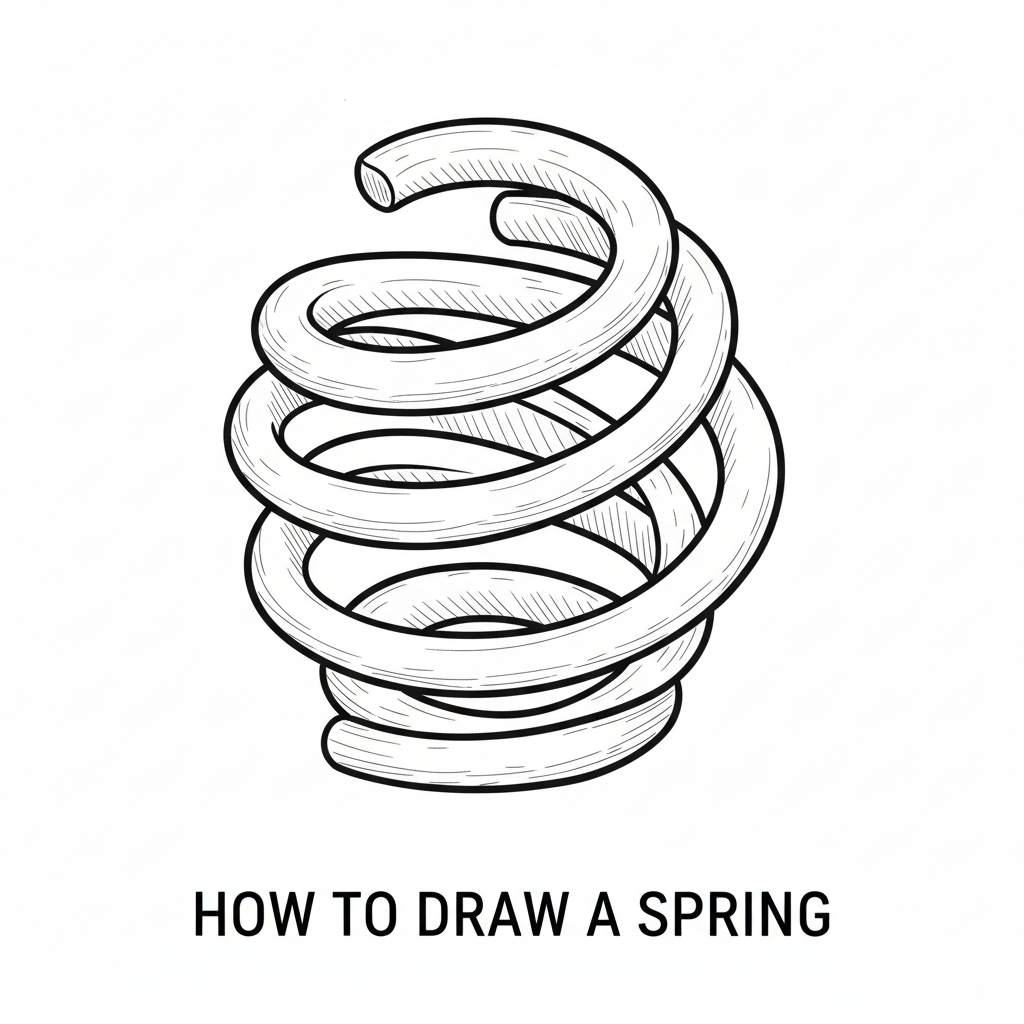
About this tutorial
Draw a coiled metal spring with pencil, ink, and shading to create a realistic 3D effect. Practice spirals, perspective, and shading.
What you need
Instructions
- 1
Step 1
Gather your materials and find a clean flat spot to draw.
- 2
Step 2
Lightly draw two vertical parallel guide lines on your paper to set the spring’s width.
- 3
Step 3
Mark a small tick at the top and a small tick at the bottom between the guide lines to set the spring’s length.
- 4
Step 4
Lightly draw a smooth spiral centerline between the guide lines from the top tick down to the bottom tick.
- 5
Step 5
Draw a second spiral line parallel to the first to create the thickness of the coil, keeping the spacing even.
- 6
Step 6
Draw short curved connecting lines at the ends of each loop so each coil looks like a solid band.
- 7
Step 7
Draw a rounded ellipse at the top between the guides to show the open rim of the spring and match the spiral direction.
- 8
Step 8
Carefully ink the outer edges of the coils and the front-overlapping edges with your pen to define the shape.
- 9
Step 9
Let the ink dry and then gently erase the remaining pencil guide lines.
- 10
Step 10
Pick a direction for your light source so you know which side of the coils will be lighter.
- 11
Step 11
Shade the underside of each coil with a pencil using darker strokes near the inner edge and lighter strokes outward.
- 12
Step 12
Blend the shaded areas with a blending stump or cotton bud to smooth the tones.
- 13
Step 13
Darken the deepest shadow gaps between coils to boost the 3D look and make the spring pop.
- 14
Step 14
Draw a soft cast shadow on the surface beneath the spring so it looks grounded.
- 15
Step 15
Share your finished coiled spring drawing on DIY.org
Get inspired
Fun facts
How do I teach my child to draw a realistic coiled metal spring with pencil, ink, and shading?
Start by drawing a straight centerline to mark the spring’s axis. Sketch evenly spaced ellipses along the line to form coils, using ellipses that get narrower with perspective. Connect the ellipses smoothly into a spiral and clean up construction lines. Ink over final lines, let dry, then erase pencil. Add shading: identify a light source, shade inner coil sides darker with hatching, blend transitions, and add a cast shadow to enhance 3D realism. Practice spirals and perspective.
What materials do I need to draw a coiled spring with pencil, ink, and shading?
You’ll need: a set of pencils (HB for guidelines, 2B–4B for shading), a kneaded eraser and regular eraser, smooth drawing paper, ruler and centerline guide, circle templates or compass for ellipses (optional), fine liners or ink pen for final lines, a brush pen for variable strokes, blending stump or tissue for smoothing, and a soft pencil or graphite stick for darkest values. Good lighting and reference photos of springs help, too.
What ages is this spring-drawing activity suitable for?
This activity suits a range: children around 7–9 can start with simplified coil sketches and practice making smooth spirals with guidance. Ages 10–13 can handle ellipses, perspective, and basic shading. Teens 14+ can refine techniques, inking, and advanced shading for realism. Adjust complexity, supervision, and tools to fit fine motor skills; shorter sessions help younger kids build focus. Always encourage practice rather than perfection.
What are some fun variations and practice tips for drawing springs?
Try variations to keep practice fun: draw springs foreshortened (end-on view), stretched or compressed, or with different coil thicknesses. Experiment with materials — colored pencils, markers, or watercolor washes for metallic sheen. Practice shading drills: gradient bands across an ellipse, reflected highlights, and strong cast shadows. For kids, turn it into a game: time-limited spiral challenges or tracing concentric ellipses. Adding a small object on the spring helps study contact shadows.
Watch & Learn
Need help?
What can I use instead of a blending stump or special pens if I don't have them?
If you don't have a blending stump, use a cotton bud or a folded tissue to 'Blend the shaded areas,' and if you lack an ink pen for the 'Carefully ink the outer edges' step, substitute a fine-tip marker or a sharpened colored pencil.
My spiral looks wobbly or the coil spacing is uneven—how do I fix that?
If your spiral centerline or spacing becomes uneven, redraw or reinforce the two vertical parallel guide lines and add extra small ticks between the top and bottom ticks to guide a smoother 'lightly draw a smooth spiral centerline' and keep the 'second spiral line' evenly spaced.
How can I adapt this spring drawing activity for different ages or skill levels?
For younger children, pre-draw the two vertical guide lines and top/bottom ticks and let them trace the spiral with a crayon instead of inking, while older kids can follow all steps—especially 'shade the underside,' 'blend the shaded areas,' and 'darken the deepest shadow gaps'—to develop realistic shading skills.
What are some ways to enhance or personalize the completed spring drawing?
To personalize the drawing, add metallic highlights with a white gel pen on the front-overlapping edges, apply colored-pencil gradients inside each coil after blending, or draw multiple springs with varied widths and matching cast shadows before sharing on DIY.org.