How to draw a soccer goal - a free soccer goal drawing guide
Learn to draw a soccer goal step-by-step using simple shapes, perspective, and shading; practice measuring lines and adding net details.


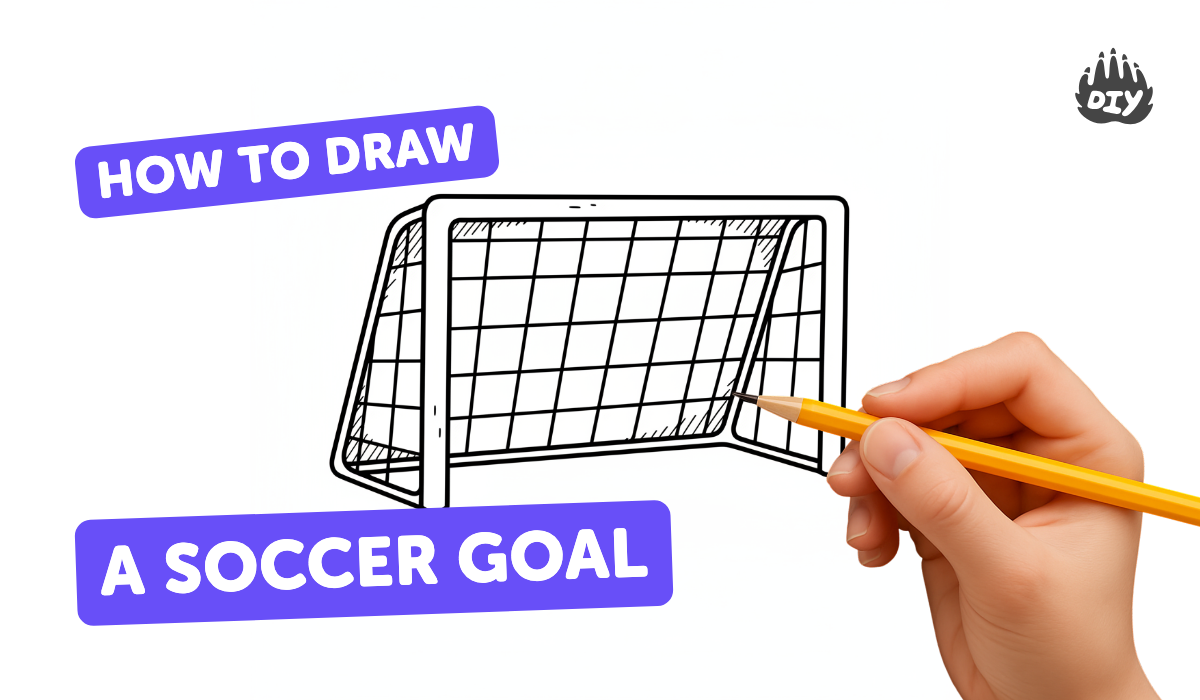
Step-by-step guide to draw a soccer goal
How to Draw a Soccer Goal Easy
Step 1
Draw a straight horizon line near the top third of your paper.
Step 2
Put a small dot on the horizon line near the center to be your vanishing point.
Step 3
Use your ruler to draw a rectangle near the bottom center of the page for the front opening of the soccer goal.
Step 4
From each corner of that front rectangle draw light straight guide lines toward the vanishing point.
Step 5
Draw a smaller rectangle by connecting the guide lines to form the back opening of the goal.
Step 6
Use your ruler to mark equal points along the top crossbar to space the net strings.
Step 7
Draw straight vertical lines from each top mark down to the bottom edge of the goal to make the net’s vertical strings.
Step 8
Draw diagonal lines slanting from top-left to bottom-right across the net to add the first set of net strands.
Step 9
Draw diagonal lines slanting from bottom-left to top-right to complete the diamond-shaped net pattern.
Step 10
Shade inside the goal and the back wall with soft pencil strokes to show depth and shadow.
Step 11
Trace the goal’s frame and the strongest net lines with a darker pencil or black marker to make them stand out.
Step 12
Erase any light construction or guide lines so the drawing looks clean.
Step 13
Colour the goal and the ground using your colouring materials to finish your scene.
Step 14
Share your finished drawing on DIY.org.
Help!?
What can I use instead of a ruler, black marker, or special colouring materials?
If you don’t have a ruler, use the straight edge of a book or a piece of cardboard to draw guide lines, replace a black marker with a dark pencil or fine-tip pen when tracing the frame, and use crayons, coloured pencils, or watered-down poster paint for the colouring step.
My guide lines don’t line up with the vanishing point or the net looks uneven—how can I fix it?
Redraw the light construction lines from each corner of the front rectangle using a ruler aimed straight at the horizon dot, re-measure equal points along the top crossbar before adding the vertical net strings, and lightly erase and adjust the back rectangle until the guide lines meet correctly.
How can I adapt this activity for younger or older kids?
For younger kids, pre-draw the horizon, vanishing point, and front rectangle and let them add big vertical net lines with crayons, while older kids can carefully mark equal spacing with a ruler, refine the back rectangle in perspective, add both diagonal net strands, and practice detailed shading inside the goal.
What are some ways to enhance or personalize the finished drawing?
Add a soccer ball and a goalkeeper in front of the goal in correct perspective, colour the net in a team colour, deepen the shading on the back wall for more depth, decorate the horizon with a crowd or stadium, and photograph the finished scene to share on DIY.org.
Watch videos on how to draw a soccer goal
How to draw a soccer goal | step by step
4 Videos
How to draw a soccer goal | step by step
How to draw a football goal and goalkeeper
How to Draw a SOCCER BALL ⚽ 🎨 | Learn to draw easily | Lingokids
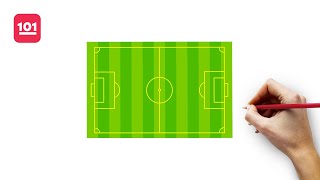
How to Draw a Soccer field | Easy Step-by-Step Drawing Tutorial
Facts about drawing fundamentals for kids
⚽ A full-size soccer goal is 8 feet (2.44 m) tall and 24 feet (7.32 m) wide — great for realistic scale in drawings!
📏 Linear perspective uses vanishing points on the horizon so parallel lines seem to meet — perfect for drawing a 3D goal
🕸️ Soccer nets form repeating grids (squares or diamonds) — draw one section neatly and repeat it to save effort
✏️ Cross-hatching and simple strokes can create convincing shading on posts and nets without complex blending
💡 Pick one light source and keep shadows consistent — that single trick makes a flat sketch look three-dimensional
How do I teach my child to draw a soccer goal step-by-step?
What materials do I need to draw a soccer goal with my child?
What ages is this soccer goal drawing activity suitable for?
What are the benefits, safety tips, and variations for drawing a soccer goal?
