How to draw a rainforest - a free rainforest drawing guide
Draw a colorful rainforest scene showing canopy, understory, and forest floor; sketch plants, birds, and frogs while learning layering, texture, and observation skills.


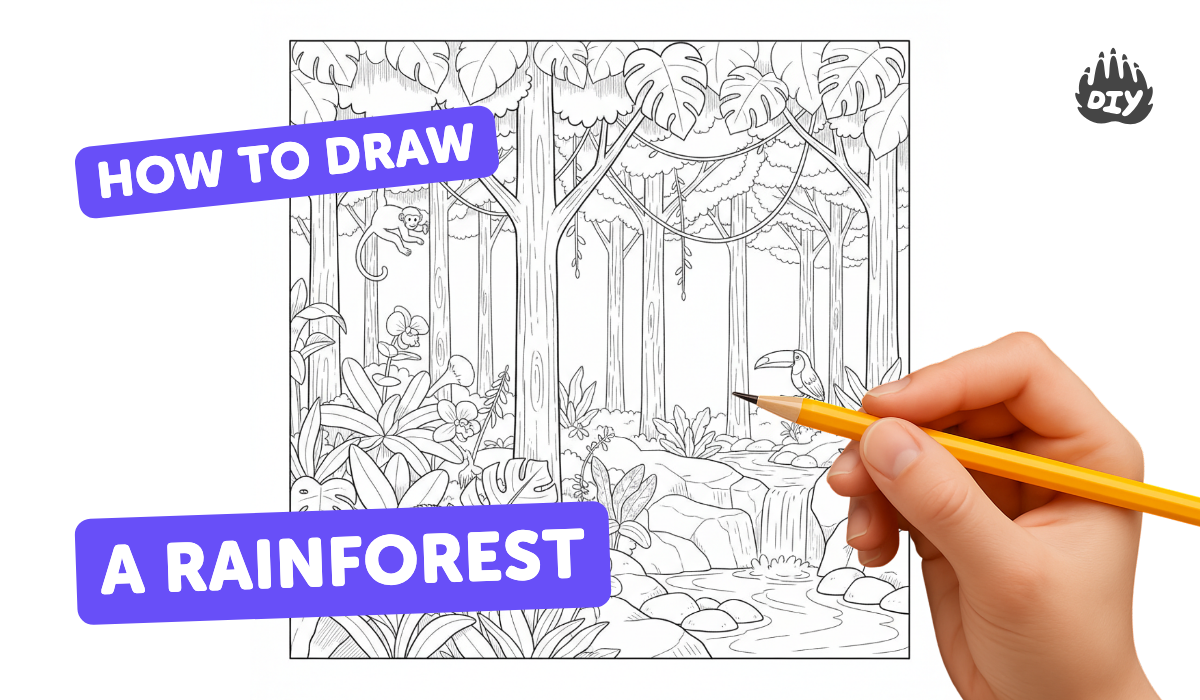
Step-by-step guide to draw a rainforest
Learn how to draw A RAIN FOREST JUNGLE: STEP BY STEP GUIDE! (Age 5 +)
Step 1
Gather your materials and clear a flat workspace so you have room to draw.
Step 2
Look at a picture of a rainforest or imagine one for two minutes to notice the three layers and animals.
Step 3
Lightly draw two horizontal guide lines across your paper to divide it into canopy understory and forest floor zones.
Step 4
Sketch big tree crowns large leaves and branches in the top zone to create the canopy.
Step 5
Draw medium trees vines and leafy shrubs in the middle zone to show the understory.
Step 6
Draw roots ferns fallen leaves and small plants in the bottom zone for the forest floor.
Step 7
Sketch birds perched or flying among the canopy leaves using simple shapes like ovals and triangles.
Step 8
Sketch frogs sitting on leaves or on the forest floor using round bodies and big eyes.
Step 9
Add texture details like leaf veins bark lines and small dots for moss to make things look real.
Step 10
Trace your final pencil lines with a black marker to make your drawing stand out.
Step 11
Carefully erase the leftover pencil marks so only the marker lines remain.
Step 12
Colour the canopy understory and forest floor using different tones and brighter colors for closer objects to show depth.
Step 13
Share your finished colorful rainforest scene on DIY.org
Help!?
What can we use instead of a black marker if we don't have one?
If you don't have a black marker, trace your final pencil lines with a fine-tip black pen or a dark-colored pencil so the lines still stand out as the instructions advise when you 'Trace your final pencil lines with a black marker to make your drawing stand out.'
My guide lines are too dark and show through the coloring — what should I do?
When you 'Lightly draw two horizontal guide lines,' use a very light hand with a soft pencil, erase the leftover pencil marks after the marker dries, and test your coloring tools on scrap paper to avoid bleed-through.
How can I adapt the activity for younger or older kids?
For younger children, pre-draw the three zones and have them sketch simple shapes for tree crowns, birds, and frogs with chunky crayons, while older kids can add detailed textures like leaf veins and bark lines and use tonal coloring to show depth between canopy, understory, and forest floor.
How can we extend or personalize our rainforest drawing beyond the basic steps?
Make the scene unique by collaging real or torn paper leaves into the canopy, labeling plants and animals you included, adding a textured forest floor with glued-on sand or fabric, or creating a short stop-motion animation of the animals before sharing your finished colorful rainforest on DIY.org.
Watch videos on how to draw a rainforest
How to Draw the Rainforest! | Drawing For Kids | Educational Art Videos For Kids
4 Videos
How to Draw the Rainforest! | Drawing For Kids | Educational Art Videos For Kids
How to Draw Rainforest (Jungle) Scenery for Kids Step by Step Easy
How to Draw Scenery of Rainforest for Kids | Jungle Scenery Drawing | Drawing Tutorial
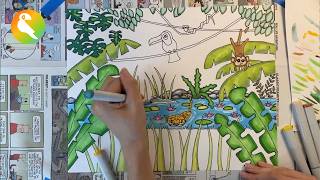
How to draw a Jungle Rainforest | Step by step art lesson | Henri Rousseau
Facts about rainforest ecosystems
🌳 Rainforests cover about 6% of Earth's land but are home to more than half of the world's plant and animal species.
🌿 The rainforest is layered—emergent trees, canopy, understory, and forest floor—each layer has different light, plants, and animals.
🐦 Many rainforest birds are brilliantly colored (think toucans and parrots) to attract mates, blend with fruit, or startle predators.
🐸 Some tiny, brightly colored frogs in rainforests are poisonous; poison dart frogs get their toxins from the insects they eat.
🎨 To show depth in a rainforest drawing, artists use layering (foreground, middle ground, background) plus texture for leaves, bark, and moss.
How do you draw a rainforest scene showing canopy, understory, and forest floor?
What materials do I need to draw a colorful rainforest scene with plants, birds, and frogs?
What ages is drawing a layered rainforest suitable for?
What are the benefits of drawing a rainforest scene for children?
