How to Draw a Pentagon
Draw a regular pentagon using a ruler, compass, or paper folding. Practice measuring angles and symmetry to learn geometric precision.
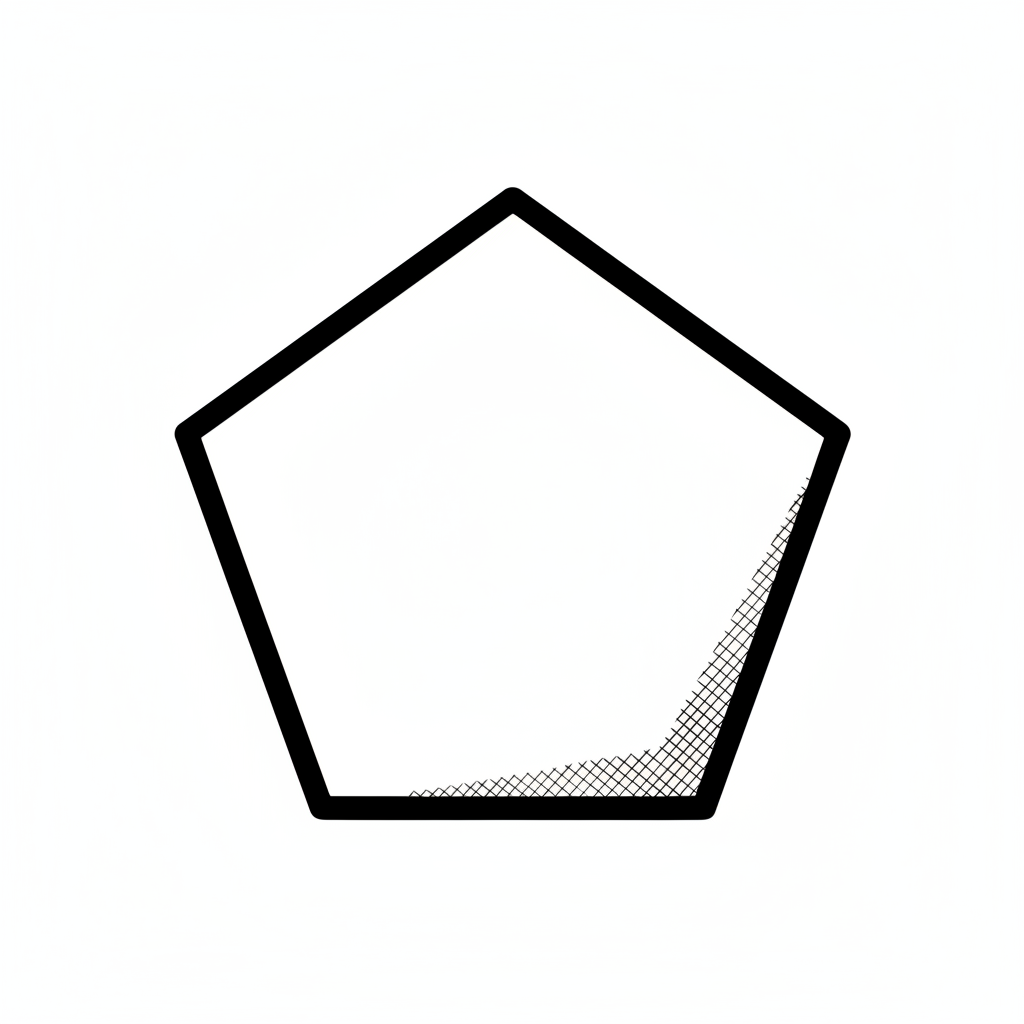
About this tutorial
Draw a regular pentagon using a ruler, compass, or paper folding. Practice measuring angles and symmetry to learn geometric precision.
What you need
Instructions
- 1
Step 1
Pick the compass + protractor method for a precise regular pentagon.
- 2
Step 2
Put your paper on a flat table and set your compass to a comfortable radius.
- 3
Step 3
Use the compass to draw a neat circle and lightly mark its center with a small dot (call it O).
- 4
Step 4
Put a dot on the circle to be your first vertex (call it P1).
- 5
Step 5
Place the protractor with its center on O and align zero with the line OP1 then mark where the 72° ray meets the circle; repeat marking at 72° increments to get four more points (72° 144° 216° 288°).
- 6
Step 6
Use the ruler to lightly connect each consecutive marked point around the circle to draw the five sides of the pentagon.
- 7
Step 7
Measure each side with the ruler to check they are all the same length.
- 8
Step 8
Trace over the pentagon edges with a darker pencil or marker to finish the shape.
- 9
Step 9
Erase the circle and extra construction marks so only the clean pentagon remains.
- 10
Step 10
Decorate or color your pentagon symmetrically to practice symmetry and neatness.
- 11
Step 11
Share a photo of your finished regular pentagon on DIY.org.
Get inspired
Fun facts
How do I draw a regular pentagon using a ruler, compass, or paper folding?
Start with a circle: draw one and mark its center. With a protractor, place the center at 0° and mark points every 72° around the circle, then connect consecutive marks with a ruler. With compass and straightedge, draw the circle, pick one point, then use the compass to step the same arc around the circumference five times and join points. For folding, fold a circle into fifths by trial folds or use a protractor guide to fold marks evenly, then connect them.
What materials do I need to draw a pentagon with a ruler, compass, or paper folding?
You’ll need plain paper or card, a sharp pencil, eraser, ruler and protractor for precise 72° markings. For compass-and-straightedge work, use a compass and straightedge instead of a protractor. For folding, a circular template or printed circle helps, plus clean hands and a flat surface. Optional: colored pencils or markers to decorate, and a bit of tape to hold folds steady.
What ages is drawing a regular pentagon suitable for?
Drawing a pentagon suits kids about 7–14 years old: younger children (5–7) enjoy guided folding or stencils with adult help, while older children can use protractors and compasses to learn precision. Tailor difficulty: preschoolers trace templates; elementary students practice measuring angles; middle-schoolers work on construction with compass and straightedge to build geometry skills and spatial reasoning.
What are the benefits and safety tips for teaching kids to draw a pentagon, plus variations to try?
Benefits include practicing angle measurement, symmetry, fine motor control and geometric reasoning. Safety tips: supervise use of pointed compasses and scissors, keep workspace tidy, and use blunt compasses for young kids. Variations: make a pentagram by connecting nonadjacent vertices, create tessellations of pentagons, or decorate each side with patterns to combine art and math.
Watch & Learn
Need help?
What can we use if we don't have a compass or protractor?
If you don't have a compass, use a round lid or coin to trace the circle, and if you lack a protractor use a printable protractor or a protractor app to mark the 72° increments.
My marked points don't line up and the sides look uneven — what should I check?
If your 72° marks look off because the protractor slips, press the protractor center on O, re-align zero with OP1 before each mark, and make light tick marks so you can correct them before connecting with the ruler.
How can I adapt this activity for different ages?
For younger kids, skip protractor steps by giving a pre-drawn circle and five evenly spaced stickers for vertices to connect with a ruler, while older kids can precisely set the compass radius, check equal side lengths in step 6, and experiment with tracing symmetry in step 9.
How can we extend or personalize the pentagon once it's drawn?
To enhance the project, turn the traced pentagon from step 8 into a star by connecting every second vertex, or make multiple pentagons, color them symmetrically per step 9, and create a garland to photograph for DIY.org.