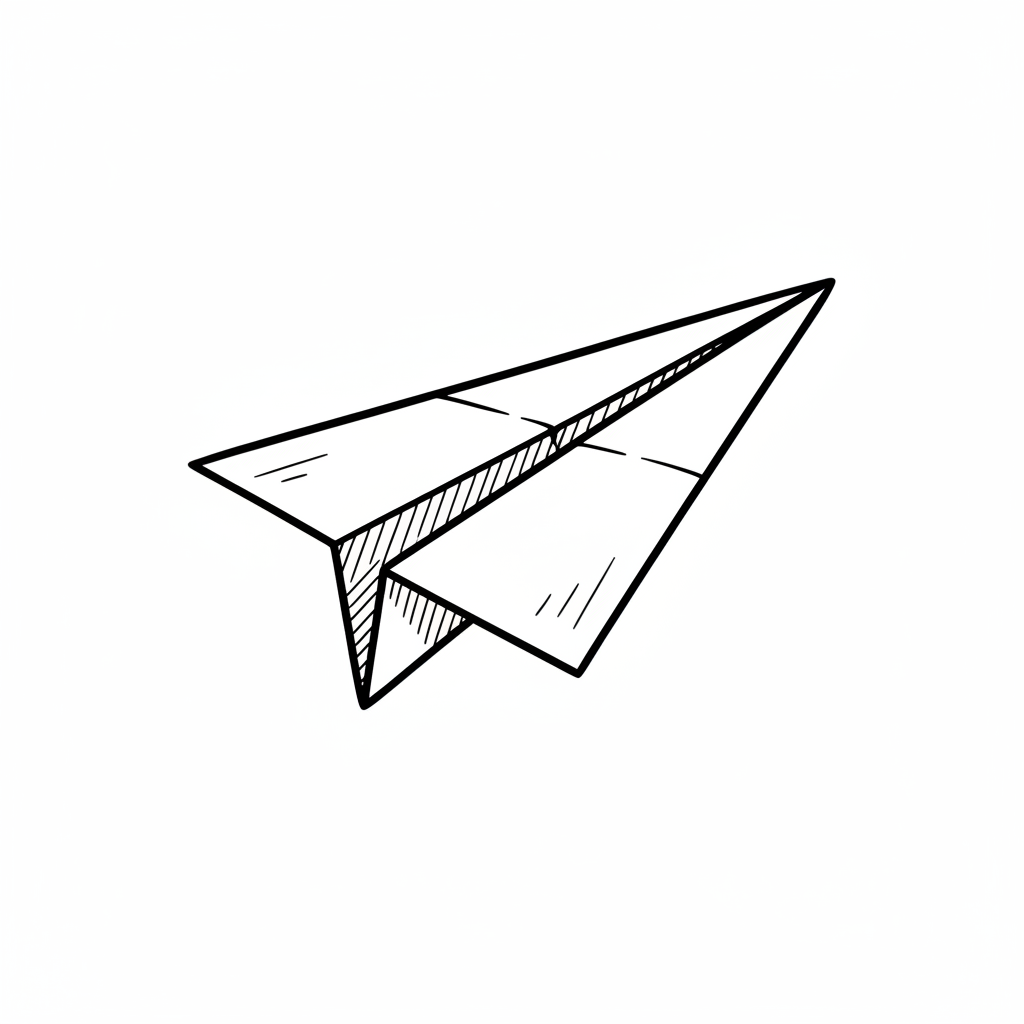
How to Draw a Paper Airplane
Fold a dart paper airplane from one sheet of paper using simple steps. Test and adjust folds to increase flight distance and straightness.
About this tutorial
Fold a dart paper airplane from one sheet of paper using simple steps. Test and adjust folds to increase flight distance and straightness.
What you need
Instructions
- 1
Step 1
Place the paper sheet on a flat table in portrait (tall) position.
- 2
Step 2
Fold the paper lengthwise by bringing the right edge to meet the left edge and make a sharp crease.
- 3
Step 3
Open the paper flat so you can see the center crease down the middle.
- 4
Step 4
Fold the top right corner down so its edge lines up with the center crease and crease firmly.
- 5
Step 5
Fold the top left corner down so its edge lines up with the center crease and crease firmly.
- 6
Step 6
Fold the small triangle at the top down so its tip meets the bottom edge of the folded flaps and crease to lock them.
- 7
Step 7
Fold the new top right edge into the center crease to make a narrower point and crease well.
- 8
Step 8
Fold the new top left edge into the center crease to match the right side and crease well.
- 9
Step 9
Fold the whole plane in half away from you along the original center crease so the pointed nose is showing.
- 10
Step 10
Fold down the top layer on the right to make the right wing by matching the top edge to the bottom edge and creasing.
- 11
Step 11
Fold down the top layer on the left to make the left wing by matching the top edge to the bottom edge and creasing.
- 12
Step 12
Bend up a tiny winglet on the trailing edge of the right wing by folding about 1 cm up.
- 13
Step 13
Bend up a tiny winglet on the trailing edge of the left wing by folding about 1 cm up.
- 14
Step 14
Hold the plane by the bottom of the nose and give it a gentle, level throw to test distance and straightness.
- 15
Step 15
If the plane dives tilt or turns, make tiny adjustments by gently bending the back edge of one wing up or down until it flies straighter and farther and then share your finished paper airplane on DIY.org.
Get inspired
Fun facts
How do you fold a dart paper airplane from one sheet?
To fold a dart paper airplane from one sheet, start with a rectangular sheet (A4 or letter). Fold it in half lengthwise and crease, then unfold. Fold the top two corners to meet the center crease to form a pointed nose. Fold those angled edges in toward the center again to narrow the nose. Fold the plane in half along the first crease, then fold each wing down so the edges align with the body. Sharpen creases before flying.
What materials do I need to fold a dart paper airplane?
You need one sheet of standard paper (A4 or letter), a flat workspace, and clean hands. Optional helpful items: a ruler or bone folder to make crisp creases, a pencil or small paperclip to add nose weight, and a bit of tape for repairs. Scissors are usually not required for a classic dart, but can trim if you want experiment variations.
What ages is folding a dart paper airplane suitable for?
This activity suits children roughly ages 5 and up with adult guidance. Ages 5–7 can practice basic folds with supervision to build fine motor skills. Kids 8+ can fold, test, and tweak flights more independently. For preschoolers, provide hand-over-hand help and supervise to avoid paper pokes. Always ensure a safe open area for flying to prevent collisions or falls.
How do you test and adjust folds to increase flight distance and straightness?
Test flights in a calm, open space. Check symmetry first — wings and creases must match. Sharpen creases to reduce drag, and try a tiny upward dihedral (wing tips slightly up) for stability. Add a small nose weight (paperclip) if it stalls, or bend trailing edges slightly to correct turns. Make one small change at a time and record results to find the best combination for distance and straight flight.
Watch & Learn
Need help?
What can I use if I don't have the exact paper sheet called for in the instructions?
Use standard printer paper, lightweight construction paper, or square origami paper instead of the 'paper sheet', but avoid thick cardstock because it won't fold sharply for the center crease and wing folds.
My plane keeps diving or turning—what should I check or fix?
If the plane dives, tilts, or turns during the test throw, first make sure all folds from the center crease (step 2) through the wing folds (steps 10–11) are very sharp using a fingernail or ruler, then make tiny adjustments by gently bending the back edge of one wing up or down as described in the final step.
How can I adapt this folding activity for different ages?
For younger children, pre-fold the center crease and the big corner folds (steps 2–5) and let them do the wing folds (steps 10–11), while older kids can do tighter nose folds (steps 6–8), experiment with the 1 cm winglets (steps 12–13), and decorate before flying.
How can we enhance or personalize the finished paper airplane?
To improve performance and personalize it, add a small piece of tape to the nose after step 9 for weight, draw designs on the wings before folding, vary the winglet size from about 1 cm in steps 12–13, and compare flights—or share your best plane on DIY.org.