How to Draw a Nose on a Face
Learn to draw a nose on a face step-by-step using basic shapes, light shading, and observation to create realistic noses with pencil and eraser.
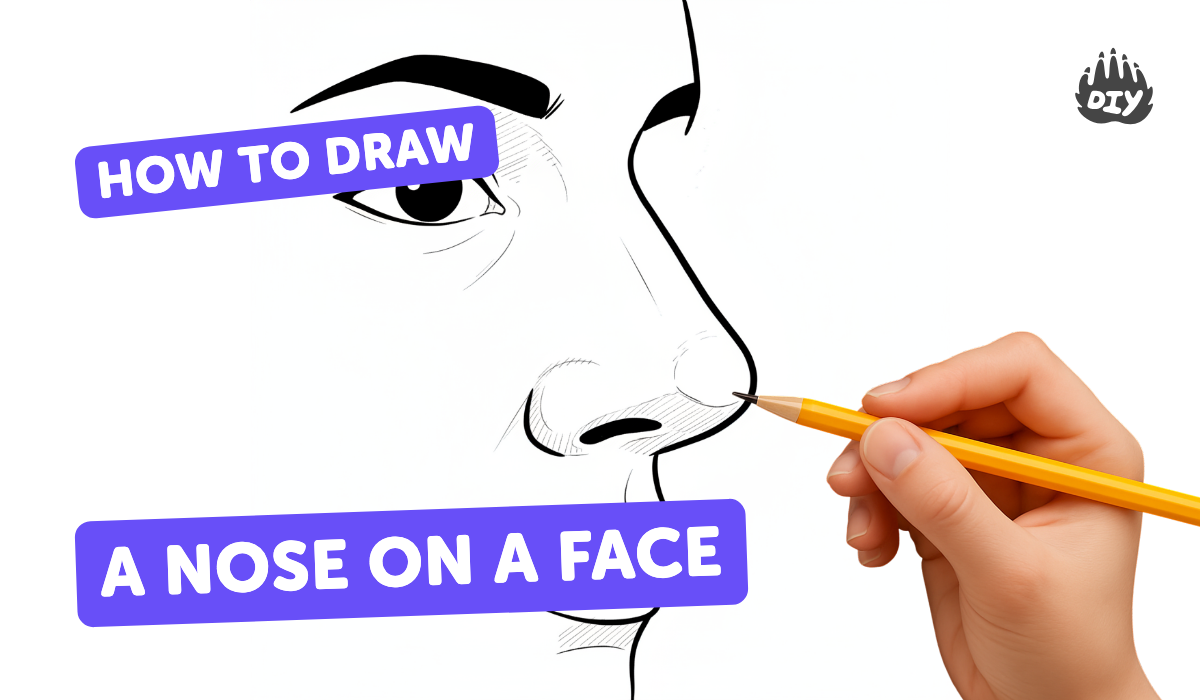
About this tutorial
Learn to draw a nose on a face step-by-step using basic shapes, light shading, and observation to create realistic noses with pencil and eraser.
What you need
Instructions
- 1
Step 1
Draw a light oval for the head to give yourself the face shape.
- 2
Step 2
Draw a light vertical line down the center of the oval to find the face middle.
- 3
Step 3
Draw a light horizontal line across the middle of the oval to mark the eye level.
- 4
Step 4
Mark a small horizontal guideline halfway between the eye line and the chin for the base of the nose.
- 5
Step 5
Draw a small circle on the base guideline to set the tip of the nose.
- 6
Step 6
Draw two gentle slanted lines from the circle upward toward the eye line to show the bridge.
- 7
Step 7
Draw two small curved ovals at the sides of the circle to indicate the nostrils.
- 8
Step 8
Lightly erase any construction lines that cross the final nose shapes.
- 9
Step 9
Refine the outer curves of the nose with soft smooth lines to make the shape look natural.
- 10
Step 10
Add light pencil shading along the sides of the nose and under the tip to create form.
- 11
Step 11
Blend the shaded areas softly with a blending stump or cotton bud for smooth gradation.
- 12
Step 12
Lift tiny highlights on the bridge and tip with the eraser to make the nose look three dimensional.
- 13
Step 13
Share your finished nose drawing on DIY.org
Fun facts
How do I teach a child to draw a nose step-by-step?
Start by having the child observe a nose from a photo or mirror. Lightly sketch orientation lines for the face and place basic shapes: an oval for the tip, two small circles or teardrops for nostrils, and a gentle curve for the bridge. Refine edges, erase construction lines, then add soft shading to suggest planes. Blend lightly and use a kneaded eraser to lift highlights. Compare to eyes and mouth to keep proportions accurate.
What materials do we need to learn drawing noses with pencil and eraser?
You’ll need a range of pencils (HB for guidelines, 2B–4B for shading), a kneaded eraser and a regular eraser, a pencil sharpener, and drawing paper. Optional: blending stump or tissue for smooth shading, a ruler or compass for proportions, reference photos or a mirror, and a soft brush to clear eraser crumbs. Keep materials simple and child-safe—avoid very soft charcoal for young children without supervision.
What ages is this nose-drawing activity suitable for?
This activity suits children ages 6–14 with adaptations: ages 6–8 focus on simple shapes and basic placement; ages 9–11 introduce light shading, proportion rules, and gentle blending; ages 12+ work on realism, subtle shadows, and different angles. Younger children (4–5) can try simplified nose stickers or tracing. Always offer supervision, encourage patience, and tailor difficulty to each child’s motor skills and attention span.
What are the benefits of practicing nose drawing and how can I vary the activity?
Practicing nose drawing builds observation skills, fine motor control, and understanding of facial proportions and light. It boosts confidence and patience as children see gradual improvement. Variations include drawing noses from profiles, three-quarter views, or exaggerated cartoon styles; using charcoal, colored pencils, or water-soluble graphite; timed gesture sketches; or doing mirror self-portraits to study their own noses. Emphasize gentle shading and eraser highlights for realism.
Watch & Learn
Need help?
What can I use instead of a blending stump or cotton bud to blend the shaded areas?
If you don't have a blending stump or cotton bud, use a clean fingertip, a soft tissue, or a folded piece of paper to softly blend the shaded sides and under-tip areas before lifting highlights with your eraser.
My nose looks lopsided or the nostrils don't match—what should I fix?
If the nose is off-center, redraw or darken the light vertical centerline and eye-level horizontal line, then reposition the tip circle and adjust the two slanted bridge lines and curved nostril ovals so they sit symmetrically before erasing construction lines.
How can I adapt this drawing for younger or older kids?
For younger children simplify to the oval, centerline, a single tip circle and two nostril ovals to focus on shape, while older kids can follow all steps including soft shading, blending with a stump, and lifting highlights with an eraser for realism.
How can we extend or personalize the nose-drawing activity after finishing the basic steps?
Extend the activity by drawing different nose types—change the size of the tip circle and nostril ovals, practice sharper or softer bridge lines, add colored-pencil skin tones with blended shading, and then share your favorite finished nose on DIY.org.