How to draw a mansion - a free mansion drawing guide
Draw a detailed mansion step by step using pencil and markers. Learn perspective basics, add windows, rooflines, landscaping, and shading for a realistic result.


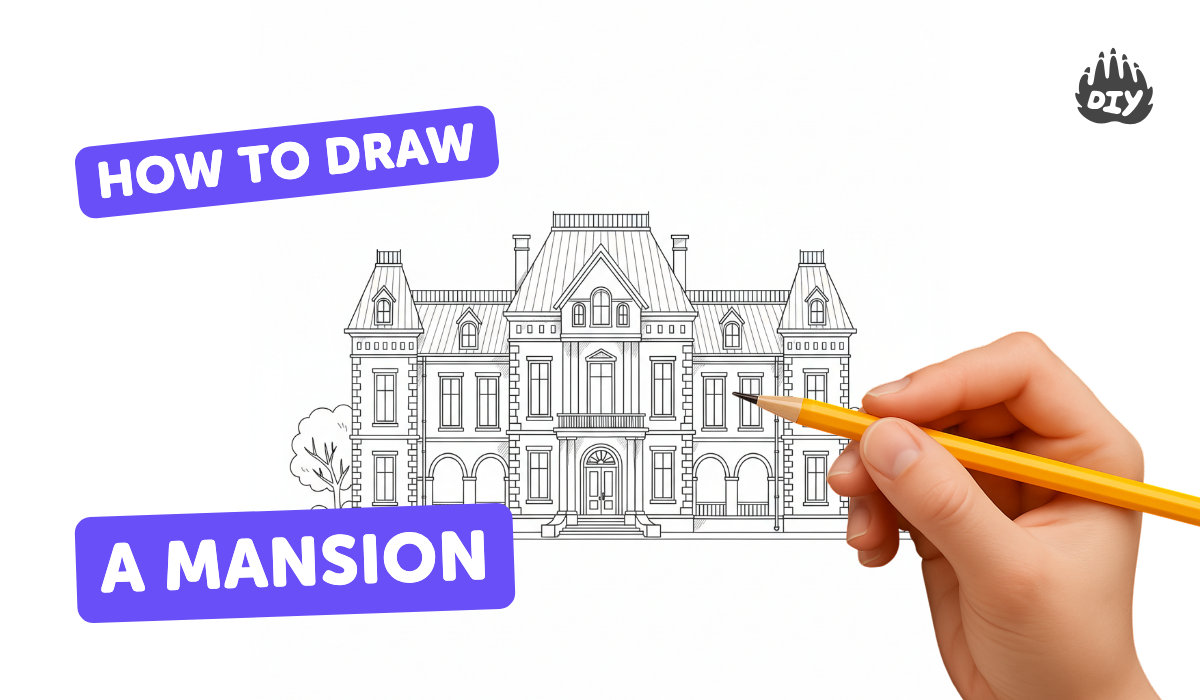
Step-by-step guide to draw a mansion
How to Draw a Mansion, Drawing Tutorial for Beginners, Useful Drawing Video
Step 1
Place your paper vertically on a flat surface so the mansion has plenty of height.
Step 2
Lightly draw a straight horizontal horizon line about one third from the top of the page.
Step 3
Mark a single vanishing point on the horizon slightly left or right of center.
Step 4
Sketch a light rectangle near the center of the page for the front face of the mansion.
Step 5
Draw straight guide lines from the rectangle's top and bottom corners toward the vanishing point to form the mansion's side walls.
Step 6
Add the main roof shape above the front face and extend its side edges toward the vanishing point so the roof follows perspective.
Step 7
Draw the main door on the front face using vertical and horizontal lines so it lines up with the front rectangle.
Step 8
Add windows on the front and side walls by sketching rectangles and making their tops and bottoms follow the perspective lines toward the vanishing point.
Step 9
Draw architectural details like columns steps a chimney and roof tiles using short simple shapes to make the mansion look fancy.
Step 10
Sketch landscaping such as a front path trees and bushes around the mansion to set the scene.
Step 11
Erase the extra perspective guide lines gently leaving only the mansion and landscaping outlines.
Step 12
Trace the final outlines and important edges with your fine black marker to make the drawing bold.
Step 13
Shade the mansion with your pencil to show a light source and darken areas under eaves and on the shaded side.
Step 14
Color the mansion and the landscape with your markers and colored pencils using lighter colors where the light hits and darker tones for shadows.
Step 15
Share your finished mansion drawing on DIY.org
Help!?
What can we use instead of a fine black marker and colored markers for the tracing and coloring steps?
If you don't have a fine black marker, trace the final outlines with a dark graphite pencil or black gel pen, and use crayons or watercolor pencils in place of markers and colored pencils when coloring the mansion and landscape.
My mansion looks skewed and the sides don't line up—how do I fix the perspective lines?
If the side walls look skewed, redraw the light rectangle and use a ruler to make straight guide lines toward the marked vanishing point, keeping your initial lines light so they erase cleanly when you erase the extra perspective guide lines gently.
How can I adapt the activity for different ages?
For younger children, pre-draw the light rectangle and vanishing point and have them draw simple front door and windows and color with markers, while older kids can add detailed roof tiles, columns, and pencil shading following the shading step to show a light source.
What are some ways to extend or personalize the mansion drawing once the basic steps are done?
To personalize and extend the activity, add textured roof tiles and patterned columns when drawing architectural details, create a watercolor wash sky before coloring the mansion and landscape, and then share the finished mansion drawing on DIY.org.
Watch videos on how to draw a mansion
Easy HOUSE Drawing for Kids! Step by Step Lessons
4 Videos
Easy HOUSE Drawing for Kids! Step by Step Lessons
HOW TO DRAW A HOUSE EASY | Drawing House form Shapes

How To Draw A House Step By Step | House Drawing For Kids | Super Easy Drawing Tutorials
How to Draw a Simple House - Step by Step Easy for Kids
Facts about drawing and perspective for kids
📐 Linear perspective uses vanishing points — a single vanishing point can make a mansion’s front look perfectly realistic.
🏛️ The word "mansion" comes from the Latin 'mansio' (a dwelling) — the Biltmore House in the U.S. has about 250 rooms!
🌳 Adding trees, people, or a fence next to your drawing gives instant scale so viewers can tell how big the mansion is.
✏️ Techniques like cross-hatching and chiaroscuro help turn flat pencil lines into believable shadows and depth.
🧭 Architects often draw at scales like 1:100 or 1:50 (1 cm = 1 m or 0.5 m) so proportions stay accurate when designing buildings.
How do I draw a detailed mansion step by step?
What materials do I need to draw a mansion with pencil and markers?
What ages is drawing a detailed mansion suitable for?
What are the benefits of drawing a detailed mansion for kids?
