How to draw a library - a free library drawing guide
Draw a cozy library scene with shelves, books, seating, windows, and a ladder; learn basic perspective, proportions, and coloring techniques step by step.


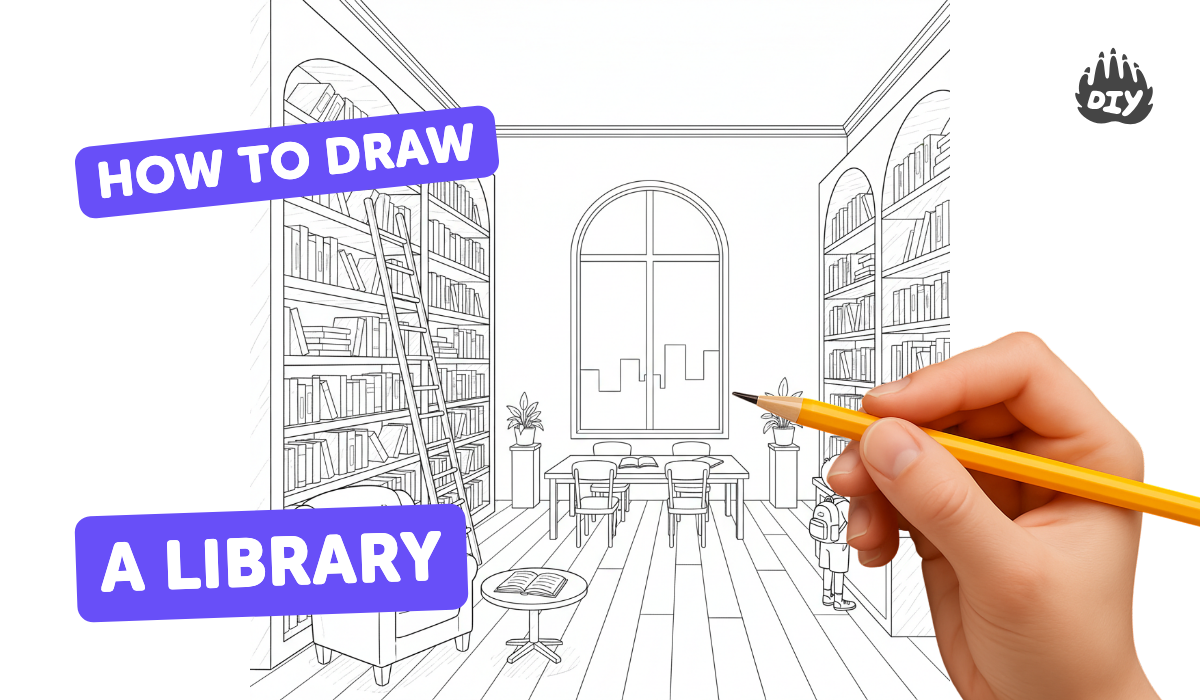
Step-by-step guide to draw a cozy library scene
How to Draw a Library (Easy Step-by-Step for Kids & Beginners)
Step 1
Place your paper horizontally on a flat surface so you have a wide view for your cozy library.
Step 2
Lightly draw a straight horizon line across the page and put a small dot on it for the vanishing point to set up one point perspective.
Step 3
Use your ruler to draw two light perspective guide lines from the vanishing point toward the bottom edges of the paper to show the floor direction.
Step 4
Draw a rectangle between the perspective guides to make the back wall where the main bookshelves will sit.
Step 5
Sketch tall bookshelves on the back wall by drawing vertical sides and horizontal shelf lines that follow the perspective guides.
Step 6
Fill the shelves with books by drawing different sized rectangles and angling their tops slightly toward the vanishing point to show depth.
Step 7
Draw a ladder leaning against the shelves by sketching two slanted rails and evenly spaced rungs between them.
Step 8
Add a comfy seating area like a rounded armchair and a small table in front of the shelves using simple shapes.
Step 9
Draw windows on a wall and add a few light rays or a bright patch on the floor to show sunlight entering the room.
Step 10
Add cozy details such as a rug a lamp a potted plant and small marks for book titles to bring your library to life.
Step 11
Carefully trace the lines you want to keep with a black pen and let the ink dry fully.
Step 12
Gently erase the light pencil guidelines to clean up your drawing and make it neat.
Step 13
Color your library by blocking in base colors then add darker tones for shadows and lighter strokes for highlights to give depth.
Step 14
Share your finished cozy library scene on DIY.org
Help!?
I don't have a ruler or a black pen — what can I use instead?
Use a straight edge like a hardcover book or a credit card to draw the perspective guide lines and swap the black pen for a fine‑tip marker or gel pen to trace the final lines.
My perspective lines don't meet the vanishing point correctly or the shelves look off — how do I fix that?
Lightly redraw the horizon and vanishing point, then use your ruler or straight edge to re‑align the two perspective guide lines toward the dot and erase the old pencil marks before inking so the shelves sit correctly on the back wall.
How can I change the activity for younger or older kids?
For younger kids, skip strict one‑point perspective and have them draw big simple shelf shapes and use stickers for books, while older kids can add extra shelves, detailed book title marks, stronger shadowing when coloring, or introduce a second vanishing point for more complexity.
What are easy ways to personalize or make the drawing more advanced?
Personalize by writing favorite titles on the small marks for book titles, paint a watercolor sunlight patch near the windows for soft highlights, add a patterned rug or potted plant details, or glue cut‑out paper book spines onto the shelves for mixed media texture.
Watch videos on how to draw a cozy library scene
How to draw a library - Step by step for kids
4 Videos

How to draw a library - Step by step for kids

How to Draw a Library in One-Point Perspective for Beginners: Narrated Drawing
How to Draw a Library in 2-Point Perspective Step by Step
How to draw library step by step (very easy) || Part 1 || Zia easy drawing
Facts about drawing and perspective for kids
📚 The word 'library' comes from the Latin 'librarium', which originally meant 'bookcase' — perfect for drawing shelves!
🖼️ One-point perspective, where lines meet at a single vanishing point, was popularized in the Renaissance and makes rooms look convincingly 3D.
🪜 Rolling library ladders became common in the 19th century to reach tall stacks — a charming detail to add to your scene.
🎨 Warm colors (reds, oranges, yellows) feel cozy and advance toward the viewer, while cool colors (blues, greens) recede — use this for atmosphere.
🌤️ Including a sunlit window instantly makes a scene feel cozier; artists use light direction to show time of day and mood.
How do I draw a cozy library scene step by step?
What materials do I need to draw a cozy library scene?
What ages is drawing a cozy library suitable for?
What are the benefits, safety tips, and variations for this library drawing activity?
