How to Draw a Door
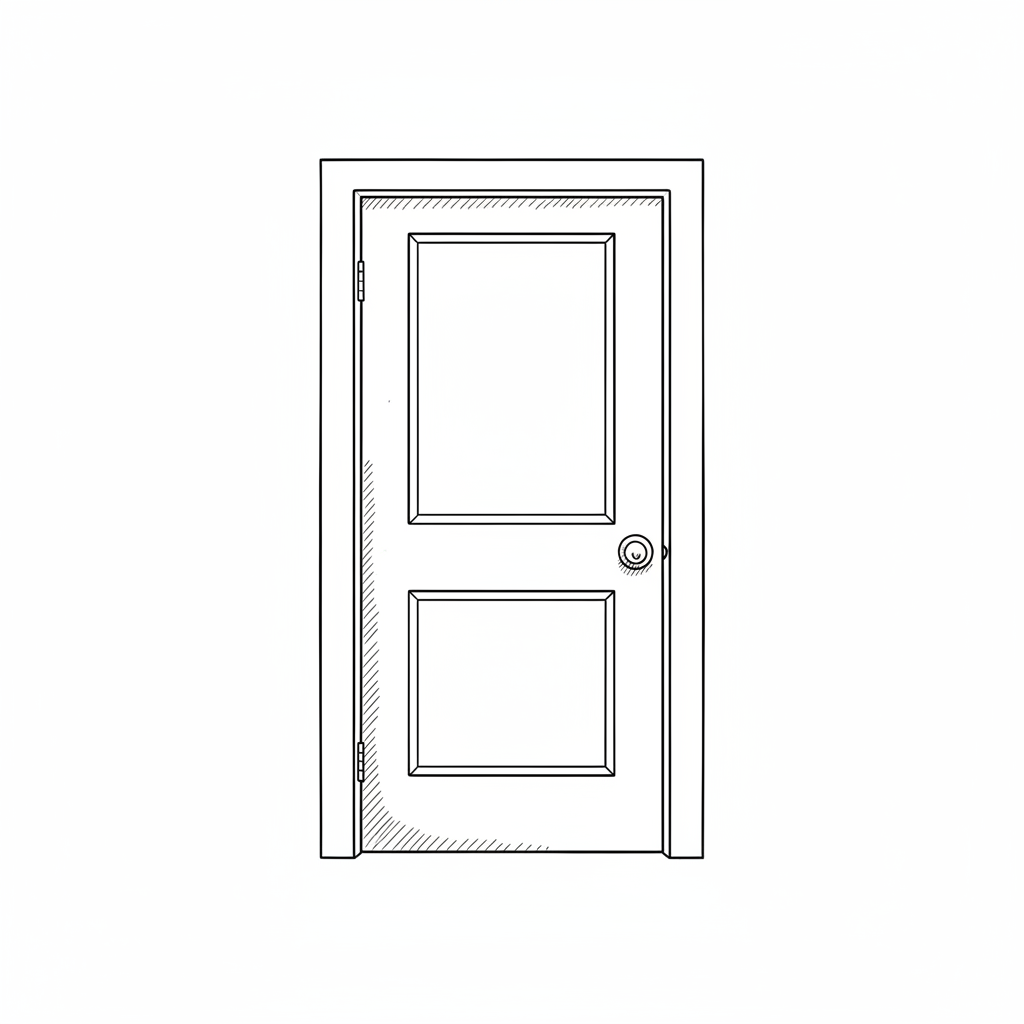
Draw a realistic door step by step using simple shapes, perspective, and shading. Practice measuring proportions and adding details like handles and panels.
About this tutorial
Draw a realistic door step by step using simple shapes, perspective, and shading. Practice measuring proportions and adding details like handles and panels.
What you need
Instructions
- 1
Step 1
Put a sheet of paper in a portrait (vertical) position on your table.
- 2
Step 2
Use your pencil and ruler to draw a light large rectangle in the middle of the paper for the outer door shape.
- 3
Step 3
Draw a slightly smaller rectangle inside the first one to make the door frame with even space all around.
- 4
Step 4
Decide whether your door will face you straight on or sit at a slight angle and remember your choice.
- 5
Step 5
If you chose an angled view mark a tiny vanishing point dot on the paper to the left or right; if straight-on skip this step.
- 6
Step 6
Show the door’s thickness: if straight-on draw a thin vertical edge line on one side; if angled draw two faint diagonal lines from the door edge toward the vanishing point and connect them with a short vertical line.
- 7
Step 7
Measure the door height with your ruler and lightly mark equal sections where you want panels to go.
- 8
Step 8
Draw the panel lines with your ruler to create rectangular or square panels on the door surface.
- 9
Step 9
Measure about one-third up from the bottom and sketch a handle shape (oval or lever) on one side of the door.
- 10
Step 10
Add a small keyhole and draw tiny rectangle hinge shapes along the door edge.
- 11
Step 11
Draw thin lines or small loops to suggest wood grain and trim around each panel for extra detail.
- 12
Step 12
Mark a small dot where the light will come from so you know which side gets lighter and which gets darker.
- 13
Step 13
Shade the opposite side of the light dot with soft pencil strokes and blend gently with your tissue to make the door look three-dimensional.
- 14
Step 14
Darken the final important lines erase stray sketch marks and then share your finished door drawing on DIY.org
Get inspired
Fun facts
How do you draw a realistic door step by step?
Start by drawing a rectangle for the door and lightly sketch a horizon line and vanishing point to set one-point perspective. Use a ruler to draw the door's edges toward the vanishing point. Block in simple shapes for panels and frames, checking proportions with your pencil as a measuring tool. Add a handle and hinges, then layer shading from light to dark to show depth. Blend gently and erase guide lines for a clean, realistic finish.
What materials do I need to draw a realistic door with my child?
You'll need drawing paper, a set of pencils (HB for sketching, 2B–6B for shading), a ruler, eraser, sharpener, and a blending stump or tissue for smooth tones. Optional: a kneaded eraser for highlights, colored pencils for paint effects, and graph paper to practice proportions. For young kids, swap sharp tools for softer pencils and supervise scissors or sharpeners.
What ages is drawing a realistic door suitable for?
This activity suits ages 6–14, with adjustments: ages 6–8 can practice simple rectangles, symmetry, and coloring while tracing basic panels. Ages 9–12 can learn one-point perspective, measuring proportions, and basic shading. Ages 13+ refine realistic shading, textures, and complex hardware. Always provide supervision for young children and tailor instructions to skill level to keep the task fun and achievable.
What are the benefits, safety tips, and variations for drawing doors?
Benefits include improved spatial reasoning, fine motor skills, and attention to detail; measuring proportions teaches math concepts. For safety, keep scissors and sharpeners supervised and choose softer pencils for small children. Variations: try two-point perspective doors, add weathered wood textures, design fantasy doors with stained glass, or use watercolors over the pencil sketch for mixed-media practice—each variation builds observation skills and creativity.
Watch & Learn
Need help?
What can we use if we don't have a ruler, pencil, or tissue for this door drawing?
Use the straight edge of a book or cereal box to draw your light large rectangle and panel lines instead of a ruler, a sharpened colored pencil or mechanical pencil in place of a regular pencil, and a folded napkin, cotton swab, or your fingertip to blend the shading where the instructions call for a tissue.
My door panels look uneven or the angled view looks wrong—what should I check or redo?
Double-check Step 2 by remeasuring with your ruler or straight edge and lightly mark equal sections for panels as in Step 10, and if using an angled view make sure your tiny vanishing point and the faint diagonal thickness lines from Step 5 align toward that dot before darkening lines.
How can I change the steps to make this activity easier for younger kids or more challenging for older kids?
For younger children simplify by doing a straight-on view with pre-drawn outer and inner rectangles and sticker handles, while older kids can add the angled vanishing point, detailed wood grain from Step 12, more precise shading and blending in Step 14, and multiple-panel designs.
What are simple ways to personalize or extend the finished door drawing?
Personalize it by adding painted colors or textures after Step 14, designing a unique handle and keyhole shape in Step 11, adding a nameplate or window above the panels, or drawing different lighting dots and re-shading to practice how light changes the door's three-dimensional look before sharing on DIY.org.