How to draw a desert - a free desert drawing guide
Draw a simple desert scene with rolling dunes, cacti, sun, and a desert animal using pencil and markers while learning texture and perspective.


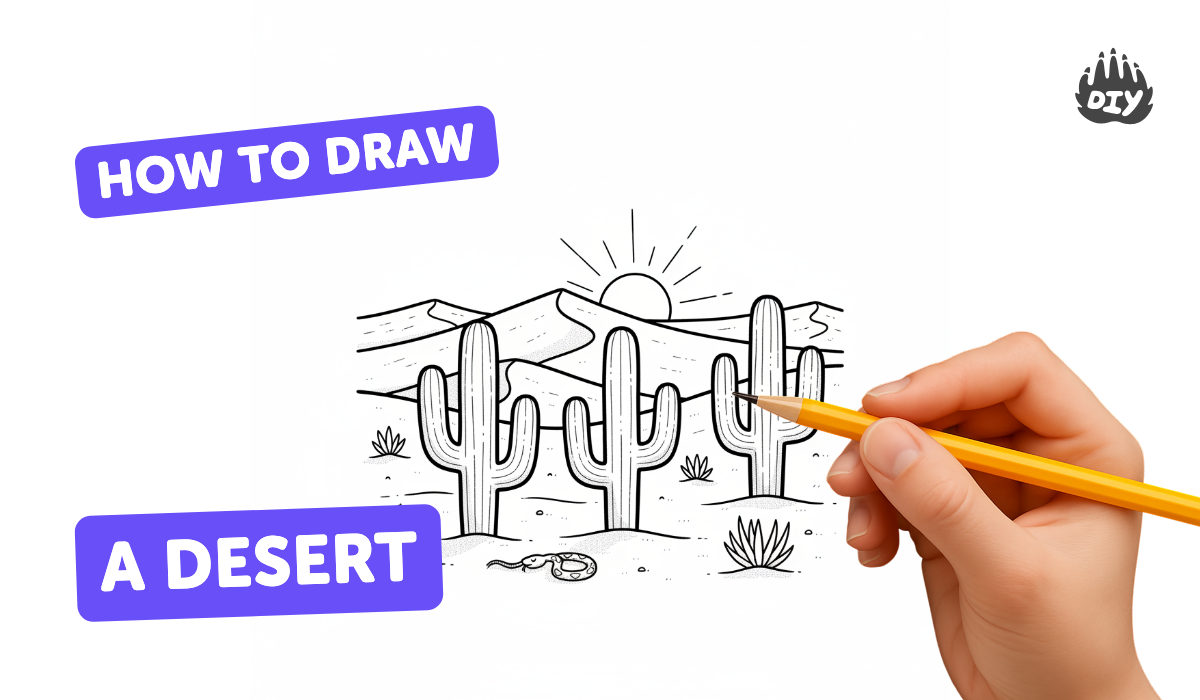
Step-by-step guide to draw a simple desert scene with pencil and markers
How to draw Landscape Art for Beginners | Children Scenery Art
Step 1
Lightly draw a straight horizon line about one-third from the top of your paper with your pencil.
Step 2
Sketch wavy dune lines across the paper below the horizon to create rolling sand shapes.
Step 3
Make distant dunes smaller and thinner and nearer dunes larger and fuller so the scene looks deep.
Step 4
Lightly draw a big simple cactus shape on a foreground dune using basic rounded arms.
Step 5
Add cactus details by drawing curved vertical ribs and tiny dash marks for spines.
Step 6
Sketch a simple desert animal like a lizard or fox using basic shapes on a nearby dune.
Step 7
Draw a sun near the horizon and add short rays to show sunlight.
Step 8
Shade one side of each dune with gentle parallel pencil lines to show where the light hits and where the shadows fall.
Step 9
Add small texture marks like tiny dots or short lines to the sand to make it look grainy.
Step 10
Trace the main pencil outlines with your black fine tip marker.
Step 11
Wait until the marker ink dries and then gently erase the remaining pencil lines.
Step 12
Color the sky and sun with markers choosing lighter colors far away and brighter colors near the front.
Step 13
Color the dunes using lighter shades for distant dunes and darker shades for foreground dunes to keep the perspective.
Step 14
Color the cactus and your animal and add a few darker marker strokes for texture and shadow.
Step 15
Share your finished desert drawing on DIY.org so everyone can see your sandy masterpiece.
Help!?
What can we use if we don't have a black fine tip marker or the marker set mentioned?
If you don't have a black fine tip marker, use a black gel pen, fine liner, or dark felt-tip pen to trace the main pencil outlines and substitute colored pencils or crayons for the markers when coloring the sky and dunes.
My ink smeared or the shading looks messy—how can I fix common mistakes while following the steps?
To avoid smearing when you trace the main pencil outlines and later erase, test pens on scrap paper, trace slowly and blot excess ink, wait until the marker ink dries before gently erasing, and keep pencil shading on the dunes light with gentle parallel lines to prevent smudging.
How can we adapt the activity for different ages and skill levels?
For toddlers use larger simple horizon and dune shapes with crayons and skip fine-tip tracing, for school-age follow all steps but simplify the animal, and for older kids add extra cactus ribs, more detailed texture dots on the sand, and refined shading with layered pencil lines before inking.
What are some ways to enhance or personalize our desert drawing once the basic steps are done?
Extend and personalize the scene by adding footprints or a campfire on a nearby dune, gluing a little craft sand over the tiny texture marks for real grain, creating a sunset color gradient in the sky, and adding darker marker strokes to foreground dunes for stronger perspective.
Watch videos on how to draw a simple desert scene with pencil and markers
How to Draw a Camel 🐪 Desert Landscape Scenery Art
4 Videos
How to Draw a Camel 🐪 Desert Landscape Scenery Art
Learn How to draw and Coloring A Lovely Scenery For Beginners Step by Step
How To Draw Easy and Simple Village Scenery With Pencil Step by Step | Scenery Drawing
How To Draw A Spring Kid Jumping Into A Puddle
Facts about landscape drawing for kids
🏜️ Deserts cover about one-third of Earth's land surface — that's a lot of sandy scenes to imagine!
🌵 The saguaro cactus can live 150–200 years and grow arms decades after sprouting, perfect for dramatic silhouettes.
🐪 Camels can drink up to around 40 gallons (150 liters) in one go — a wild desert survival fact to spark character ideas.
✏️ Pencil techniques like hatching, cross-hatching, and stippling are super helpful for showing sand texture and rough cactus skin.
📐 Linear perspective uses vanishing points so rolling dunes look like they recede into the distance, making scenes feel deep and real.
How do I draw a simple desert scene with rolling dunes, cacti, sun, and a desert animal?
What materials do I need to draw this desert scene with pencil and markers?
What ages is this desert drawing activity suitable for?
What are the benefits of drawing a desert scene with texture and perspective?
