How to Draw a Cliff
Learn step by step to draw a rocky cliff with shading, texture, and simple perspective; practice sketching layers, rocks, and a dramatic edge.
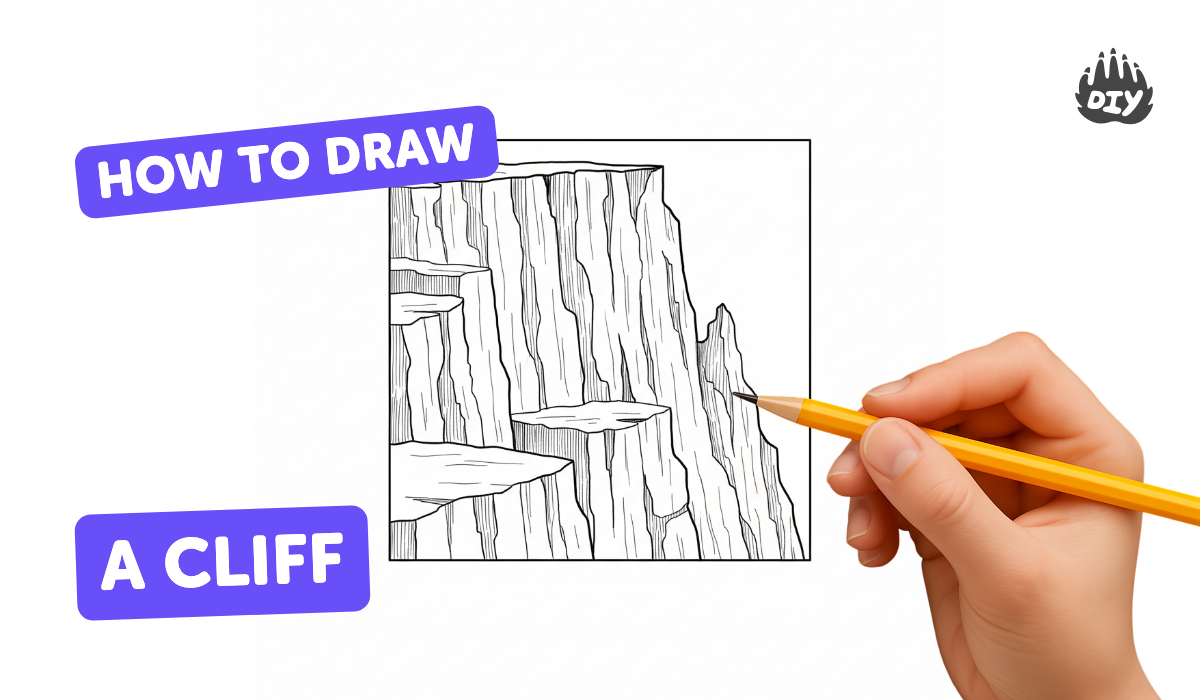
About this tutorial
Learn step by step to draw a rocky cliff with shading, texture, and simple perspective; practice sketching layers, rocks, and a dramatic edge.
What you need
Instructions
- 1
Step 1
Place your paper in portrait orientation on a flat surface.
- 2
Step 2
Lightly draw a horizontal horizon line about one-third from the top of the paper.
- 3
Step 3
Mark a small vanishing point on the horizon where the cliff edge will seem to disappear.
- 4
Step 4
Sketch a jagged cliff silhouette from near the vanishing point down to the bottom edge of the paper.
- 5
Step 5
Draw several horizontal slightly curved lines across the silhouette to show rock layers.
- 6
Step 6
Add big irregular shapes inside the cliff for boulders and ledges.
- 7
Step 7
Draw short angled lines and small cracks across the layers to create rock texture.
- 8
Step 8
Choose which side the light is coming from and lightly mark the direction with an arrow beside the drawing.
- 9
Step 9
Shade the side away from the light using a 2B pencil with strokes that follow the rock forms.
- 10
Step 10
Add darker shadows into crevices and under ledges with a 4B pencil.
- 11
Step 11
Gently blend the shaded areas with a blending stump or tissue to soften tones.
- 12
Step 12
Erase thin lines along outer edges to lift small highlights on the rock faces.
- 13
Step 13
Use the pencil to add tiny scratches dots and rough marks for final rock texture.
- 14
Step 14
Share your finished cliff drawing on DIY.org.
Fun facts
How do I teach a child to draw a rocky cliff step by step?
Start by showing simple perspective: draw a horizon and a vanishing point. Block the cliff’s basic silhouette with jagged lines, then divide it into stacked rock layers. Add big ledges and cracks, sketching rock shapes within each layer. Use cross-contour lines to suggest form, then shade darker in crevices and beneath ledges. Finish with texture—small lines, dots, and an eraser for highlights—and encourage slow, repeated practice of each step.
What materials do I need to draw a cliff with my child?
You’ll need drawing paper or a sketchbook, a range of pencils (HB, 2B, 4B), a good eraser and sharpener, and a blending stump or tissue for smooth shading. Add a ruler for basic perspective lines and several reference photos of cliffs. Optional extras: charcoal or colored pencils, masking tape to hold paper, and scrap paper for practice. Household substitutes like cotton swabs for blending work well for younger children.
What ages is this cliff drawing activity suitable for?
This activity suits children about 6 years and up, with adjustments. Ages 4–6 can practice simple cliff silhouettes and bold textures. Ages 7–10 can work on layered shapes, basic shading, and crack details. Ages 11+ can explore perspective, complex textures, and dramatic lighting. Always adapt expectations to a child’s fine-motor skills and attention span; short, guided steps help younger kids succeed and stay engaged.
How can I adapt the cliff drawing activity for different skill levels or add variations?
For beginners, simplify to cliff silhouettes and one-tone shading. Intermediate kids add layered rocks, cracks, and basic perspective. Advanced variations include charcoal or ink for dramatic contrast, adding an ocean or sky, or making a mixed-media collage with torn paper layers. Try timed sketches, a guided step-by-step worksheet, or a collaborative mural. Each variation builds observation, spatial awareness, and texture skills while keeping the activity fresh and fun.
Watch & Learn
Need help?
What can I use if I don't have a blending stump or a 4B pencil listed in the instructions?
If you don't have a blending stump, gently rub shaded areas with a clean tissue or fingertip, and if you lack a 4B pencil, deepen shadows by layering and pressing a 2B pencil more firmly or using a soft charcoal pencil to mimic the darker tones.
My cliff looks flat after I blend—what step can fix the lost texture?
Restore texture by erasing thin lines along outer edges to lift highlights, redraw short angled lines and small cracks with your 2B, and add darker crevice shadows with a 4B as described in the shading steps.
How can I adapt this cliff drawing for younger children or make it harder for older kids?
For younger children simplify by drawing a bold jagged silhouette and using crayons or a 2B for basic curved layer lines and blending with a tissue, while older kids can refine the vanishing point, add more rock layers, use both 2B and 4B for nuanced shading, and finish tiny scratches and dots for realism.
How can we extend or personalize the activity after finishing the basic cliff drawing?
Extend the drawing by adding a tiny figure or tree on the cliff edge, sketching a sea or sky along the horizon line and adding color with colored pencils or watercolor, or inkening final edges before sharing the finished cliff on DIY.org.