How to Draw a Chain
Learn to draw a realistic chain by sketching linked loops, shading for depth, and practicing proportions and spacing step by step.
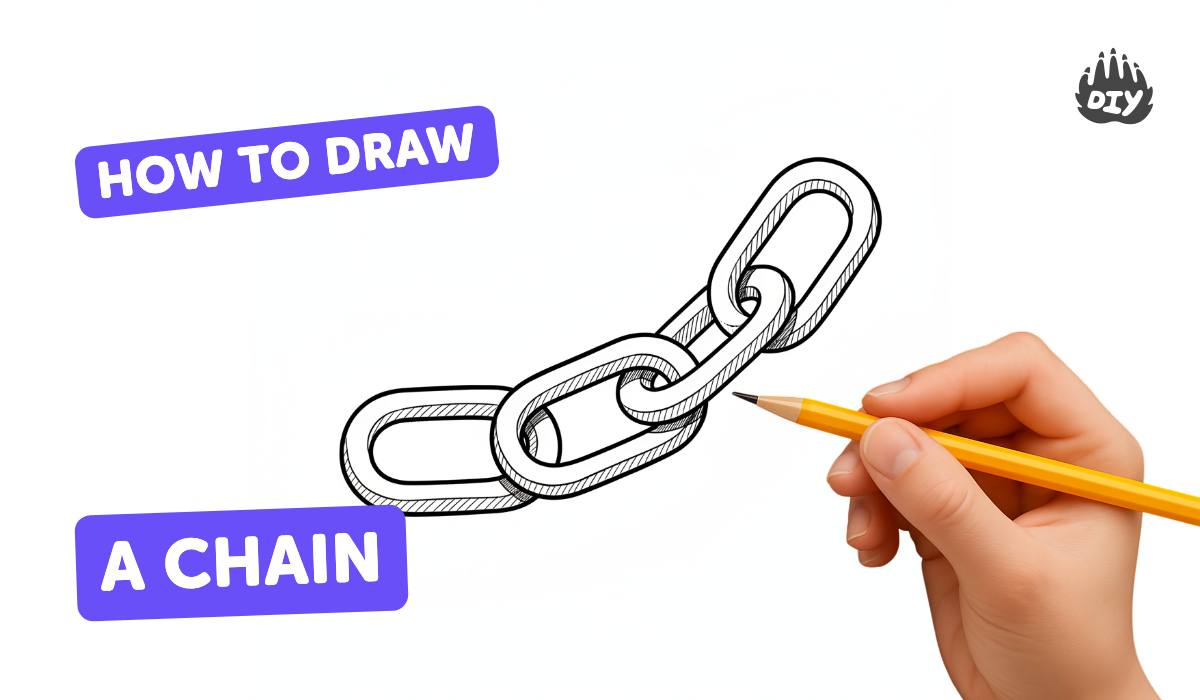
About this tutorial
Learn to draw a realistic chain by sketching linked loops, shading for depth, and practicing proportions and spacing step by step.
What you need
Instructions
- 1
Step 1
Gather all your materials and place them on a clean flat workspace so you are ready to draw.
- 2
Step 2
Lightly draw a straight or gently curved guideline across the paper to show the path of your chain.
- 3
Step 3
Mark evenly spaced points along the guideline to show where the centers of each link will go.
- 4
Step 4
Draw a light oval around the first point to create the first chain link.
- 5
Step 5
Draw a second oval around the next point so it overlaps the first and looks linked.
- 6
Step 6
Continue drawing ovals along the guideline so each new link passes through the previous one.
- 7
Step 7
Erase the parts of each loop that should sit behind the link in front so the links look interlocked.
- 8
Step 8
Draw a smaller inner oval inside each link to give each link visible thickness.
- 9
Step 9
Draw a small arrow at the top edge of the paper to show the direction the light is coming from.
- 10
Step 10
Shade the side of each link that faces away from the arrow to create the illusion of depth.
- 11
Step 11
Use a blending stump or tissue to smooth and soften the shaded areas for a realistic metal look.
- 12
Step 12
Use the eraser to lift thin highlights where the light would hit each link for shiny reflections.
- 13
Step 13
Write your name or draw a small signature in the corner of the paper.
- 14
Step 14
Share your finished chain drawing on DIY.org.
Fun facts
How do I teach my child to draw a realistic chain step by step?
Start by showing a single loop and explaining how links overlap. Draw a light center line to set the chain’s curve. Sketch evenly spaced ovals on the line, tilt alternating ovals for realism. Erase overlapping interior lines to show one link sitting through another. Add an inner rim to each oval for thickness. Decide a light source, then shade the opposite side of each link and add soft cast shadows. Practice spacing and proportions slowly.
What materials do we need to draw a realistic chain with kids?
You’ll need a pencil (HB or 2B), a good eraser, a sharpener, and several sheets of drawing paper. Optional helpful tools: a fine mechanical pencil for details, a blending stump or tissue for smooth shading, a ruler or flexible curve for guides, and colored pencils or markers if you want to finish in color. Keep scrap paper for testing pressure. These basics let kids focus on shape and shading.
What ages is learning to draw a realistic chain suitable for?
Suitable for children roughly ages 4 and up, with adaptations. Preschoolers (4–6) can practice large linked loops with crayons to build hand control. Ages 6–9 can sketch ovals, practice spacing, and erase overlaps. Ages 9–12 start shading and studying proportions; teens refine realism and advanced shading. Always supervise very young kids with pencils and scissors, and match instructions to each child’s fine-motor level.
What are the benefits of drawing chains for children?
Drawing chains strengthens fine motor skills, hand–eye coordination, and spatial reasoning as children learn proportions and link placement. Practicing overlapping shapes and shading teaches observation of light, depth, and value. It also boosts concentration, patience, and problem-solving—figuring out spacing and perspective. You can connect it to math (repeating patterns and measurement) and art (texture and realism), making it a useful cross-curricular exercise for different ages.
Watch & Learn
Need help?
What can we use instead of a blending stump, special eraser, or artist paper if we don't have them?
If you don't have a blending stump use a clean tissue, cotton swab, or fingertip to smooth the shaded areas, and replace a kneaded eraser with a regular pencil eraser and standard printer paper for the drawing surface.
My links don't look linked — how can I fix that while drawing?
Draw the ovals lightly and mark the centers first, then carefully erase the parts of each loop that should sit behind the next link (as instructed) using a small eraser so the overlaps read as interlocked.
How can I adapt the activity for different age groups?
For toddlers have an adult pre-draw the guideline and evenly spaced points and let them color big ovals, for elementary kids have them draw and erase overlapping ovals and add inner ovals, and for older kids have them add the arrow, detailed shading away from the arrow, blending with a stump, and lifted highlights with the eraser.
How can we enhance or personalize the finished chain drawing?
Use metallic colored pencils or light watercolor over your shaded links, vary link shapes and sizes along the guideline, add a cast shadow beneath the chain, lift thin highlights with the eraser where the arrow indicates light, and sign and share on DIY.org as the instructions suggest.