How to Draw a Beach Ball
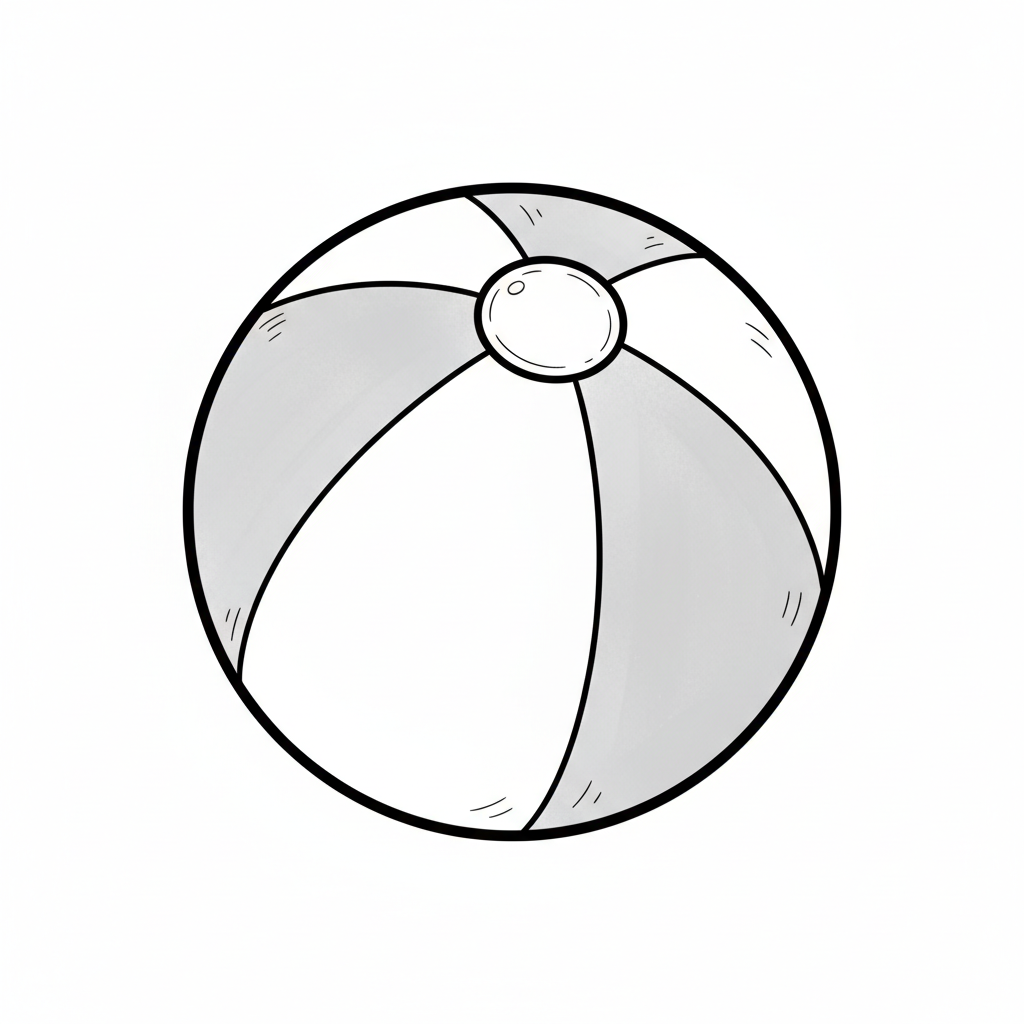
Learn to draw a beach ball using simple shapes, lines, and colors. Practice proportion, perspective, and shading to create a realistic, colorful illustration.
About this tutorial
Learn to draw a beach ball using simple shapes, lines, and colors. Practice proportion, perspective, and shading to create a realistic, colorful illustration.
What you need
Instructions
- 1
Step 1
Place your paper on a flat table and get your pencil ready.
- 2
Step 2
Put the round object on the paper and trace a circle to make the ball outline.
- 3
Step 3
Lightly mark a small top point inside the circle where the ball’s shiny pole will be.
- 4
Step 4
Lightly mark a bottom point directly opposite the top point inside the circle.
- 5
Step 5
Draw a gentle curved line from the top point to the bottom point through the middle to make the center seam.
- 6
Step 6
Draw one curved seam line to the right connecting the top and bottom points to form a panel edge.
- 7
Step 7
Draw one curved seam line to the left connecting the top and bottom points to form another panel edge.
- 8
Step 8
Trace the outer circle and the panel lines with a firmer pencil or black marker to make the final outlines.
- 9
Step 9
Erase any light sketch lines left inside the ball so the drawing looks clean.
- 10
Step 10
Choose three bright colours for the panels and get your colouring materials ready.
- 11
Step 11
Colour each panel with the chosen colours in an alternating pattern, leaving a small crescent near the top white as the highlight.
- 12
Step 12
Lightly shade the side of the ball opposite the white highlight to make the ball look round.
- 13
Step 13
Draw a soft oval shadow under the ball and shade it darker close to the ball to ground it.
- 14
Step 14
Share your finished beach ball drawing on DIY.org
Get inspired
Fun facts
How do I teach my child to draw a realistic beach ball step by step?
Start by lightly sketching a circle using a compass or a round object. Draw a small off-center circle for the valve, then divide the ball into curved panels with evenly spaced, slightly converging lines. Erase extra guides and refine outlines. Shade along panel edges and under the ball to show curvature, add a bright highlight for reflection, and color alternating panels. Finish with a soft ground shadow for perspective.
What materials do we need to draw a beach ball with shading and color?
You'll need a pencil, eraser, paper, and a round template (cup or compass). For color and shading use colored pencils, markers, or watercolor paints and a blending stump or cotton bud for smooth gradients. A fine-liner for outlines is optional. Protect the workspace with scrap paper and keep wipes or paper towels handy. For kids, choose washable markers or paints and heavier paper to prevent tearing.
What ages is drawing a beach ball suitable for?
Suitable for ages 4–12 with adjustments: preschoolers (4–6) can trace a circle and color panels with help; early elementary (7–9) can draw panels and practice simple shading; older kids (10–12+) can work on proportion, perspective, and realistic shading. Supervise scissors or paints for younger children and offer simpler steps or templates as needed. Adapt complexity to each child's fine-motor skills and attention span.
What are the benefits of drawing a beach ball for kids and simple variations to try?
Drawing a beach ball builds fine motor skills, spatial reasoning, and observation of light, color, and proportion. It teaches perspective and shading while boosting focus and creative confidence. Try variations like a simplified cartoon ball for beginners, a watercolor wash for soft blends, or placing the ball in a beach scene to practice background and scale. Use non-toxic, washable supplies and supervise small parts for safety.
Watch & Learn
Need help?
What can I use if I don't have a round object or a black marker for the outline?
Instead of a round object you can trace a cup, jar lid, or a large coin for the circle, and if you don't have a black marker you can darken the final outlines with a firmer pencil or a fine-tip pen.
My seam lines or the top/bottom points look uneven—how can I fix that?
If the seam lines or top and bottom points are off, hold the round object steady while tracing, re-lightly mark the top and bottom directly opposite each other inside the circle, then redraw the gentle curved seam lines before firming them with marker.
How can I adapt this beach ball drawing for different age groups?
For preschoolers pre-trace the circle and let them use crayons to color broad panels, for school-age kids follow all steps including the highlight and shadow, and for older kids add extra seam lines, detailed shading, or colored-pencil blending opposite the white highlight to increase realism.
What are some ways to extend or personalize the finished beach ball drawing?
You can personalize the panels with stripes, polka dots, or a name, experiment with different three-color combinations and highlight positions, or add a soft oval shadow and a simple beach background before sharing on DIY.org.