How to draw a basketball court - a free basketball court drawing guide
Draw a scaled basketball court on paper using a ruler and a compass; mark boundaries, center circle, three-point lines, free-throw lanes, and labels.


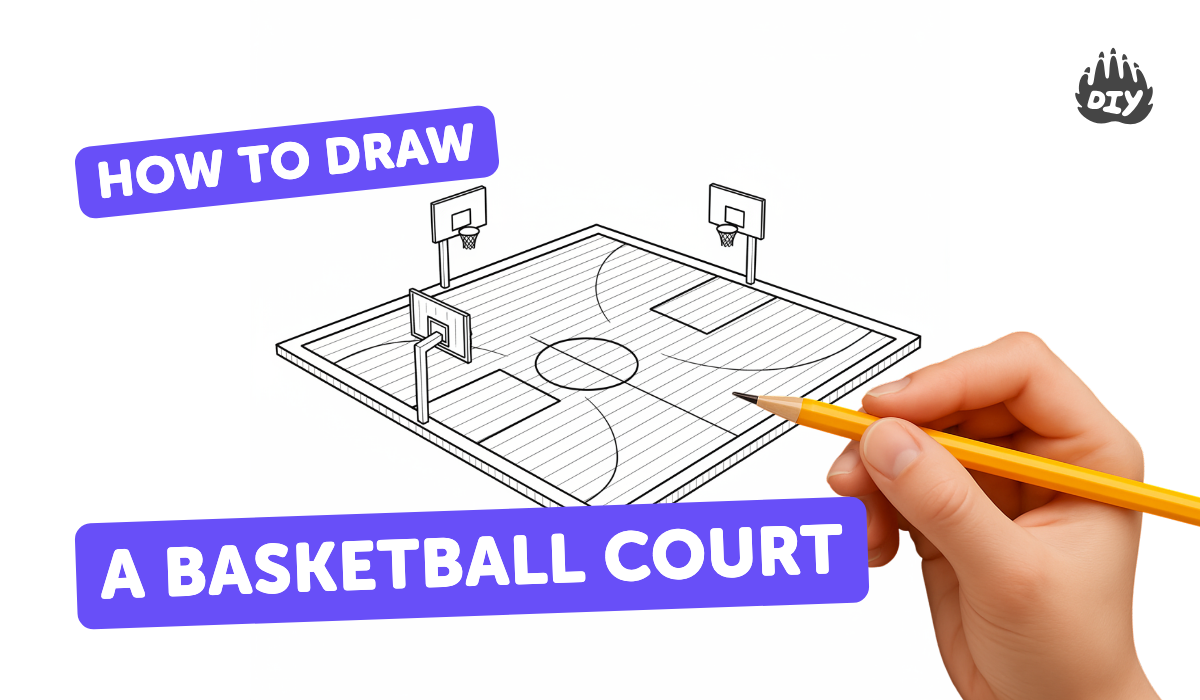
Step-by-step guide to draw a scaled basketball court on paper
How to Draw a Basketball Court
Step 1
Choose a scale for your drawing such as 1 meter = 1 centimeter and write the scale at the top of your paper.
Step 2
Calculate the scaled court size by multiplying the real court size 28 m by the scale for the length and 15 m by the scale for the width and write those two numbers on the paper.
Step 3
Use your ruler to draw a rectangle on the paper with the scaled length and width to make the court boundary.
Step 4
Measure and mark the midpoint of the long sides and draw a straight center line across the court connecting those two midpoints.
Step 5
Calculate the scaled center circle radius by multiplying 1.8 m by your scale and write that number beside your drawing.
Step 6
Set your compass to the scaled center circle radius then draw the center circle using the center point where the center line and the court midline cross.
Step 7
Calculate the scaled free-throw lane width (4.9 m) and the scaled distance from each baseline to the free-throw line (5.8 m) by multiplying by your scale and write those numbers.
Step 8
From each baseline measure in the scaled distance to the free-throw line and use your ruler to draw the free-throw lane rectangles centered on the court width.
Step 9
Use your compass to draw the free-throw semicircles at the top of each lane with the same radius as the center circle if required by your chosen rules or with the scaled radius you prefer.
Step 10
Calculate the scaled three-point distance (6.75 m) by multiplying by your scale and write that number beside your drawing.
Step 11
Mark the basket point centered on the width and at the correct scaled distance from each baseline then set your compass to the scaled three-point distance and draw the three-point arcs around each basket; add the straight corner lines if your scale reaches the sideline.
Step 12
Label the court parts (Baselines; Sidelines; Center Circle; Three‑Point Line; Free‑Throw Lanes; Center Line) and color any areas you like to finish your court.
Step 13
Share your finished basketball court drawing on DIY.org
Help!?
What can I use instead of a compass or special tools to draw the center circle and three-point arcs?
If you don't have a compass, use a length of string tied to a pencil and anchored at your center point or trace around round objects (like a lid) to draw the center circle and three-point arcs.
My free-throw lanes or center line don't look centered — what should I check and how can I fix them?
If your free-throw lanes or center line look off-center, re-measure the paper width with your ruler, mark and re-check the midpoints on the long sides before drawing the center line and rectangles, and use light pencil strokes so you can erase mistakes.
How can I adapt the activity for a younger child who struggles with multiplying the real court dimensions by the scale?
For younger children, simplify the math by choosing an easy scale like 1 m = 1 cm and give them graph paper and a pre-measured rectangle so they can focus on drawing the center circle, lanes, and coloring rather than multiply lengths.
How can we extend or personalize the basketball court drawing once the basic court (lines, circles, and labels) is finished?
To enhance the project, personalize the court by drawing a team logo in the center circle, adding scaled player cutouts using your chosen scale, and laminating the finished drawing to turn it into a reusable game board.
Watch videos on how to draw a scaled basketball court on paper
How to Draw a Basketball Court Step-by-step
4 Videos
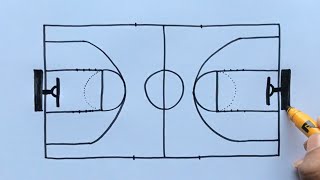
How to Draw a Basketball Court Step-by-step
How To Draw A Basketball For Young Artists!
How to Draw a Basketball | Super Easy Drawing Step-by-Step Tutorial!
Basketball Drawing, Coloring, and Painting Easy Tutorial for Kids and Toddlers
Facts about scale drawing and geometry
🏀 A standard NBA basketball court is 94 feet long and 50 feet wide (about 28.65 × 15.24 meters).
📏 If you use a 1:50 scale, a 94-foot court becomes roughly 22.5 inches (57 cm) on paper — a handy size for a classroom sheet.
🎯 The NBA three-point line is 23 feet 9 inches at the top (23.75 ft) and 22 feet in the corners; FIBA’s line is 6.75 m (~22.15 ft).
⭕ The center circle is 12 feet in diameter, and the free-throw line is 15 feet from the backboard — perfect measurements to mark with a ruler.
🧭 A drawing compass lets you draw exact circles and arcs; set its span to the scaled radius to make precise center and free-throw circles.
How do I draw a scaled basketball court on paper?
What materials do I need to draw a scaled basketball court?
What ages is drawing a scaled basketball court suitable for?
What are the benefits, safety tips, and variations for this activity?
