How to Draw a 3d House
Draw a simple 3D house step-by-step using basic shapes, perspective lines, windows, roof, and shading to create a realistic drawing.
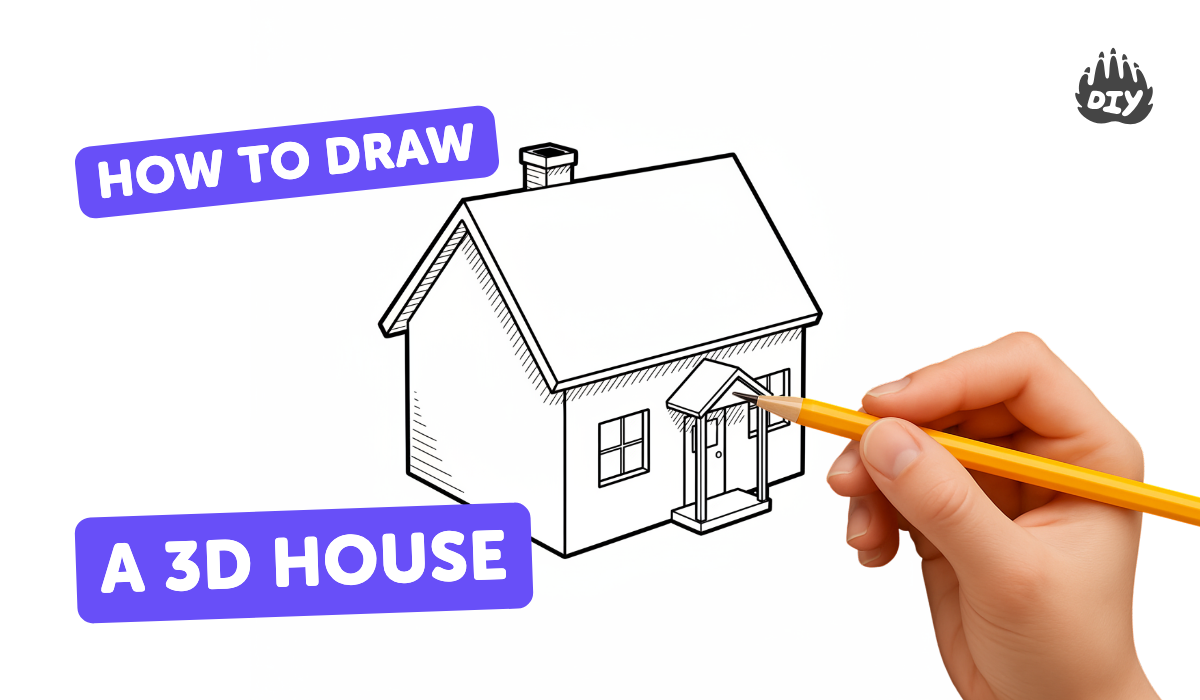
About this tutorial
Draw a simple 3D house step-by-step using basic shapes, perspective lines, windows, roof, and shading to create a realistic drawing.
What you need
Instructions
- 1
Step 1
Place your paper on the table in either portrait or landscape so you have lots of room to draw.
- 2
Step 2
Draw a light horizontal line across the page about one third from the top to be the horizon line.
- 3
Step 3
Put a small dot on the horizon line near the center to be your vanishing point.
- 4
Step 4
Draw a medium-sized rectangle or square below the horizon to be the front wall of your house.
- 5
Step 5
From each corner of the front wall, draw light straight lines heading toward the vanishing point to show the house’s depth.
- 6
Step 6
Draw a vertical line where the back corner should be to close the side wall and make the house 3D.
- 7
Step 7
Draw a triangle on top of the front wall to make the front roof peak.
- 8
Step 8
From the roof peak, draw two slanted light lines toward the vanishing point to make the slanted side of the roof.
- 9
Step 9
Draw a short line between the slanted roof lines at the back to finish the roof side.
- 10
Step 10
Draw a door on the front wall by sketching a tall rectangle in the middle or to one side.
- 11
Step 11
Draw windows on the front and side walls by sketching small rectangles where you want them to be.
- 12
Step 12
Add window panes by drawing a cross in each window so they look like real windows.
- 13
Step 13
Draw a small circle or dot on the door to be the doorknob.
- 14
Step 14
Shade the side wall and the slanted roof with gentle pencil strokes on the side away from your light source to make the house look 3D.
- 15
Step 15
Share your finished 3D house drawing on DIY.org
Fun facts
How do you draw a simple 3D house step-by-step?
To draw a simple 3D house step-by-step, start by drawing a horizon line and a single vanishing point. Sketch a front rectangle for the house face, then draw parallel perspective lines to the vanishing point to form the side wall. Add a triangular roof on the front face and extend roof planes toward the vanishing point. Draw windows and a door, include guideline lines for window depth, erase construction lines, then add shading consistent with a chosen light source. Finish with outlines and color
What materials do I need to draw a 3D house with my child?
You'll need plain drawing paper, a pencil (HB or 2B) for sketching and a softer pencil (4B or 6B) for shading, a ruler for straight edges and perspective lines, a good eraser, and a sharpener. Optional supplies: colored pencils, markers, blending stump or tissue for smooth shading, and a reference photo. For younger children, use thicker pencils and larger paper to make handling easier.
What ages is drawing a 3D house suitable for?
This activity suits a wide age range: simple 3D houses using basic shapes are great for ages 5–7 with adult support for drawing lines and cutting. Ages 8–11 can follow perspective lines and add windows and roofs independently. Ages 12+ can refine proportions, shading, and multiple vanishing points. Adapt instructions, tools, and complexity to the child's motor skills and attention span; always supervise younger children when using sharp tools.
What are the benefits and variations of drawing a 3D house?
Drawing a 3D house builds spatial reasoning, fine motor skills, and visual planning while boosting confidence. Variations include making a row of houses, adding landscaping, trying two-point perspective, or turning it into a nighttime or holiday scene. For safety, use child-safe pencils and supervise blending tools. Encourage mixed-media experiments—watercolor washes under colored-pencil details—to teach layering and texture, and keep challenges age-appropriate to keep the activity fun.
Watch & Learn
Need help?
What can I use if I don't have a ruler or pencil for the perspective lines?
If you don't have a ruler to draw the light straight lines from the front wall corners to the vanishing point, use the straight edge of a book or a folded piece of paper and a pencil so your perspective lines stay straight.
My side wall looks skewed — how do I fix the 3D effect?
If the side wall looks skewed because the corner lines don't meet the vanishing point, lightly redraw each guide line from the front-wall corners to the vanishing point, place the back vertical line where those pairs intersect to close the side wall, then erase extra guide lines before adding the roof triangle.
How can I adapt this 3D house activity for different ages?
For younger children (3–6), simplify by drawing just a front-wall rectangle and a triangle roof and skip the horizon/vanishing point, while older kids (10+) can add more windows, detailed shading on the slanted roof, and try two-point perspective by adding a second vanishing point on the horizon line.
How can we extend or personalize the finished 3D house?
To personalize and extend the activity, add brick or siding texture to the front wall, color the windows and roof, place a light-source arrow and deepen the pencil shading on the side wall and slanted roof, and draw more houses converging to the same vanishing point to create a street before sharing on DIY.org.