Grow crystals
Grow colorful crystals by dissolving salt or sugar in warm water, adding food coloring and a seed crystal, then observe, measure growth, and record results.


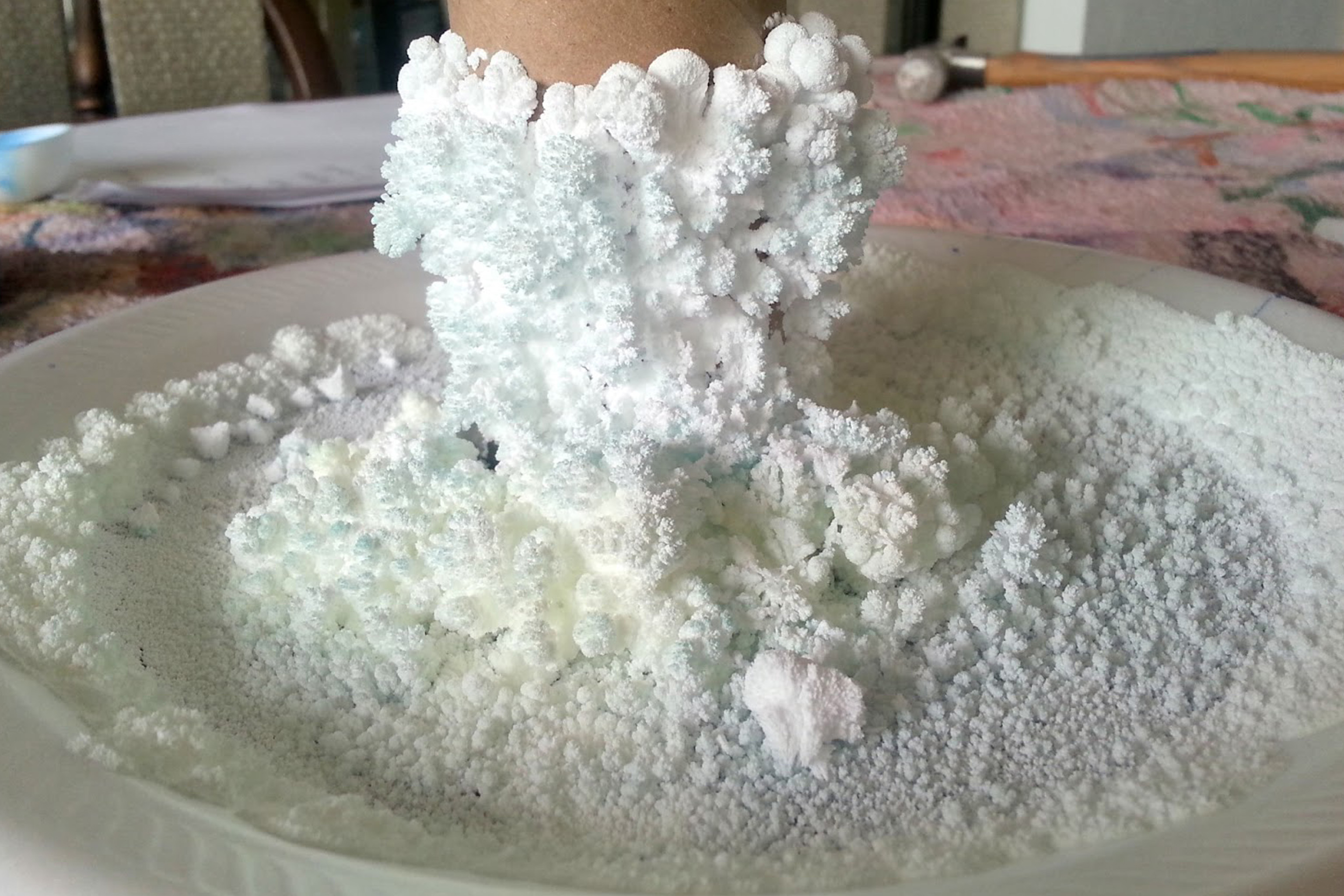

Step-by-step guide to grow colorful crystals
Step 1
Choose whether you will grow crystals with table salt or with granulated sugar.
Step 2
Measure one cup of water into a heat-safe container.
Step 3
With an adult's help heat the water until it is warm but not boiling.
Step 4
Add one tablespoon of your chosen salt or sugar to the warm water.
Step 5
Stir the water with your spoon until the added salt or sugar disappears.
Step 6
Keep adding one tablespoon and stirring until extra granules stop dissolving and the solution looks very clear.
Step 7
Carefully pour the hot saturated solution into the clear glass jar or cup.
Step 8
Add five drops of food coloring to the jar.
Step 9
Gently stir once to mix the color into the solution.
Step 10
Tie one end of the string to the pencil or popsicle stick so the string can hang across the jar.
Step 11
Lower the string so the tip sits in the solution without touching the sides or bottom and leave it overnight to form a seed crystal.
Step 12
Place the jar somewhere safe and undisturbed and leave it for several days to a week to let crystals grow larger.
Step 13
Use the ruler to measure the longest crystal and write its length on your paper with today's date.
Step 14
Measure the same crystal once every day for a week and write each new length and the date on your paper.
Step 15
Take a photo or write a short note about your crystal growth and share your finished creation on DIY.org
Help!?
What can we use instead of a clear glass jar or a popsicle stick if we don't have them?
Use a clean clear plastic cup or a mason jar that can hold hot liquid instead of the glass jar, and substitute a pencil, chopstick, or wooden skewer for the popsicle stick while still tying the string so it hangs without touching the sides or bottom.
Why did crystals not form or why is my solution cloudy, and how can I fix it?
If crystals don't form or the solution is cloudy, reheat the water (step 3), keep adding and stirring one tablespoon of salt or sugar until extra granules stop dissolving so the solution is saturated (steps 4–5), ensure the string hangs freely without touching the jar sides or bottom (steps 8–9), and place the jar somewhere safe and undisturbed (step 11).
How can I adapt the activity for younger or older children?
For preschoolers have an adult handle the heating and pouring (steps 2–6) while the child adds food coloring, stirs, and makes simple measurements, and for older kids have them run multiple jars (salt vs sugar), vary food coloring or string materials, and record daily crystal lengths and photos for comparison (steps 6, 9, 10–12).
How can we extend or personalize the crystal-growing activity once the basic crystals form?
To extend the project twist a pipe cleaner or bend a paperclip into a shape and tie it to the pencil so crystals grow on the shape, try different food coloring drops in separate jars, and create a growth chart with daily measurements and photos to compare results (steps 6, 8–12).
Watch videos on how to grow colorful crystals
Grow Your Own Crystals at Home! Easy DIY
4 Videos

Grow Your Own Crystals at Home! Easy DIY
Grow Your Own Crystals at Home! Supplies & steps in the description. Subscribe for more fun ideas!
Grow Crystals at Home Fun Kids Science Experiment | Try Think Box With Aras
How to grow crystals at home STEM activity for kids #crystals #science experiment #chemistry
Facts about crystal growth and chemistry experiments for kids
🧪 Hot water can dissolve more sugar than cold water, so cooling a supersaturated solution makes crystals pop out!
🍭 Rock candy is just giant sugar crystals — people have been making sweet crystal candy for centuries.
🧂 Table salt (sodium chloride) naturally forms little cube-shaped crystals you can see with a magnifying glass.
✨ A tiny seed crystal gives dissolved molecules a place to line up, helping fast and organized crystal growth.
⏳ Crystal growth time varies wildly: rock candy can form in hours or days, while some mineral crystals take thousands of years.
How do I grow colorful salt or sugar crystals with my child?
What materials do I need to grow crystals at home?
What ages is growing crystals suitable for?
What safety tips should I follow when growing crystals with kids?
