Give a sketchbook tour
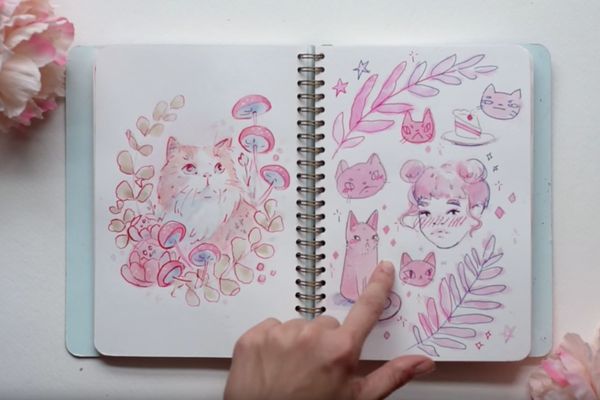
Give a sketchbook tour by showing favorite drawings, discussing materials and techniques, and explaining creative choices to practice observation and speaking skills.


Drawing Apps
Step-by-step guide to give a sketchbook tour
5 EASY ways to FILL your sketchbook!
Step 1
Gather your sketchbook and lay it on a table where you can sit comfortably.
Step 2
Find a quiet spot with good light so you can focus and show your drawings clearly.
Step 3
Flip through your sketchbook and choose 4 to 6 favorite drawings to talk about.
Step 4
Put a page marker or sticky note on each chosen drawing so you can find them quickly.
Step 5
On small paper or sticky notes write the main material used for each marked drawing.
Step 6
On a separate line write one short sentence for each drawing explaining why you made it.
Step 7
Decide the order you will show the drawings from first to last.
Step 8
Practice a short description aloud for the first drawing using your notes.
Step 9
Practice a short description aloud for each of the other drawings using your notes.
Step 10
Do a full run-through of your sketchbook tour from start to finish like you are talking to a friend.
Step 11
Pick one thing you want to improve next time such as louder speaking or clearer explanations.
Step 12
Share your finished sketchbook tour on DIY.org so others can see your art and hear your story.
Help!?
What can I use if I don't have sticky notes or page markers to mark my chosen drawings?
If you don't have sticky notes or page markers for the step 'put a page marker or sticky note on each chosen drawing,' fold each drawing's corner, slide in a paperclip, tuck a small index card under the page, or stick on short strips of washi tape as substitutes.
I'm nervous and keep blanking out during the full run-through — how can I avoid that?
If you get stuck during the 'full run-through,' keep the small papers or sticky notes you wrote with the 'main material' and the one-sentence reason next to each marked drawing and glance at them as quick prompts while you speak.
How should I adapt the sketchbook tour for different ages or skill levels?
For younger kids, limit the tour to 2–3 favorite drawings with an adult writing the short sentences and holding the sticky-note prompts, while older kids can choose 6 drawings, add material and technique notes on small paper, and practice longer descriptions aloud.
How can I make my sketchbook tour more interesting before I share it on DIY.org?
To enhance your tour for sharing on DIY.org, record the run-through on a phone, include close-up shots of the materials you listed on the small papers, and add a short clip showing the one improvement you picked (like louder speaking or clearer explanations).
Watch videos on how to give a sketchbook tour
12 Simply Awesome Sketchbook Tips - EASY and FUN Ideas
4 Videos

12 Simply Awesome Sketchbook Tips - EASY and FUN Ideas
my first sketchbook tour 🌷 fun ideas, life sketches & experiments!

10 tips for starting your sketchbook — and keeping it going!

8 Tips to Make Your Sketchbook Great by Design
Facts about sketching and art journaling for kids
🖼️ Leonardo da Vinci filled dozens of sketchbooks with drawings and inventions — artists' notebooks can be full of ideas, not just finished art.
✏️ A pencil's 'lead' is actually graphite; fun trivia says one pencil could draw a continuous line many miles long (often quoted around 35 miles).
🎨 Pencil grades range from H (hard, light) to B (soft, dark) — artists use different grades to create texture, shading, and contrast.
🗣️ Talking through your drawings (like during a sketchbook tour) helps you organize your thoughts and remember techniques better.
📱 Taking photos or scans of sketchbook pages is an easy way to build a digital portfolio to share and get feedback.
How do you do a sketchbook tour with a child?
What materials do I need for a sketchbook tour?
What ages is a sketchbook tour suitable for?
What are the benefits of doing a sketchbook tour with a child?
