Find a mushroom habitat
Explore a local park or forest to find and document mushroom habitats using a notebook, camera, and magnifier, observing safely without touching or eating.


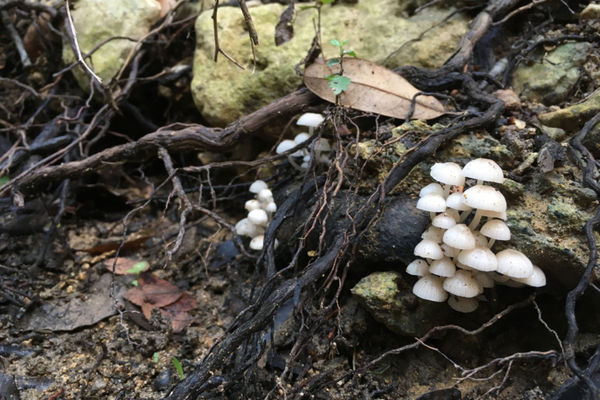

Step-by-step guide to find a mushroom habitat
How Mushrooms Grow in the Wild - Lifecycle of Fungus Illustrated - Spores and Mycelium
Step 1
Put your notebook pencil camera magnifier and small ruler or stick into a bag so they are ready.
Step 2
Ask an adult to take you to a nearby park or forest where mushroom finding is allowed.
Step 3
Put on sturdy shoes and outdoor clothes before you leave.
Step 4
Agree with your adult to stay on trails and to never touch or eat any mushrooms.
Step 5
Walk slowly along the trail and scan the ground logs and tree bases for mushrooms.
Step 6
When you spot a mushroom stop and ask your adult for permission to observe it closely.
Step 7
Take a photo that shows the mushroom and the area around it to capture the habitat.
Step 8
Hold your small ruler or stick next to the mushroom for scale without touching the mushroom.
Step 9
Take a close-up photo with the ruler or stick visible to show the mushroom’s size.
Step 10
Use your magnifier to look at the cap gills and stem from above and describe what you see.
Step 11
Write in your notebook the substrate moisture nearby plants and how many mushrooms are there.
Step 12
Do the same recording process at least two more mushroom spots or until your time is done.
Step 13
At home organize your photos and notes into a neat page for each mushroom site in your notebook.
Step 14
Share your finished creation on DIY.org
Help!?
What can we use instead of a magnifier or small ruler if we can't find them?
If you don't have a magnifier, use your phone's camera zoom or a reading glass to examine the cap, gills, and stem, and if you lack a small ruler, place a common stick or a coin next to the mushroom for scale.
My close-up photo is blurry or my ruler accidentally touches the mushroom — what should I do?
If your close-up photo is blurry or your ruler accidentally touches the mushroom, ask the adult to steady the camera at arm's length, position the ruler beside (not on) the cap for scale, and retake the photo without touching the fungus.
How can I change the activity for younger children or make it more challenging for older kids?
For preschoolers, simplify the task by focusing on taking one habitat photo and drawing the mushroom in the notebook with the adult handling the magnifier and ruler, while older kids can visit at least three sites, record substrate and moisture details, and research possible species at home.
How can we extend or personalize our mushroom notebook pages before sharing on DIY.org?
To personalize and enhance the project, add a simple map and labels for substrate and moisture on each notebook page, include your close-up and habitat photos with the ruler visible, and create a decorated field-guide page to upload to DIY.org.
Watch videos on how to find a mushroom habitat
Inside the Mushroom Farm: How Mushrooms are Grown
4 Videos

Inside the Mushroom Farm: How Mushrooms are Grown

Growing Mushrooms in a Greenhouse

How do mushrooms grow?
Discovering Mushrooms in the Ground | Fascinating Fungi and Their Growth
Facts about mycology for kids
🍄 Mushrooms are the fruiting bodies of fungi — not plants — and some species are bioluminescent (they glow!).
🔬 A single mushroom can release millions of microscopic spores; wind can carry spores hundreds of miles.
🌳 Many fungi form mycorrhizal partnerships with trees, exchanging nutrients and helping whole forests stay healthy.
📸 Good photos, location notes, and habitat details make mushroom identification much easier for experts later.
⚠️ Never touch or eat wild mushrooms you find — some poisonous species look almost identical to edible ones.
How do I explore a mushroom habitat with my child?
What materials do I need to explore mushroom habitats with kids?
What ages is mushroom habitat exploration suitable for?
What safety tips should parents follow when exploring mushroom habitats with children?
