Fancy an Obstacle?
Build a colorful backyard obstacle course using cushions, ropes, cones, and tape; design, time, and improve challenges to test balance, speed, and creativity.



Step-by-step guide to Fancy an Obstacle?
Step 1
Choose a flat outdoor spot in your backyard and clear it of toys and sticks.
Step 2
Place a cone or marker for the Start and another for the Finish about 10 to 15 paces apart.
Step 3
Arrange three to five cushions in a line between Start and Finish so you can jump from one to the next.
Step 4
Lay a rope straight on the ground to make a balance line you can walk along.
Step 5
Use tape or chalk to draw a zigzag path between the cushions for a quick-steer challenge.
Step 6
Draw a small chalk circle next to a cone and write "spin 3 times" inside it for a fun station.
Step 7
Decorate your obstacles with chalk or coloring materials to make the course bright and exciting.
Step 8
Walk through the course slowly to check each obstacle is safe and stable.
Step 9
Ask someone to time your run or set a phone timer so you can measure your speed.
Step 10
Run the course once to see how it feels.
Step 11
Move one obstacle to make the course harder or easier based on your first run.
Step 12
Run the course three times trying to beat your best time.
Step 13
Share a photo or description of your finished colorful obstacle course on DIY.org.
Help!?
What can we use instead of cones, rope, or cushions if we don't have them?
Use shoes, small buckets, or marked sticks for the Start and Finish, a scarf or long towel instead of the rope balance line, and folded blankets or gym mats in place of the cushions for the jump line.
What should we do if cushions slide or the rope keeps moving when we practice the course?
Follow 'Walk through the course slowly to check each obstacle is safe and stable,' then anchor sliding cushions with a towel or tape and secure rope ends under rocks or heavy toys before timing runs.
How can we change the course to suit younger children or older kids?
For younger children, shorten the 10–15 paces gap, use only two soft cushions and remove the 'spin 3 times' chalk circle, while older kids can spread Start and Finish farther apart, add more cushions, tighten the zigzag with tape or chalk, and aim to beat the timed three-run challenge.
How can we make the obstacle course more fun or personal after we've built it?
Decorate your obstacles with chalk or coloring materials, add themed stations like a 'bear crawl' between cushions, move one obstacle after your first run to change difficulty, and share a photo of your colorful course on DIY.org.
Watch videos on how to Fancy an Obstacle?
KIDDO : Obstacle Courses for Early Childhood Settings
4 Videos
KIDDO : Obstacle Courses for Early Childhood Settings
Agility ladder obstacle courses for the classroom
Obstacle Course for Kids
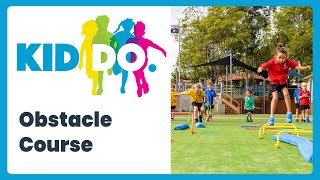
KIDDO Activity: Obstacle Course
Facts about backyard obstacle courses and active play
🏁 Obstacle courses evolved from military and physical training and inspired modern TV hits like Ninja Warrior and obstacle-race events.
🧭 Parkour started in France in the late 20th century and focuses on efficient, creative movement over obstacles using only the body.
⏱️ The World Health Organization recommends children aged 5–17 get at least 60 minutes of moderate-to-vigorous physical activity daily — obstacle courses are a fun way to reach that goal.
🎯 Timing runs and changing course rules turns play into measurable challenges that build speed, balance, and problem-solving skills.
🪢 Simple gear like ropes, cushions, cones and tape are staples in PE and backyard courses because they're inexpensive, safe, and easy to rearrange.
How do I build a 'Fancy an Obstacle?' backyard obstacle course step by step?
What materials do I need to make a colorful 'Fancy an Obstacle?' backyard course?
What ages is the 'Fancy an Obstacle?' backyard course suitable for?
How can I keep kids safe while playing on the 'Fancy an Obstacle?' course?
