Draw How Plant Roots Absorb Water!
Draw a labeled diagram showing how plant roots absorb water, using a simple celery experiment and colored water to observe and illustrate capillary action.




Step-by-step guide to draw how plant roots absorb water
Step 1
Gather all the materials listed and put them on a clean table.
Step 2
Fill the clear glass or jar about three quarters full with water.
Step 3
Add several drops of food coloring to the water.
Step 4
Gently swirl the glass so the color mixes evenly into the water.
Step 5
Cut about one centimeter off the bottom of the celery stalk with adult help.
Step 6
Stand the celery stalk upright in the colored water so the cut end is submerged.
Step 7
Leave the glass undisturbed for at least four hours or overnight to let the color move.
Step 8
Look at the celery every hour and notice if colored bands or streaks appear up the stalk.
Step 9
Carefully remove the celery from the glass with adult help.
Step 10
Cut a thin cross section at the base of the stalk with adult help so you can see colored vessels.
Step 11
On your paper sketch the celery stalk outline and draw the cross section you cut.
Step 12
Use colouring materials to color the path where the dye moved and the leaves.
Step 13
Label parts on your drawing such as root area or base xylem stem leaves and draw arrows showing water movement.
Step 14
Write one short sentence that explains how roots absorb water and how the water travels up the plant by capillary action.
Step 15
Share your finished drawing and notes on DIY.org.
Help!?
What can we use instead of celery, food coloring, or a clear glass if we can't find them?
If you don't have celery use white carnations or a white-stemmed houseplant and stand its cut stem in colored water, substitute natural dyes like diluted beet or red cabbage juice for food coloring, and use a clear plastic cup instead of a glass so you can still watch the dye move.
Why didn't the dye move up the celery after leaving it overnight and what should we check?
If no color appears, make sure you freshly cut about one centimeter off the bottom (step 5), that the cut end is fully submerged (step 6), that you used several drops of food coloring (step 3), and try leaving the glass undisturbed longer so the dye can travel up the xylem.
How can we adapt this activity for different ages?
For younger children have an adult do the cutting and assist with steps 5 and 9 while the child watches and colors simple streaks and labels, and for older kids have them record hourly observations (step 7), cut and examine the cross section themselves with supervision (step 9), and graph dye movement.
What are some ways to extend or personalize the experiment after the basic steps?
Extend the activity by using several celery stalks with different dye colors or water temperatures, photographing the stalk each hour (step 7) to make a time-lapse, comparing cross sections you cut (step 9), and adding more detailed labels and arrows before sharing on DIY.org.
Watch videos on how to draw plant root water absorption
Absorption of Water By Plants | ikenSchoool
3 Videos

Absorption of Water By Plants | ikenSchoool
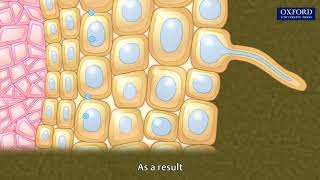
Animation 10.3 Absorption of water in plants

THE UPTAKE AND TRANSPORT OF WATER AND MINERAL IONS BY ROOT SYSTEM
Facts about plant biology
🌱 Root hairs dramatically increase a root's surface area so a plant can soak up more water.
💧 In the celery dye experiment you can often see colored water reach the leaves within a day.
🔬 Xylem is made of hollow, dead cells that act like tiny straw-like tubes to carry water up plants.
🌊 Capillary action helps pull water up thin tubes, and with transpiration it can lift water dozens of meters.
🌳 Some large trees can transpire hundreds of liters of water each day, moving moisture from roots to leaves.
How do I do the celery experiment to show how plant roots absorb water and draw a labeled diagram?
What materials do I need for the Draw How Plant Roots Absorb Water activity?
What ages is the celery capillary action drawing activity suitable for?
What are the benefits of doing the celery experiment and drawing a labeled diagram?
