Build a submarine
Build a small model submarine from a plastic bottle, clay, straws, and a weight to test buoyancy and control sinking and floating safely.


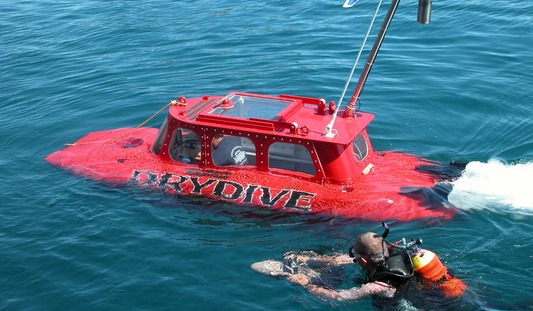

Step-by-step guide to build a model submarine
How to Make a Submarine at Home Out of Plastic Bottle - Very Simple
Step 1
Gather all your materials on a clean table so everything is ready to use.
Step 2
Rinse and dry the plastic bottle to remove any drink residue.
Step 3
Remove the bottle label so you can see inside and decorate later.
Step 4
Ask an adult to carefully use scissors to make a small hole in the bottle cap just big enough for a straw to fit through.
Step 5
Push a straw through the hole so the straw tip reaches near the bottom inside the bottle and the straw top sticks out above the cap.
Step 6
Press modeling clay around the straw on the outside of the cap to make an airtight seal so no air leaks around the straw.
Step 7
Attach small weights to the outside bottom of the bottle with tape or clay until the bottle sits low in your hand but still floats when gently placed in water.
Step 8
Decorate the bottle with stickers or markers to make your submarine look awesome.
Step 9
Fill a basin or tub with water to use as your testing pool.
Step 10
Place your sealed submarine gently on the water with the straw top above the water surface and watch it float.
Step 11
Submerge the straw top below the water surface so water can travel down the straw and fill the bottle to make the submarine sink.
Step 12
Pull the straw top above the water and blow gently into the straw so air pushes water out and the submarine rises again.
Step 13
Add or remove small weights as needed to get the submarine to sink and float just the way you want.
Step 14
Repeat sinking and floating tests until your submarine moves smoothly and you can control it with the straw.
Step 15
Share a photo or video of your finished submarine and what you learned on DIY.org
Help!?
What can I use instead of modeling clay or a drinking straw if I can't find them?
Use hot-melt glue or silicone sealant in place of modeling clay to make an airtight seal around the cap, and replace a drinking straw with a piece of clear plastic tubing or a cut plastic pen barrel pushed through the cap so the straw tip still reaches near the bottom of the bottle.
My submarine leaks or won't float correctly—what should I check or fix?
If water leaks or it won't float, re-press or add more modeling clay around the straw on the outside of the cap to make an airtight seal, wrap tape around the straw if the hole is too big, and change the small weights attached to the outside bottom until the bottle sits low in your hand but still floats when gently placed in water.
How can I adapt this activity for different age groups?
For younger children have an adult pre-pierce the cap and pre-cut the straw and let them decorate and tape weights to the outside, while older kids can make their own airtight clay seals, test different bottle sizes, and fine-tune the amount of weights to control sinking and floating during repeated tests.
What are simple ways to extend or personalize the submarine project?
To extend the project add or remove small weights to experiment with buoyancy, glue on a small plastic periscope or a waterproof LED to the bottle for decoration, or attach a thin fishing line to guide the submarine while you practice submerging the straw to sink and blowing to rise.
Watch videos on how to build a model submarine
Build a Submarine - STEM activity
4 Videos
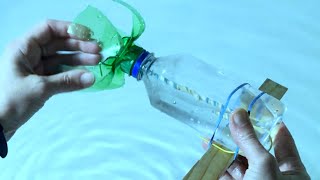
Build a Submarine - STEM activity
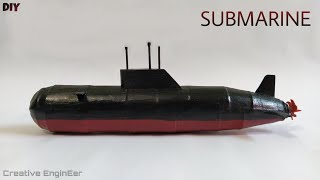
How to make SUBMARINE with paper and cardboard | DIY RC submarine
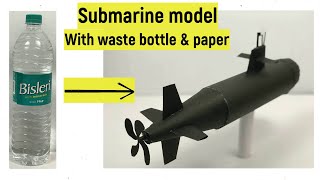
Submarine model out of paper & waste bottle | DIY submarine | Best out of waste | Paper submarine
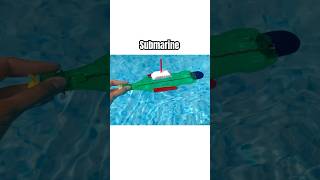
🌊 How to Make a DIY Submarine from a Plastic Bottle! Easy & Fun Experiment 🚢🔧
Facts about buoyancy and water science
🛥️ Real submarines change depth by filling and emptying ballast tanks—your bottle sub does the same with water, air, and a weight.
⚖️ Archimedes' principle says an object floats when it displaces water equal to its own weight—perfect to test with a mini submarine.
🌊 Small tweaks (a bit of clay or a trapped bubble of air) can turn a floating model into one that hovers or sinks—tiny changes matter!
♻️ A recycled plastic bottle makes a great watertight hull—repurposing bottles is a super-easy way to build model boats and subs.
🧪 Straws can act as simple pumps or snorkels to trap or release air—kids can safely experiment with how air affects buoyancy.
How do I build a small model submarine from a plastic bottle to test buoyancy safely?
What materials do I need to build a bottle submarine and test sinking/floating?
What ages is this plastic bottle submarine activity suitable for?
What safety tips should I follow when testing a homemade bottle submarine?
