Tiananmen Square Massacre Facts For Kids

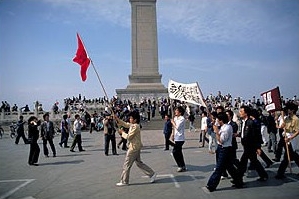
The Tiananmen Square Massacre was a pro-democracy protest in Beijing in 1989 that ended violently when the Chinese government deployed military force against unarmed civilians.
Select reading age
Go deeper More articles
Tiananmen Square Massacre
Tiananmen Square Massacre Facts For Kids
Videos & Quizzesincluded
Image by JiΕ™Γ­ Tondl ( Blow up ), licensed under Creative Commons Attribution-Share Alike 4.0

About this topic

The Tiananmen Square Massacre was a sad event that happened in Beijing, China, in 1989. πŸ—“οΈ People gathered in a big square called Tiananmen Square to express their wishes for more rights and freedom. They wanted the government to listen to them. The gathering started peacefully with many students, workers, and citizens joining in. However, on June 4, the Chinese government decided to use force to stop the protests, leading to a tragic event where many people were hurt or lost their lives. It’s important to remember these events to understand how people can stand up for what they believe in. πŸŽ‰
Explore with ChatDino

Key Points

Many people who were present during the Tiananmen Square Massacre have powerful stories to share.
The Tiananmen Square Massacre left a lasting impact on China and the world.
In the 1970s and 1980s, China was changing quickly!
Countries around the world were shocked when they heard about the Tiananmen Square Massacre.
On June 4, 1989, things turned very serious.
After the massacre, the Chinese government became strict and did not allow protests like that to happen again.
In China, the government tries very hard to prevent discussions about the Tiananmen Square Massacre.
Before June 1989, many students began protesting in April of that year.

Photos of Tiananmen Square Massacre

Tiananmen Square Massacre β€” photo 1

Tiananmen Square Massacre β€” photo 1

A slogan inside the Former Residence of Hu Yaobang, a leading reformist whose death triggered the Tiananmen Square protests in 1989.

A slogan inside the Former Residence of Hu Yaobang, a leading reformist whose death triggered the Tiananmen Square protests in 1989.

Deng Xiaoping (1904–1997) was the Paramount Leader of China.

Deng Xiaoping (1904–1997) was the Paramount Leader of China.

Tiananmen Square Massacre β€” photo 4Image by Rob Bogaerts / Anefo, licensed under Creative Commons Attribution-Share Alike 3.0 nl

Tiananmen Square Massacre β€” photo 4

Li PengImage by World Economic Forum from Cologny, Switzerland. cropped by Shizhao, licensed under Creative Commons Attribution-Share Alike 2.0

Li Peng

Han Dongfang, founder of the Beijing Workers' Autonomous FederationImage by La Serviette, licensed under Creative Commons Attribution-Share Alike 3.0

Han Dongfang, founder of the Beijing Workers' Autonomous Federation

Photo of Pu Zhiqiang, student protester at Tiananmen, taken on 10 May. The words say: "We want the freedom of newspapers, freedom of associations, also to support the 'World Economic Herald', and support those just journalists."Image by θ”‘ζ·‘θŠ³@sfchoi8964, licensed under Creative Commons Attribution 2.5

Photo of Pu Zhiqiang, student protester at Tiananmen, taken on 10 May. The words say: "We want the freedom of newspapers, freedom of associations, also to support the 'World Economic Herald', and support those just journalists."

Wen Jiabao, then chief of the Party's General Office, accompanied Zhao Ziyang to meet with students in the square, surviving the political purge of the party's liberals and later serving as Premier from 2003 to 2013.Image by Presidential Press and Information Office, licensed under Creative Commons Attribution 4.0

Wen Jiabao, then chief of the Party's General Office, accompanied Zhao Ziyang to meet with students in the square, surviving the political purge of the party's liberals and later serving as Premier from 2003 to 2013.

The Type 59 main battle tank, here on display at the Military Museum of the Chinese People's Revolution in western Beijing, was deployed by the People's Liberation Army on 3 June 1989.

The Type 59 main battle tank, here on display at the Military Museum of the Chinese People's Revolution in western Beijing, was deployed by the People's Liberation Army on 3 June 1989.

πŸ™ Survivor Stories

Many people who were present during the Tiananmen Square Massacre have powerful stories to share. πŸ™Some were students who risked everything to voice their opinions about freedom. They remember the hope, laughter, and determination of the crowd but also the fear during the turmoil. Some survivors moved to other countries where they could speak freely about their experiences, becoming important voices for human rights. Their stories inspire new generations to understand the significance of standing up for what is right and learning from history to create a better future. ✨
Go deeper

✊ Legacy And Impact

The Tiananmen Square Massacre left a lasting impact on China and the world. It reminded many people of the importance of free speech and human rights. ✊People around the globe learned to appreciate their rights, and it inspired new movements for equality and justice. In China, although the government tried to erase the memory, it lives on in the hearts of many people who remember the bravery of the protesters. 🌟As we continue to learn about this event, it encourages us to think about how we can make our voices heard and promote freedom for all! πŸ“’
Go deeper

🌟 Historical Context

In the 1970s and 1980s, China was changing quickly! πŸ‡¨πŸ‡³ The country went from strict rules to opening up to new ideas. Many people, especially students, wanted more freedom to express themselves and have a say in how they live. They admired democratic countries where citizens could vote and share their thoughts freely. These ideas inspired protests in cities throughout China, including Beijing, where thousands gathered at Tiananmen Square. The protests were about wanting a better future, and this was a time when many people were hopeful for change! 🌟
Go deeper

😲 International Response

Countries around the world were shocked when they heard about the Tiananmen Square Massacre. 😲Many leaders spoke out against the violence and called for the Chinese government to respect people's rights. Countries like the United States and those in Europe imposed sanctions, which means they stopped trading and working with China as much as before. People everywhere protested in support of the students in China, holding vigils and writing letters. 🌍This brought attention to the importance of defending the right to peaceful protest and standing up for human rights globally. ✊
Go deeper

😒 The Day Of The Massacre

On June 4, 1989, things turned very serious. 😒The Chinese government sent soldiers and tanks to Tiananmen Square to break up the protests. People were scared but stood their ground, believing in what they were fighting for. Tens of thousands of protesters were still present, peacefully calling for change. The government, however, ordered the soldiers to use force, and many individuals were hurt while trying to protect the square. Reports say that hundreds to thousands of people lost their lives that day. The event quickly became a symbol of the struggle for freedom and democracy in China. 🚫
Go deeper

πŸš” Aftermath And Repression

After the massacre, the Chinese government became strict and did not allow protests like that to happen again. πŸš”They began arresting people who spoke out against them. Families of the victims were often threatened or punished. Over time, the government covered up information about the event, causing a lot of fear for people who might want to protest for their rights. Many citizens were upset to see their friends and family treated badly, and this led to feelings of sadness and anger in society. It was a difficult time for China as the country tried to heal. ❀️
Go deeper

🚫 Censorship And Memory In China

In China, the government tries very hard to prevent discussions about the Tiananmen Square Massacre. 🚫They control what people can read or see, making it difficult for younger generations to learn about this important part of history. Schools do not teach students about the event. Even online, information is deleted to keep people from talking about it. Many citizens still remember and mourn what happened, quietly honoring those who fought for their rights. Remembering is essential, but in China, it remains a challenging topic because of censorship. πŸ“š
Go deeper

πŸ“… Events Leading Up To The Massacre

Before June 1989, many students began protesting in April of that year. πŸ“…The movement started after Hu Yaobang, a leader who supported reforms, passed away. Students honored him by gathering in Tiananmen Square, asking for political reforms, less corruption, and more freedoms. Over weeks, the crowd grew to thousands, and people made speeches, held hunger strikes, and even sang songs! 🎢The protests showed unity and hope. However, the government became worried that these peaceful gatherings could lead to big changes, which is why they eventually decided to take action. 🚨
Go deeper

🧠 Take the Quiz about Tiananmen Square Massacre

Question 1 of 10

What year did the Tiananmen Square Massacre occur?

Question 2 of 10

What was the primary motivation behind the protests?

Question 3 of 10

What iconic image is associated with the massacre?

Question 4 of 10

What was declared in Beijing as a response to the protests?

Question 5 of 10

Which reformist leader's death spurred the protests?

Question 6 of 10

How does the Chinese government treat information regarding the Tiananmen Square Massacre?

Question 7 of 10

What was the international response to the Tiananmen Square Massacre?

Question 8 of 10

On which date is the anniversary of the Tiananmen Square Massacre remembered?

Question 9 of 10

Where were vigils held to remember the events of the massacre?

Question 10 of 10

What type of government action was taken against the protesters?

πŸ”’

Your results

Answer all 10 questions to see how you did.

Kid-safe AI powered by AstroSafe

DIY.org

Kid-safe AI for discovery and learning. Ask anything, explore everything, learn with confidence.

Product

  • Pricing
  • App
  • All Apps

Resources

  • Blog
  • Kids Wikipedia
  • Worksheets
  • Activities for Kids
  • Build a Hacker Simulator
  • SafeTube

Company

  • About
  • Terms & Conditions
  • Privacy Policy
  • AstroSafe
TwitterInstagramYouTube

Β© 2026 DIY.org. All rights reserved. Β· Powered by AstroSafe