Tayassuidae Facts For Kids
Peccaries, part of the family Tayassuidae, are pig-like ungulates native to Central and South America known for their unique characteristics and social behavior.
Select reading age

Tayassuidae Facts For Kids
Videos & Quizzesincluded
About this topic
Peccaries are super cool animals that look like pigs! 🐗They belong to the family Tayassuidae and are often called "javelinas." These furry friends live in the Americas, from the southern United States all the way to Argentina. Peccaries are social creatures, often found in groups called herds. They’re mainly active at dawn and dusk, which makes them special nighttime explorers! 🌅With their sharp sense of smell and keen hearing, they communicate using grunts and squeals. Let's explore more about these fascinating animals!
Explore with ChatDinoKey Points
Here are some fun facts about peccaries!
Peccaries are social animals that love to hang out in groups called herds.
Peccaries are generally not endangered, but their habitats are threatened by deforestation and hunting.
Peccaries hold an important place in the cultures of many Indigenous tribes in the Americas.
Peccaries are omnivores, which means they eat both plants and animals!
Peccaries call many places home!
Peccaries have short legs and sturdy hoofs, just like pigs!
Peccaries are often compared to pigs because they belong to two different families within the same order, known as Artiodactyla.
Peccaries have a unique way of welcoming new baby javelinas into the world!
Peccaries belong to the group called "ungulates," which means they are hoofed mammals.
Photos of Tayassuidae

Tayassuidae — photo 1

Skulls of wild boar (left) and white-lipped peccary (right): Note how the upper canines of the peccary point downwards.

Tayassuidae — photo 3
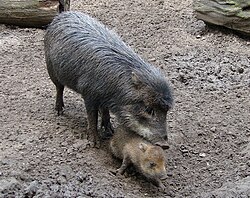
Tayassuidae — photo 4

Tayassuidae — photo 5
🎉 Fun Facts
Here are some fun facts about peccaries! 🎉Did you know that peccaries can run up to 30 miles per hour? That’s super fast for their size! They can also use their snouts to dig through dirt, looking for roots and tubers. 🏃♂️ Peccaries have a unique scent gland located on their backs that helps them mark their territory. Each group has its own smell, helping them recognize one another! Lastly, peccaries are often mistaken for wild boar, but they are indeed their own species with fascinating qualities!
Go deeper🤗 Behavioral Traits
Peccaries are social animals that love to hang out in groups called herds. These herds can be anywhere from a few to over 20 individuals! 🤗They communicate with each other through a variety of sounds, like grunts and squeals. This helps them stay connected and warn each other of danger. Peccaries are also known to be very playful, often engaging in games with one another. They enjoy taking mud baths to keep their skin cool and clean. Their social and playful nature makes them fascinating animals to observe!
Go deeper🌳 Conservation Status
Peccaries are generally not endangered, but their habitats are threatened by deforestation and hunting. 🌳⚠️ While the Collared Peccary isn’t at risk, the White-lipped Peccary population is declining due to habitat loss. Conservation efforts are important to ensure these animals can thrive in the wild. Protecting their habitats helps maintain a healthy ecosystem while ensuring the peccaries can continue to roam and play in their natural homes!
Go deeper🦖 Cultural Significance
Peccaries hold an important place in the cultures of many Indigenous tribes in the Americas. 🦖They are often seen in stories and myths, representing strength and resourcefulness. In some regions, people hunt peccaries for food, making them an essential part of local diets. Additionally, peccaries can inspire art and folklore, highlighting their cultural significance and how they connect people to nature. Understanding these relationships helps us appreciate the role these animals play in human culture!
Go deeper🌿 Diet And Feeding Habits
Peccaries are omnivores, which means they eat both plants and animals! 🌿🍖 They primarily enjoy a diet of roots, fruits, nuts, and seeds. Sometimes, they nibble on small insects and even small animals if they get the chance! Their strong jaws and sharp teeth help them chew tough plant materials. Peccaries often forage together in groups, using their snouts to dig in the ground and uncover tasty treats. Because they have such a varied diet, they play an important role in their ecosystem!
Go deeper🌍 Habitat And Distribution
Peccaries call many places home! 🌍You can find them in various habitats like forests, grasslands, and swamps across the Americas. They mostly live in Central and South America, but the Collared Peccary can be found as far north as Texas! They prefer areas with plenty of vegetation, where they can easily find food and stay safe from predators. Peccaries are considered adaptable animals, which allows them to thrive in different environments, from deserts to jungles!
Go deeper🐖 Physical Characteristics
Peccaries have short legs and sturdy hoofs, just like pigs! 🐖They typically weigh between 50 to 100 pounds and stand about 2 to 3 feet tall. Their fur is usually dark brown or gray, which helps them blend in with their forest homes. Peccaries also have prominent tusks, which can grow quite long and help them dig for food! 🐾Their sharp teeth are perfect for munching on fruits, roots, and even small animals. Overall, peccaries are strong and rugged little beasts!
Go deeper🐷 Relation To Other Species
Peccaries are often compared to pigs because they belong to two different families within the same order, known as Artiodactyla. 🐷However, pigs belong to the family Suidae, while peccaries are in Tayassuidae. Their lifestyles and habitats differ, but they share some similar physical traits like their hooves and snouts. Even though they look alike, they have different behaviors and diets! It's fascinating to see how related species can be so unique in their own ways!
Go deeper🍼 Reproduction And Life Cycle
Peccaries have a unique way of welcoming new baby javelinas into the world! 🍼They are usually pregnant for about 5 months, and female peccaries give birth to 1 to 4 babies at once. These little ones are born with their eyes open and can walk almost immediately! The mother takes care of them, teaching them how to forage for food and navigate the world. Javelinas grow up quickly and can join the herd as early as a few months old. They usually live about 10-15 years in the wild!
Go deeper🐾 Taxonomy And Classification
Peccaries belong to the group called "ungulates," which means they are hoofed mammals. They are part of the family Tayassuidae, and there are three main species: the Collared Peccary, the Chacoan Peccary, and the White-lipped Peccary. 🐾The Collared Peccary is the most common and has a distinct white stripe around its neck, while the White-lipped Peccary has a white stripe on its face! Each species is unique and adapted to different environments. Learning about how they are classified helps us understand their differences and similarities!
Go deeper