Stone Facts For Kids
Rock is a natural, solid piece of Earth made of minerals; it shapes the ground and mountains, and studying it helps us learn Earth's history.

About this topic
People who study rocks learn about how they formed, what they are made of, and where they are found. Rocks are not only on Earth — planets and moons can have rocks too. Studying rocks helps us understand Earth’s history and how its surface changed over time.
Quick Facts
Key Points
Photos of Stone
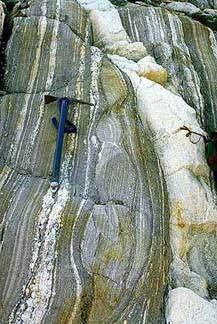
Metamorphic banded gneiss
📘 How Scientists Study Rocks
Geology became a clearer science in the 1800s, when people began to sort rocks and write rules about them. In the 1900s, new ways to measure age and to see how continents move helped geologists explain Earth’s deep history.
🔎 Igneous Rocks
One important way to tell igneous rocks apart is how much silica they have. Rocks with more silica tend to be lighter in color, like granite. Ocean crust is mostly basalt, while many continental areas have more granite-type rocks.
🧭 Sedimentary Rocks
Sedimentary rocks usually form in flat layers and often hold fossils, which are remains of ancient plants or animals. Geologists sort the grains by size: very tiny clay, slightly larger silt, then sand, and finally gravel-sized pieces.
💡 Metamorphic Rocks — Changed By Heat And Pressure
Metamorphism happens in a few ways: near hot magma (contact), when rocks are buried under many layers (burial), or over large areas where continents push together (regional). Some metamorphic rocks show neat layers or shiny sheets (foliated rocks like slate, schist, gneiss), while others are more solid and even (non-foliated rocks like marble and quartzite). These rocks make up a large part of Earth’s crust.
🌟 Rocks From Space
Robots and astronauts study rocks on other worlds to learn how planets formed and changed. Moon rocks brought back by astronauts and the Martian rocks seen by rovers help scientists compare Earth’s rocks with rocks from space and tell a story about the early Solar System.
🧩 Human-made Rock (anthropic Rock)
People create these rocks to get special shapes, colors, or strength that natural stone may not provide. A geologist once suggested treating these human-made materials as a fourth group of rocks, alongside natural ones, because they behave like real stone in many ways.
🗺️ Stone For Building
Many civilizations used local rocks: people in ancient Egypt cut soft sedimentary rock for early buildings around 4000 BCE, Romans used tuff near their cities, and medieval Europeans often built with limestone. Quarries and mining grew as people needed stone for roads, fortresses, temples, and bridges, shaping the look of many places around the world.
🔬 Mining: Getting Stone From The Earth
Mining changes how the land looks and works, so miners plan how to do the work and how to clean up afterward. This clean-up is called reclamation — it means fixing the land, planting new plants, and making the area safe for other uses when mining is finished.
📘 Stone Tools: How People Used Rocks
Different kinds of stone tools had different jobs: hand-axes for chopping, scrapers for cleaning animal hides, and small points for hunting. Today most tools are made of metal or plastic, but archaeologists study old stone tools to learn how people lived long ago. Some cultures still use stone tools for special tasks.
🧠 Take the Quiz about Stone
Frequently asked questions
What is a rock?
A rock is a naturally made, solid piece of Earth. It is made of one or more minerals glued together.
What do geologists study?
Geology is the science that studies rocks and the forces that change them. Geologists look at where rocks are found, what they are made of, and how old they are.
How do igneous rocks form?
Igneous rocks form when hot, melted rock cools and becomes solid. If it cools deep inside Earth, it makes coarse-grained rocks like granite; if it erupts as lava and cools fast, it makes fine-grained or glassy rocks like basalt and pumice.
What are sedimentary rocks and fossils?
Sedimentary rocks form at Earth’s surface from pieces of other rocks, shells, or minerals that come out of water. Grains are carried by wind, water, or ice, then buried and glued together in lithification. They usually form in flat layers and often hold fossils.
What are metamorphic rocks?
Metamorphic rock is any rock that has been changed deep inside Earth by heat and pressure. The original rock is called the protolith, and minerals can recrystallize to form new textures. Some metamorphic rocks show neat layers (foliated) while others are more solid (non-foliated).
What is anthropic rock?
Anthropic rock is rock that people make or rebuild, like concrete. Some geologists think these materials act like real stone and could be considered a fourth group of rocks.