Standard Genetic Code Facts For Kids
The standard genetic code is a universal set of rules found in DNA that guides living cells in translating genetic information into proteins, essential for life.
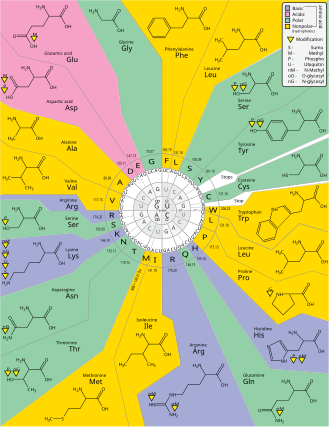
About this topic
Key Points
Photos of Standard Genetic Code
![Reading frames in the DNA sequence of a region of the human mitochondrial genome coding for the genes MT-ATP8 and MT-ATP6 (in black: positions 8,525 to 8,580 in the sequence accession NC_012920[32]). There are three possible reading frames in the 5' → 3' forward direction, starting on the first (+1), second (+2) and third position (+3). For each codon (square brackets), the amino acid is given by the vertebrate mitochondrial code, either in the +1 frame for MT-ATP8 (in red) or in the +3 frame for MT-ATP6 (in blue). The MT-ATP8 genes terminates with the TAG stop codon (red dot) in the +1 frame. The MT-ATP6 gene starts with the ATG codon (blue circle for the M amino acid) in the +3 frame.](https://upload.wikimedia.org/wikipedia/commons/thumb/a/af/Homo_sapiens-mtDNA~NC_012920-ATP8%2BATP6_Overlap.svg/960px-Homo_sapiens-mtDNA~NC_012920-ATP8%2BATP6_Overlap.svg.png)
Reading frames in the DNA sequence of a region of the human mitochondrial genome coding for the genes MT-ATP8 and MT-ATP6 (in black: positions 8,525 to 8,580 in the sequence accession NC_012920[32]). There are three possible reading frames in the 5' → 3' forward direction, starting on the first (+1), second (+2) and third position (+3). For each codon (square brackets), the amino acid is given by the vertebrate mitochondrial code, either in the +1 frame for MT-ATP8 (in red) or in the +3 frame for MT-ATP6 (in blue). The MT-ATP8 genes terminates with the TAG stop codon (red dot) in the +1 frame. The MT-ATP6 gene starts with the ATG codon (blue circle for the M amino acid) in the +3 frame.
![Examples of notable mutations that can occur in humans[36]](https://upload.wikimedia.org/wikipedia/commons/thumb/7/72/Notable_mutations.svg/960px-Notable_mutations.svg.png)
Examples of notable mutations that can occur in humans[36]
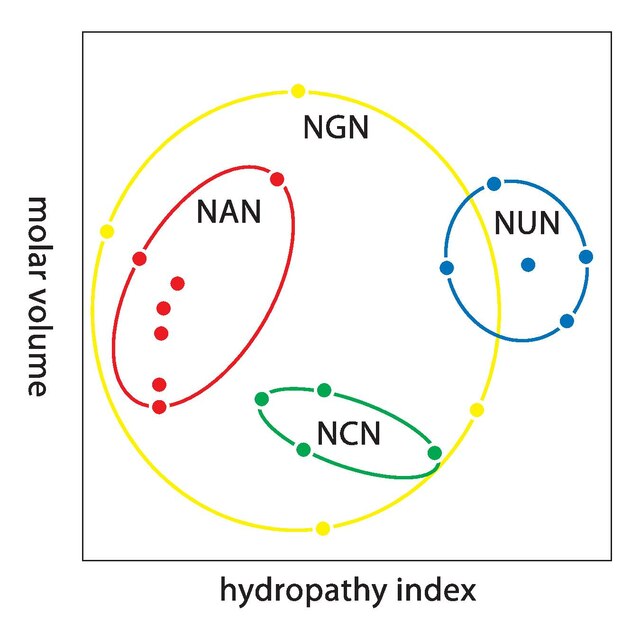
Grouping of codons by amino acid residue molar volume and hydropathicity. A more detailed version is available.

Axes 1, 2, 3 are the first, second, and third positions in the codon. The 20 amino acids and stop codons (X) are shown in single letter code.
![Genetic code logo of the Globobulimina pseudospinescens mitochondrial genome by FACIL. The program is able to correctly infer that the Protozoan Mitochondrial Code is in use.[58] The logo shows the 64 codons from left to right, predicted alternatives in red (relative to the standard genetic code). Red line: stop codons. The height of each amino acid in the stack shows how often it is aligned to the codon in homologous protein domains. The stack height indicates the support for the prediction.](https://upload.wikimedia.org/wikipedia/commons/thumb/e/e1/FACIL_genetic_code_logo.png/960px-FACIL_genetic_code_logo.png)
Genetic code logo of the Globobulimina pseudospinescens mitochondrial genome by FACIL. The program is able to correctly infer that the Protozoan Mitochondrial Code is in use.[58] The logo shows the 64 codons from left to right, predicted alternatives in red (relative to the standard genetic code). Red line: stop codons. The height of each amino acid in the stack shows how often it is aligned to the codon in homologous protein domains. The stack height indicates the support for the prediction.