Skylab Facts For Kids
Skylab was a space station launched by NASA in 1973, serving as a laboratory for scientific research and experiments in microgravity.
Select reading age
Skylab Facts For Kids
Videos & Quizzesincluded
About this topic
Skylab was the first American space station, launched by NASA on May 14, 1973. 🛰️ It orbits the Earth at an altitude of about 270 miles (435 kilometers) and was designed to be a home for astronauts doing scientific experiments. Skylab provided a unique way to study Earth and space for almost a decade! Astronauts lived and worked there, conducting important research that helped us learn more about our planet and the universe. 🪐Skylab was a big deal because it showed that humans could live in space for a long time!
Explore with ChatDinoQuick Facts
Key Points
Skylab was made possible by the success of earlier Apollo missions.
Skylab hosted three main missions with astronauts living in space!
The future of space stations is bright!
Skylab has captured imaginations!
Skylab faced many challenges!
Skylab left a big legacy!
Skylab was like a big science lab in space!
Skylab was about the size of a 5-room house, measuring 90 feet long!
Photos of Skylab

Skylab — photo 1

Skylab — photo 2

Skylab — photo 3

Skylab — photo 4

Skylab — photo 5

Skylab — photo 6

Skylab — photo 7

Von Braun's sketch of a Space Station based on conversion of a Saturn V stage, 1964

The floor grating of Skylab under construction
🚀 History Of Skylab
Skylab was made possible by the success of earlier Apollo missions. 🚀The space station was built from leftover parts of the Apollo program. It was launched atop a Saturn V rocket, the same type used to send astronauts to the Moon. The first crew arrived on May 25, 1973, and their names were Charles "Pete" Conrad, Joseph Kerwin, and Paul Weitz. Over several years, three different groups of astronauts visited Skylab, helping it become a great place for experiments and research. 🌌In 1974, Skylab was officially retired, but it remained in space until it re-entered Earth's atmosphere in 1979!
Go deeper🚀 Missions And Crew
Skylab hosted three main missions with astronauts living in space! 🚀The first crew, Skylab 2, spent 28 days on board and worked on experiments. The second crew, Skylab 3, had astronauts Alan Bean, Owen Garriott, and Jack Lousma; they spent 59 days in space! 🌒The final crew, Skylab 4, stayed for a record 84 days in 1974! Each group conducted scientific experiments, took beautiful photos of Earth, and tested how humans can live in space for long periods. The brave astronauts were true pioneers! 🦸♂️🌠
Go deeper🌟 Future Of Space Stations
The future of space stations is bright! 🌟Just like Skylab, new space stations will help us learn more about living in space. The International Space Station (ISS) is currently in orbit, where astronauts conduct experiments just like those on Skylab. 🚀Scientists are working on new designs, like the Lunar Gateway, which will orbit the Moon! 🌕These future stations will help us prepare for missions to Mars and beyond! As technology improves, we can expect exciting discoveries and adventures in space. Who knows what we will learn next? 🌌✨
Go deeper📺 Skylab In Popular Culture
Skylab has captured imaginations! 📺It inspired movies, TV shows, and books about space! In the 1970s, many children learned about Skylab in schools. There were comic books featuring heroic astronauts exploring space! 🌟Films like "The Right Stuff" show how important space missions are. Skylab even appeared in video games where players could learn about space travel! It’s a fun way for kids to engage in science. Many people remember Skylab as a pioneer of space stations and continue to dream about adventures in the stars! 🌌🎮
Go deeper🌧️ Challenges And Innovations
Skylab faced many challenges! 🌧️ When it first launched, a solar panel got damaged. This led to a tricky situation! Engineers had to solve it quickly so that Skylab could get enough power. Astronauts also had to learn how to live in a place with no gravity. They created new ways to exercise and stay healthy. 💪Thanks to all the problem-solving efforts, Skylab introduced innovations like special tethers to keep items from floating away. It opened the door for future space stations, helping scientists and astronauts continue to learn about life in space! 🚀🔧
Go deeper🎉 Skylab's Legacy And Impact
Skylab left a big legacy! 🎉It taught us about living and working in space and inspired future missions like the International Space Station (ISS). Scientists learned valuable lessons about human health and the effects of long-term space travel! 🌌.The experiments done at Skylab helped prepare astronauts for future missions to Mars! In 1979, pieces of Skylab re-entered Earth’s atmosphere, but its impact remains strong. People around the world learned more about space exploration and how it helps us understand our own planet better. 🗺️✨
Go deeper🧪 Scientific Research Conducted
Skylab was like a big science lab in space! 🧪Astronauts studied solar phenomena, Earth’s atmosphere, and even how the human body adapted to weightlessness. They watched the Sun through special filters to learn about its impact on Earth, discovering solar flares. 🌞The crew also performed medical experiments, like measuring how muscles and bones change in low gravity. They helped scientists understand sleep patterns and exercise needs in space. Skylab’s research opened doors to more knowledge about health that’s important for future space missions! 🌍🌙
Go deeper🏠 Skylab's Design And Structure
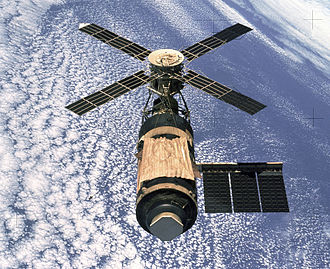
Skylab was about the size of a 5-room house, measuring 90 feet long! 🏠It had solar panels for energy and special windows for great views of space and Earth. Astronauts lived in the "habitable" area which included a kitchen, sleeping quarters, and workstations. There was also space for experiments! It had a large telescope to study the stars. 🌌Skylab had a unique design that kept the inside stable and safe while orbiting around our planet. By using parts from the Apollo missions, NASA created a revolutionary place for living and learning in space! 🌠✨
Go deeper