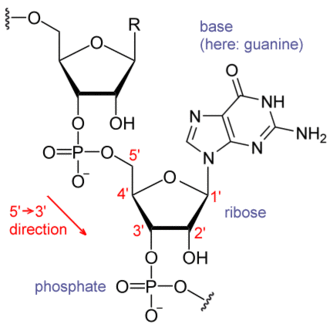
RNA, or Ribonucleic Acid, is a vital molecule found in living organisms that helps carry genetic information from DNA and aids in protein synthesis.
Set reading age
View for Kids
Easy to read and understand
View for Students
Clear, detailed explanations
View for Scholars
Deep dives and big ideas
RNA, or Ribonucleic Acid, is a crucial molecule found in all living things! 🌱It plays an important role in how our bodies work, helping to create proteins, which are the building blocks of life. 🎉It is made up of small units called nucleotides, which are like tiny LEGO pieces. RNA is different from DNA, the molecule that carries genetic instructions. While DNA is like a cookbook with many recipes, RNA helps to read and use those recipes! 📖Scientists discovered RNA in the early 1860s, thanks to hardworking researchers named Friedrich Miescher and others.
After mRNA is made, it often needs to be edited in a process called RNA splicing! ✂️ This process removes non-coding parts called introns and keeps only the important coding parts called exons. Think of it like cutting out the parts of a movie you don't want to see! 🎬Once the splicing is done, the mRNA is ready to leave the nucleus and go to the ribosome to make proteins. This editing gives cells a way to create different proteins from the same gene! It’s one of the reasons our bodies can produce so many different proteins using the same DNA!
There are three main types of RNA, each with a different job! 📋Messenger RNA (mRNA) carries messages from DNA to the ribosomes, where proteins are made. Transfer RNA (tRNA) helps bring the right building blocks (amino acids) to the ribosomes. Ribosomal RNA (rRNA) is a part of the ribosomes themselves, helping to assemble proteins. 🏗️ These types work together, almost like a team, to keep our bodies functioning properly. Understanding these types of RNA can help scientists learn more about how life works!
RNA is a special molecule that helps make proteins in our bodies! 💪It’s made of a long chain of building blocks called nucleotides. Each nucleotide has three parts: a sugar, a phosphate group, and a nitrogen base. 😃There are four different nitrogen bases in RNA: adenine (A), uracil (U), guanine (G), and cytosine (C). These bases are like letters that spell out instructions for the body. Unlike DNA, which stays in the nucleus (the cell's control center), RNA works in the cytoplasm, the jelly-like area inside our cells. 🌐
RNA has many important functions in our cells! 🌟The main job of messenger RNA (mRNA) is to carry genetic information from DNA to ribosomes, where proteins are made. Transfer RNA (tRNA) brings amino acids, the building blocks of proteins, to the ribosome, allowing them to be assembled in the right order. Ribosomal RNA (rRNA) helps make up the ribosome itself! 🏢Each type of RNA has a unique role that is essential for life, helping cells grow, repair, and respond to their environment!
RNA has a unique structure that makes it special! 🌀Unlike DNA, which looks like a twisted ladder (double helix), RNA is usually single-stranded, meaning it looks like a straight line or ribbon. Each RNA strand is made up of many nucleotides connected together. The sugar in RNA is called ribose, and it has one more oxygen atom than the sugar in DNA. ⚗️ The specific arrangement of the nitrogen bases (A, U, G, C) along the RNA strand is what gives it its special instructions, like a treasure map! 🗺️
RNA is made through a process called transcription! 📝This happens inside the cell when a specific section of DNA is copied. First, an enzyme called RNA polymerase attaches to the DNA and "unzips" it. Then, it starts creating the RNA strand by matching the nitrogen bases: A pairs with U, and C pairs with G. 🔄Once the RNA strand is complete, it “detaches” from the DNA, and the DNA zips back up again. The newly made mRNA then travels from the nucleus to the cytoplasm, ready to build proteins!
RNA is playing a big role in medicine, especially in vaccines! 🦠Recently, scientists created mRNA vaccines to help protect against diseases like COVID-19. These vaccines use a piece of mRNA that teaches our cells how to recognize and fight the virus without causing the disease. 💉RNA is also being studied for treating genetic disorders by replacing faulty genes or helping to combat conditions like cancer. Researchers are discovering new ways to use RNA to improve health, making it an exciting area of medicine!
The study of RNA is still growing and evolving! 🔍Scientists are investigating how RNA might be used in new treatments for diseases, creating even better vaccines, and understanding how life began on Earth! Several upcoming techniques may allow researchers to manipulate RNA more easily, leading to breakthroughs in personalized medicine. 🌈As we learn more about RNA, it holds great potential for improving our lives and helping us better understand the world of biology! Who knows what amazing ideas will come next?
Protein synthesis is how cells create proteins using RNA! 🧬It has two main steps: transcription and translation. First, during transcription, mRNA is made from DNA. Next, during translation, the mRNA travels to a ribosome. 🌊Here, tRNA reads the mRNA and brings the necessary amino acids. The ribosome connects the amino acids in the order specified by the mRNA, forming a protein chain. 🎈This process happens all the time in our bodies, allowing us to grow, heal, and function properly!
Scientists use RNA in genetic engineering to help improve plants, animals, and even humans! 🌿One popular technique involves using RNA to introduce new traits into organisms. For example, scientists can insert a piece of RNA into plant DNA to make them resistant to diseases. 🌟This can lead to healthier crops and food for people. Additionally, researchers are exploring how RNA can help us understand and treat genetic disorders by designing RNA molecules that can turn faulty genes on or off, helping to correct problems!


DIY is a creative community where kids draw, build, explore ideas, and share.
No credit card required