All Articles

Richard Feynman

Richard Feynman Facts For Kids

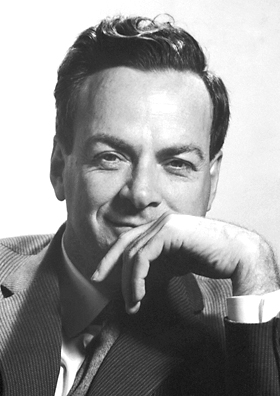
Richard Phillips Feynman was an influential American theoretical physicist known for his groundbreaking work in quantum mechanics and his engaging teaching style.
🎨 Reading age for 6-8
Background blob
Richard Feynman
Facts for Kids!
Image by The Nobel Foundation, licensed under Public domain in Sweden

Do more with AI

Introduction

Richard Feynman was a famous American physicist, born on May 11, 1918, in New York City 🗽. He loved science and learning about how the world works! Feynman is best known for his work in physics, especially in quantum mechanics, which is like magic for tiny particles! ✨He helped solve many puzzles in physics, making it easier for people to understand. Richard was not just a scientist; he was also a playful person who loved to teach 🎓 and enjoy life! He passed away on February 15, 1988, but his ideas live on in the world of science.

Images of Richard Feynman

Feynman's Los Alamos ID badge

Feynman's Los Alamos ID badge

At the 1946 colloquium on the "Super" at the Los Alamos Laboratory. Feynman is in the second row, fourth from left, next to Oppenheimer.

At the 1946 colloquium on the "Super" at the Los Alamos Laboratory. Feynman is in the second row, fourth from left, next to Oppenheimer.

Feynman (center) with Robert Oppenheimer (immediately right of Feynman) at a Los Alamos Laboratory social function during the Manhattan Project

Feynman (center) with Robert Oppenheimer (immediately right of Feynman) at a Los Alamos Laboratory social function during the Manhattan Project

Feynman diagram of electron/positron annihilation

Feynman diagram of electron/positron annihilation

Feynman with drums

Feynman with drums

Paul Dirac and Richard Feynman at Jabłonna, Poland. July 1962.Image by Marek Holzman, licensed under Creative Commons Attribution 4.0

Paul Dirac and Richard Feynman at Jabłonna, Poland. July 1962.

Feynman at the Robert Treat Paine Estate in Waltham, Massachusetts, in 1984Image by Copyright Tamiko Thiel 1984, licensed under Creative Commons Attribution-Share Alike 3.0

Feynman at the Robert Treat Paine Estate in Waltham, Massachusetts, in 1984

Feynman's vision of a medical use for nanotechnology by swallowing the doctor may be partially achieved by the ribosome, which functions as a biological machine. Such protein domain dynamics can only now be seen by neutron spin echo spectroscopy.Image by User:Bensaccount . Original uploader was Bensaccount at en.wikipedia, licensed under Creative Commons Attribution 3.0

Feynman's vision of a medical use for nanotechnology by swallowing the doctor may be partially achieved by the ribosome, which functions as a biological machine. Such protein domain dynamics can only now be seen by neutron spin echo spectroscopy.

Feynman during a lecture

Feynman during a lecture

Feynman's Los Alamos ID badge

Feynman's Los Alamos ID badge

At the 1946 colloquium on the "Super" at the Los Alamos Laboratory. Feynman is in the second row, fourth from left, next to Oppenheimer.

At the 1946 colloquium on the "Super" at the Los Alamos Laboratory. Feynman is in the second row, fourth from left, next to Oppenheimer.

Feynman (center) with Robert Oppenheimer (immediately right of Feynman) at a Los Alamos Laboratory social function during the Manhattan Project

Feynman (center) with Robert Oppenheimer (immediately right of Feynman) at a Los Alamos Laboratory social function during the Manhattan Project

Feynman diagram of electron/positron annihilation

Feynman diagram of electron/positron annihilation

Feynman with drums

Feynman with drums

Paul Dirac and Richard Feynman at Jabłonna, Poland. July 1962.Image by Marek Holzman, licensed under Creative Commons Attribution 4.0

Paul Dirac and Richard Feynman at Jabłonna, Poland. July 1962.

Feynman at the Robert Treat Paine Estate in Waltham, Massachusetts, in 1984Image by Copyright Tamiko Thiel 1984, licensed under Creative Commons Attribution-Share Alike 3.0

Feynman at the Robert Treat Paine Estate in Waltham, Massachusetts, in 1984

Feynman's vision of a medical use for nanotechnology by swallowing the doctor may be partially achieved by the ribosome, which functions as a biological machine. Such protein domain dynamics can only now be seen by neutron spin echo spectroscopy.Image by User:Bensaccount . Original uploader was Bensaccount at en.wikipedia, licensed under Creative Commons Attribution 3.0

Feynman's vision of a medical use for nanotechnology by swallowing the doctor may be partially achieved by the ribosome, which functions as a biological machine. Such protein domain dynamics can only now be seen by neutron spin echo spectroscopy.

Feynman during a lecture

Feynman during a lecture

Feynman Diagrams

Feynman Diagrams are cool drawings that Richard created to help scientists understand particle interactions! ✏️✨ These diagrams show how particles like electrons and photons interact over time. Each line represents a particle, and the points where lines meet show where they collide or change. They are like cartoons for physicists! 🎨Using Feynman Diagrams makes it easier to calculate different probabilities in quantum mechanics. Scientists all over the world still use these diagrams today to visualize complex particle behaviors, making them an essential tool in the world of physics!

Legacy And Awards

Richard Feynman left a lasting legacy in the world of physics and education! 🚀Besides the Nobel Prize, he received many awards, including the National Medal of Science. Feynman's ideas still shape our understanding of quantum physics even today. He inspired many people to embrace curiosity and lifelong learning. Schools, libraries, and scholarships are named after him, ensuring that his love for science continues to inspire future generations. 🌱His impact is felt far beyond the academic world, encouraging everyone to wonder and explore!

Teaching Philosophy

Richard Feynman had an incredible way of teaching! 🧑‍🏫 He believed that learning should be fun and adventurous. He often used simple language to explain complex ideas so everyone could understand. He encouraged students to ask questions and explore their curiosity 🌱. Feynman once said, "The greatest increase in understanding comes from the questions you ask." He made science exciting by using demonstrations, games, and humor in his lessons, making students eager to learn and discover new things every day! 🌟

Career At Los Alamos

During World War II, Richard worked at the Los Alamos Laboratory 🏢 in New Mexico. He was part of the Manhattan Project, which created the first atomic bombs 💣. Richard was a brilliant problem-solver, helping to figure out how to make the bombs work. Despite the serious work, he was known for his sense of humor and creativity. After the war, he continued to research and teach about physics at many universities. His work at Los Alamos was just the beginning of his exciting career!

Nobel Prize In Physics

In 1965, Richard Feynman was awarded the Nobel Prize in Physics 🏆! He received this famous award along with two other scientists, Julian Schwinger and Sin-Itiro Tomonaga, for their work on Quantum Electrodynamics. The prize is given to people who have made amazing discoveries in physics. Feynman's acceptance speech was lively and fun, just like him! He believed that science should be exciting and accessible to everyone. Winning the Nobel Prize showed how important and impactful his work was for all of science! 🎊

Early Life And Education

Richard grew up in a Jewish family in an apartment in the Bronx 🏙️. His dad, Melville, was a teacher, and his mom, Lucille, encouraged Richard’s love for learning. He was very curious and loved to play with gadgets 🔧. Richard went to the Massachusetts Institute of Technology (MIT) for college. He graduated with a degree in physics in 1939! 🎉After that, he went to Princeton University for his Ph.D. where he studied even more about the mysteries of the universe.

Personal Life And Hobbies

Richard Feynman loved to enjoy life beyond physics! 🎉He was a great musician 🎶 and played the bongo drums! He even played in nightclubs and had fun performances. Feynman was curious about everything — he loved painting, picking locks, and even visiting museums! 🎨He enjoyed solving puzzles and opened a safe just for fun! He traveled around the world, meeting people and learning about different cultures. Richard believed that exploring life was just as important as understanding science, making him a well-rounded person with many interests! 🌍

Influence On Popular Science

Richard Feynman had a big impact on popular science! 📚He wrote several books, including "Surely You're Joking, Mr. Feynman!" which shared fun stories about his life and science. His lively personality and storytelling made science appealing to everyone! 🌟With his appearances on television and in documentaries, he made complex ideas easier to understand. Feynman inspired many young scientists and curious minds to explore science, showing them how exciting discovery can be! He is remembered as one of the most influential science communicators of his time.

Feynman's Lectures On Physics

Feynman's Lectures on Physics is a famous series of lectures he gave at Caltech, where he taught many students! 🎓These lectures cover a wide range of topics in physics and make complex ideas simple and fun to understand. They were recorded and later published in book form 📖 so that anyone could learn from them. Many people, even after decades, still study these lectures because they are entertaining and insightful. Feynman’s passion for teaching shines through every page, making it a classic resource for understanding physics! 🌌

Contributions To Quantum Electrodynamics

Quantum Electrodynamics, or QED for short, is a big deal in physics! 🌌Richard helped explain how light and matter interact at the smallest level. He developed new equations that showed how electrons (tiny particles) behave when they interact with photons (particles of light) 🌈. His ideas changed how scientists think about these tiny particles. Because of him, we can better understand technology, like lasers and smartphones! 📱Feynman's work in QED won him great respect among scientists around the world.

Richard Feynman Quiz

Q1
Question 1 of 10

Learn more about Richard Feynman

Ready to create?

Make

To create a safe space for kid creators worldwide!

Create

Vibe Coding

Kids GPT

All Tools

Kibu

Resources

Worksheets

SafeTube

Blog

FAQ

Account

Pricing

Log-in

Sign-up

Data Deletion

Company

About

Community Guidelines

Privacy Policy

Terms of Service

2025, URSOR LIMITED. All rights reserved. DIY is in no way affiliated with Minecraft™, Mojang, Microsoft, Roblox™ or YouTube. LEGO® is a trademark of the LEGO® Group which does not sponsor, endorse or authorize this website or event. Made with love in San Francisco.