All Articles

Psychology

Psychology Facts For Kids

Psychology is the scientific study of the mind and behavior, aiming to understand how people think, feel, and act.

🎨 Reading age for 6-8
Background blob
Psychology
Psychology
Facts for Kids!

Do more with AI

Introduction

Psychology is the science that helps us understand our minds and behaviors! 🧠It explores why we think, feel, and act the way we do. People who study psychology, called psychologists, help us learn about emotions, relationships, and how we make decisions. Psychology is important because it helps kids and adults understand themselves and others better. For example, it can explain why you might feel happy when playing with friends or how to handle anger when things don’t go your way. History shows that psychology has been around for thousands of years, helping people understand their feelings and behaviors. 🌟

Images of Psychology

James McKeen Cattell, the first psychologist in the United States

James McKeen Cattell, the first psychologist in the United States

Wilhelm Wundt (seated), a German psychologist, with colleagues in his psychological laboratory, the first of its kind, c. 1880

Wilhelm Wundt (seated), a German psychologist, with colleagues in his psychological laboratory, the first of its kind, c. 1880

One of the dogs used in Russian psychologist Ivan Pavlov's experiment with a surgically implanted cannula to measure saliva, preserved in the Pavlov Museum in Ryazan, RussiaImage by Rklawton, licensed under Creative Commons Attribution-Share Alike 3.0

One of the dogs used in Russian psychologist Ivan Pavlov's experiment with a surgically implanted cannula to measure saliva, preserved in the Pavlov Museum in Ryazan, Russia

False-color representations of cerebral fiber pathways affected, per Van Horn et al.[91]Image by Van Horn JD, Irimia A, Torgerson CM, Chambers MC, Kikinis R, et al., licensed under Creative Commons Attribution 2.5

False-color representations of cerebral fiber pathways affected, per Van Horn et al.[91]

Skinner's teaching machine, a mechanical invention to automate the task of programmed instructionImage by Silly rabbit, licensed under Creative Commons Attribution 3.0

Skinner's teaching machine, a mechanical invention to automate the task of programmed instruction
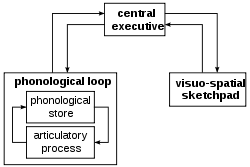
Baddeley's model of working memory

Baddeley's model of working memory

The Müller–Lyer illusion. Psychologists make inferences about mental processes from shared phenomena such as optical illusions.Image by Fibonacci, licensed under Creative Commons Attribution-Share Alike 3.0

The Müller–Lyer illusion. Psychologists make inferences about mental processes from shared phenomena such as optical illusions.

Front row: Sigmund Freud, G. Stanley Hall, Carl Jung. Back row: Abraham A. Brill, Ernest Jones, Sándor Ferenczi at Clark University in 1909.

Front row: Sigmund Freud, G. Stanley Hall, Carl Jung. Back row: Abraham A. Brill, Ernest Jones, Sándor Ferenczi at Clark University in 1909.

Psychologist Abraham Maslow in 1943 posited that humans have a hierarchy of needs, and it makes sense to fulfill the basic needs first before higher-order needs can be met.[129]Image by User:Factoryjoe, licensed under Creative Commons Attribution-Share Alike 3.0

Psychologist Abraham Maslow in 1943 posited that humans have a hierarchy of needs, and it makes sense to fulfill the basic needs first before higher-order needs can be met.[129]

Developmental psychologists engage a child with a book and then make observations based on how the child interacts with the object.Image by César Rincón, licensed under Creative Commons Attribution 2.0

Developmental psychologists engage a child with a book and then make observations based on how the child interacts with the object.

James McKeen Cattell, the first psychologist in the United States

James McKeen Cattell, the first psychologist in the United States

Wilhelm Wundt (seated), a German psychologist, with colleagues in his psychological laboratory, the first of its kind, c. 1880

Wilhelm Wundt (seated), a German psychologist, with colleagues in his psychological laboratory, the first of its kind, c. 1880

One of the dogs used in Russian psychologist Ivan Pavlov's experiment with a surgically implanted cannula to measure saliva, preserved in the Pavlov Museum in Ryazan, RussiaImage by Rklawton, licensed under Creative Commons Attribution-Share Alike 3.0

One of the dogs used in Russian psychologist Ivan Pavlov's experiment with a surgically implanted cannula to measure saliva, preserved in the Pavlov Museum in Ryazan, Russia

False-color representations of cerebral fiber pathways affected, per Van Horn et al.[91]Image by Van Horn JD, Irimia A, Torgerson CM, Chambers MC, Kikinis R, et al., licensed under Creative Commons Attribution 2.5

False-color representations of cerebral fiber pathways affected, per Van Horn et al.[91]

Skinner's teaching machine, a mechanical invention to automate the task of programmed instructionImage by Silly rabbit, licensed under Creative Commons Attribution 3.0

Skinner's teaching machine, a mechanical invention to automate the task of programmed instruction

Baddeley's model of working memory

Baddeley's model of working memory

The Müller–Lyer illusion. Psychologists make inferences about mental processes from shared phenomena such as optical illusions.Image by Fibonacci, licensed under Creative Commons Attribution-Share Alike 3.0

The Müller–Lyer illusion. Psychologists make inferences about mental processes from shared phenomena such as optical illusions.

Front row: Sigmund Freud, G. Stanley Hall, Carl Jung. Back row: Abraham A. Brill, Ernest Jones, Sándor Ferenczi at Clark University in 1909.

Front row: Sigmund Freud, G. Stanley Hall, Carl Jung. Back row: Abraham A. Brill, Ernest Jones, Sándor Ferenczi at Clark University in 1909.

Psychologist Abraham Maslow in 1943 posited that humans have a hierarchy of needs, and it makes sense to fulfill the basic needs first before higher-order needs can be met.[129]Image by User:Factoryjoe, licensed under Creative Commons Attribution-Share Alike 3.0

Psychologist Abraham Maslow in 1943 posited that humans have a hierarchy of needs, and it makes sense to fulfill the basic needs first before higher-order needs can be met.[129]

Developmental psychologists engage a child with a book and then make observations based on how the child interacts with the object.Image by César Rincón, licensed under Creative Commons Attribution 2.0

Developmental psychologists engage a child with a book and then make observations based on how the child interacts with the object.

Social Psychology

Social psychology studies how we interact with other people and how society affects our behavior! 🌍For example, how do friends influence our choices? Or, why do people act differently in a group compared to when they are alone? 👥Researchers study topics like prejudice, love, and teamwork. They observe how things like crowds, leaders, or social roles change our behavior. Social psychologists can help organizations and communities create better relationships, encourage teamwork, and promote kindness. They even study important events, like why people protest or support a cause together! 🙌

Clinical Psychology

Clinical psychology focuses on helping people with emotional and mental health issues! 🏥Clinical psychologists work with individuals who may feel sad, anxious, or confused. They use different treatments, like talking therapies, to help people understand their feelings and develop coping strategies. One common therapy is Cognitive Behavioral Therapy (CBT), which helps people change unhelpful thought patterns. 🧠Clinical psychologists might also assess conditions like depression, ADHD, or other mental health issues. They play a crucial role in improving people's lives, helping them feel happy and healthy again! 💖

Cognitive Psychology

Cognitive psychology studies how we think, learn, and remember things! 💭This branch of psychology looks at how our minds work, like how we solve problems or make decisions. For example, have you ever wondered why you may remember a song but forget your homework? 🎶Cognitive psychologists study memories and how we process information every day! They use experiments and tests to see how our brains handle different tasks. By understanding cognitive processes, psychologists can help improve learning skills, memory techniques, and even create tools for people with learning challenges! 🎓

Behavioral Psychology

Behavioral psychology explores how our actions are learned from experiences! 📚This branch focuses on how we respond to different rewards and punishments. For example, if you do well on a test and get a sticker, you might study harder next time! 🌟B.F. Skinner was a famous psychologist who used experiments with animals to understand behavior. He found that behaviors rewarded often are repeated. Through this understanding, psychologists can help shape positive behaviors, like teaching good habits or encouraging good manners! 👍Behavioral psychology helps us understand why we do what we do!

History Of Psychology

The history of psychology goes back a long way! 📜Ancient Greeks like Socrates and Plato were some of the first to think about how our minds work. In the 1800s, psychology became a science thanks to Wilhelm Wundt, who opened the first psychology lab in Germany! 🏫Over the years, many famous psychologists, like Sigmund Freud and B.F. Skinner, studied different parts of the mind and behavior. In the 20th century, psychology grew even more, with special branches like clinical and developmental psychology. Today, psychologists help people all over the world understand their emotions and behaviors! 🌎

Branches Of Psychology

Psychology has many branches, each focusing on different aspects of the mind and behavior! 🌳Some of the main branches include:
1. Cognitive Psychology - Studies how we think, learn, and remember. 🧩
2. Developmental Psychology - Looks at how we grow and change from babies to adults. 🍼
3. Behavioral Psychology - Examines how we learn through rewards and punishments. 🎓
4. Social Psychology - Studies how we interact with others and form relationships. 🤝
5. Clinical Psychology - Helps people with mental health problems like anxiety or depression. 🏥
Each branch plays an important role in helping us understand human emotions and actions! 🌈

Developmental Psychology

Developmental psychology looks at how we grow and change throughout our lives! 👶It studies how babies learn to talk, how kids develop friendships, and how teenagers become adults. One famous psychologist, Jean Piaget, discovered that children think differently than adults! 🧠Developmental psychologists also study emotions, social skills, and how experiences affect us as we age. They help parents and teachers understand children's needs at different ages. For example, understanding how kids play can help create better learning environments! 🏫This branch is all about helping people grow up happy and healthy!

Major Theories Of Psychology

There are several major theories in psychology that help us understand the mind! 📊One important theory is Behaviorism, which says that our actions are learned through experiences and can be changed by rewards or punishments. 🏅Another is Cognitive Theory, which focuses on how we think and process information. 🧠There’s also Psychoanalytic Theory by Sigmund Freud, which explains how our unconscious mind affects our feelings and actions. Finally, there's Humanistic Psychology, which emphasizes personal growth and the need for love and acceptance! 💖These theories help psychologists understand different ways people think and behave!

Research Methods In Psychology

Psychologists use various research methods to study how we think and act! 🔍One common method is surveys, which ask people questions to gather information about their thoughts and feelings. Another method is experiments, where psychologists test ideas by changing one thing to see how it affects others. 🔬For example, they might change the color of a room to see how it affects people’s mood! Observations help researchers watch how people behave in different situations. 📸These methods ensure psychologists get accurate information to understand human behavior better!

Applications Of Psychology In Everyday Life

Psychology is super helpful in our everyday life! 🌈For example, understanding emotions can help you make friends or resolve conflicts. Knowledge of psychology can also improve how teachers teach and how students learn! 📚It helps parents understand their children’s behaviors, such as why they may throw a tantrum. Businesses use psychology to create better workplaces and advertise products effectively. 🏢In sports, psychologists work with athletes to boost confidence and reduce anxiety during competitions. Overall, psychology helps us understand ourselves and others, making the world a better, happier place! 🌟

Psychology Quiz

Q1
Question 1 of 10

Learn more about Psychology

Ready to create?

Drop Files here
Make

To create a safe space for kid creators worldwide!

Create

Vibe Coding

Kids GPT

All Tools

Kibu

Resources

Worksheets

SafeTube

Blog

FAQ

Account

Pricing

Log-in

Sign-up

Data Deletion

Company

About

Community Guidelines

Privacy Policy

Terms of Service

2025, URSOR LIMITED. All rights reserved. DIY is in no way affiliated with Minecraft™, Mojang, Microsoft, Roblox™ or YouTube. LEGO® is a trademark of the LEGO® Group which does not sponsor, endorse or authorize this website or event. Made with love in San Francisco.