Proper Motion Facts For Kids
Proper motion is the measure of how stars appear to move across the sky as seen from the center of mass of the Solar System, due to their actual movement through space.
Select reading age

Proper Motion Facts For Kids
Videos & Quizzesincluded
About this topic
Have you ever wondered how stars move? 🌌Proper motion is the way we see stars change position in the sky! Imagine standing still and watching clouds float by. The stars also “float” across our sky, but very slowly. Proper motion tells us how fast and in which direction stars are moving. Instead of zipping around, they travel at tiny speeds, like how slow a snail moves! Proper motion helps astronomers understand more about stars and their amazing journeys in space. It’s like a cosmic dance that we can observe from Earth! 🌠
Explore with ChatDinoKey Points
Long ago, smart people called astronomers noticed that some stars didn't stay still!
There are two types of proper motion!
Proper motion is a scientific term that refers to how we observe stars moving across the sky!
To measure proper motion, scientists use special tools like telescopes!
Proper motion is super useful in astronomy!
Proper motion and parallax are different but related!
In the future, astronomers will continue observing stars to learn more about proper motion!
Several factors influence how stars move!
When we talk about proper motion, distance and velocity are essential!
Some stars have high proper motion, which makes them special!
Photos of Proper Motion
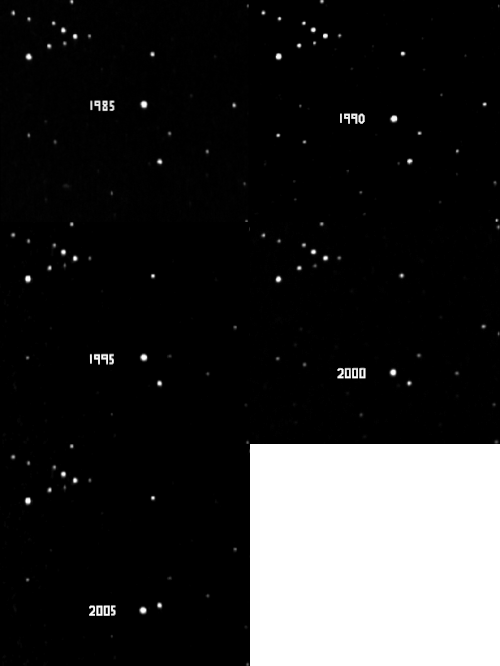
Barnard's Star, showing position every 5 years 1985–2005.
🌌 Historical Background
Long ago, smart people called astronomers noticed that some stars didn't stay still! 🌌Ancient Greek astronomers recognized the stars’ movement but didn’t know why. In the 19th century, a brilliant scientist named Fredrick Bessel was the first to measure proper motion! 🌟He studied a star named 61 Cygni and showed that it was moving. Over the years, many astronomers studied various stars and improved their methods to measure proper motion more accurately. Today, thanks to telescopes and computers, we understand stars better and can track their positions like never before! 🌠
Go deeper✨ Types Of Proper Motion
There are two types of proper motion! ✨The first is “tangential” motion, which means moving sideways across the sky. This is like running in a straight line! The second type is “radial” motion, where stars get closer or go farther away, like a car driving toward or away from you. Proper motion is measured using both types together, giving astronomers a complete picture. They can then understand whether stars are racing toward us or just shifting sideways in the sky! 🌠This information is vital for studying the Milky Way galaxy and its star patterns!
Go deeper🌟 What Is Proper Motion?
Proper motion is a scientific term that refers to how we observe stars moving across the sky! 🌟Scientists use this information to learn about the speed and direction of stars. Since stars are super far away, we measure movement in tiny angles called arcseconds. One arcsecond is like a small slice of the moon viewed from Earth! Proper motion happens over many years, so we need to watch the stars for a long time to see changes. Imagine watching a turtle move; it takes time, just like how we see stars’ movement in the vast night sky! 🌙
Go deeper🔭 Measuring Proper Motion
To measure proper motion, scientists use special tools like telescopes! 🔭They take pictures of the stars over many years and compare them. By looking at two photos taken at different times, they can see how much a star has moved. The movement can be tiny, so they measure it in arcseconds. For example, a star might move just 0.1 arcseconds in a year! Some telescopes even use cameras to track multiple stars at once! This helps astronomers map the night sky, giving us a cosmic treasure map of stars and their secrets! 🌌
Go deeper🌌 Applications In Astronomy
Proper motion is super useful in astronomy! 🌌Astronomers use it to learn about the stars’ lifecycles and how they move in our galaxy, the Milky Way! By tracking stars, scientists can also find out if they belong to the same star group or cluster. This is important because stars can be born together and then drift apart over time! Proper motion helps astronomers discover new stars and understand the big picture of our universe! 🌌With proper motion, we’re uncovering the mysteries of the cosmos layer by layer, just like peeling an onion! 🧅
Go deeper🌟 Proper Motion Vs. Parallax
Proper motion and parallax are different but related! 🌟Parallax helps us measure how far a star is from Earth. Imagine closing one eye and looking at something, then switching to the other eye; it looks like it moves! That’s parallax! It helps astronomers find distances in space. Proper motion, on the other hand, tells us the speed and direction a star is moving over time. So, while parallax helps with distance, proper motion helps with movement. Together, they create a full picture of how stars live, move, and interact in the vast universe! 🚀
Go deeper🌌 Future Observations And Studies
In the future, astronomers will continue observing stars to learn more about proper motion! 🌌New telescopes, like the James Webb Space Telescope, will help us track stars very far away and in different galaxies. 🚀Scientists plan to study more about proper motion to discover exotic stars, star clusters, and even new exoplanets! With advanced technology, we hope to find patterns in star movements and learn more about our universe! 🌠Just like detectives in a mystery, astronomers will uncover the secrets of stars and their journeys across the night sky! 🕵️♀️
Go deeper🌌 Factors Influencing Proper Motion
Several factors influence how stars move! 🌌One key factor is distance. If a star is closer to Earth, we can see it move more easily! Additionally, stars might be moving quickly through space, like a racecar on a track! Their mass also plays a role—heavier stars might move differently than lighter ones. 🌟Finally, the gravitational pull from nearby stars or galaxies can change their paths. Imagine being pulled closer by a friend on a swing! These factors help astronomers understand why each star has its own unique journey! 🌠
Go deeper🚀 Relation To Distance And Velocity
When we talk about proper motion, distance and velocity are essential! 🚀A star's apparent movement depends on how far it is from Earth. If a star is very far away, it might seem to barely move, even if it's going really fast! The velocity is the speed at which a star travels through space. Some stars zoom around at amazing speeds, like 100 kilometers per second! Here’s a fun fact: the closer a star is, the easier it is for us to measure its movement correctly! 🏃This is why astronomers study nearby stars first before looking at the distant ones! 🌟
Go deeper🌟 Notable Stars With High Proper Motion
Some stars have high proper motion, which makes them special! 🌟One of the most famous is Barnard’s Star, which moves quickly across our sky! It’s located about 6 light-years away in the constellation Ophiuchus. Over 100 years, Barnard’s Star can move more than 10 arcseconds! Another star, Sirius, the brightest star in the night sky, also has measurable proper motion. These stars are like fast runners in a cosmic race! 🏃♂️ Knowing which stars have high proper motion helps astronomers get closer to understanding how stars move and interact in our galaxy! 🌌
Go deeper